
Form 1065 Schedule M-3: Net Income (Loss) Reconciliation for Certain Partnerships
Last updated:
-by Nikhil Chowdary | TaxZerone
Schedule M-3 (Form 1065) at a Glance
- Learn who must file Schedule M-3, including the IRS filing thresholds based on total assets, adjusted total assets, gross receipts, and Reportable Entity Partner (REP) ownership, along with voluntary filing rules.
- Explore how to complete Schedule M-3 with detailed explanations of Part I, Part II, and Part III, including financial information, income reconciliation, expense reconciliation, and the four-column reporting method for temporary and permanent differences.
- Understand how Schedule M-3 connects with Form 1065, Schedule M-1, Schedule K, Schedule C, and other related tax forms, while learning the required reconciliation (tie-out) rules and reporting requirements.
Large partnerships that meet IRS filing thresholds must use Schedule M-3 (Form 1065) to provide a detailed reconciliation of book income and taxable income. Unlike Schedule M-1, Schedule M-3 requires line-by-line reporting of temporary and permanent differences, giving the IRS greater transparency into a partnership's tax reporting.
This guide explains Schedule M-3 instructions, who must file Schedule M-3, how each part works, how it differs from Schedule M-1, and how it fits into the overall Form 1065 filing process.
Table of Contents
What Is Schedule M-3 (Form 1065)?
Schedule M-3 is a multi-part supplemental schedule attached to Form 1065 that reconciles a partnership's financial statement net income (loss) with its taxable income (loss) per the return. It is the large-partnership equivalent of the simpler Schedule M-1 used by smaller partnerships, but with significantly more depth and transparency.
The schedule is organized into three parts:
- Part I — Financial Information and Net Income (Loss) Reconciliation: Identifies the type of financial statements the partnership prepares, reconciles consolidated financial statement income to the partnership's own book income, and arrives at the partnership's net income (loss) per its own income statement.
- Part II — Reconciliation of Net Income (Loss) per Income Statement with Income (Loss) per Return — Income Items: Line-by-line reconciliation of income and gain items.
- Part III — Reconciliation of Net Income (Loss) per Income Statement with Income (Loss) per Return — Expense/Deduction Items: Line-by-line reconciliation of expense and deduction items.
Each line in Parts II and III uses four columns — A through D — to classify every income or expense item precisely.
The Four Columns of Schedule M-3 (Parts II and III)
The column structure is the most important feature of Schedule M-3 and is what distinguishes it from the simpler Schedule M-1. Every income and expense line in Parts II and III must be reported across all four columns:
| Column | Label | What It Represents |
|---|---|---|
| Column A | Income (Loss) per Income Statement | The amount as recorded in the partnership's financial statements (GAAP or other basis) |
| Column B | Temporary Difference | The portion of the difference between Column A and Column D that will reverse in a future year |
| Column C | Permanent Difference | The portion of the difference that will never reverse — a lasting divergence between book and tax |
| Column D | Income (Loss) per Tax Return | The taxable amount that flows into the partnership's Form 1065 and ultimately to Schedule K |
The math: Column A + Column B + Column C = Column D. For every line, the sum of the temporary and permanent differences, added to or subtracted from the book amount, must produce the tax return amount.
This four-column structure forces the partnership to explicitly identify and label every book-to-tax difference as either a timing issue (temporary) or a lasting divergence (permanent) — a level of specificity the IRS uses to evaluate compliance risk and identify audit targets.
Who Must File Schedule M-3 (Form 1065)?
According to the IRS Instructions for Schedule M-3 (Form 1065), any entity filing Form 1065 must file Schedule M-3 if any one of the following four conditions is true:
Condition 1 — Total Assets of $10 Million or More
The amount of total assets at the end of the tax year reported on Schedule L, Line 14, Column (d), equals or exceeds $10 million.
Condition 2 — Adjusted Total Assets of $10 Million or More
The adjusted total assets for the tax year equal or exceed $10 million. Adjusted total assets are calculated using a specific IRS worksheet that modifies the Schedule L balance sheet figure to account for:
- Distributions made during the year
- Net losses for the year
- Certain other adjustments
This prevents partnerships from avoiding the Schedule M-3 requirement by making large distributions just before year-end to reduce their reported asset balance.
Condition 3 — Total Receipts of $35 Million or More
The total receipts for the tax year equal or exceed $35 million. Total receipts is defined as gross receipts or sales (net of returns and allowances), plus all other income reported on Form 1065, including interest, dividends, rents, royalties, and capital gains.
Condition 4 — Reportable Entity Partner Ownership of 50% or More
A Reportable Entity Partner (REP) owns or is deemed to own, directly or indirectly, a 50% or greater interest in the partnership's income, loss, or capital on any day during the tax year — and that REP was itself required to file Schedule M-3 on its most recently filed U.S. income tax return prior to that day.
This condition creates a cascading requirement: if a large corporate partner that files Schedule M-3 owns 50% or more of a partnership, that partnership is also pulled into the Schedule M-3 filing requirement — even if it would not otherwise meet the asset or receipts thresholds on its own.
Summary of Filing Triggers
| Trigger | Threshold |
|---|---|
| Total assets (Schedule L, Line 14) | $10 million or more |
| Adjusted total assets | $10 million or more |
| Total receipts | $35 million or more |
| Reportable Entity Partner ownership | 50% or more interest on any day |
Meeting any one of these four conditions requires the partnership to file Schedule M-3. All four do not need to be satisfied simultaneously.
Voluntary Filing of Schedule M-3
Partnerships that do not meet any of the four filing triggers above may still voluntarily file Schedule M-3 in place of Schedule M-1. Some partnerships choose this route to maintain reporting consistency with related entities in a consolidated group, or to provide greater transparency to partners or lenders who review the tax return.
Completing Schedule M-3: The $50 Million Asset Threshold Rule
The level of completion required for Schedule M-3 depends on whether the partnership has $50 million or more in total assets at year-end:
Partnerships With $50 Million or More in Total Assets
These partnerships must complete Schedule M-3 in its entirety — all three parts and all four columns for every applicable line item.
Partnerships With Less Than $50 Million in Total Assets (But Required to File M-3)
These partnerships, as well as those voluntarily filing Schedule M-3, have two options:
- Complete Schedule M-3 in its entirety (all three parts), OR
- Complete only Part I of Schedule M-3, and then complete Schedule M-1 instead of Parts II and III.
Line by line instruction for Schedule M-3
Before completing Schedule M-3, partnerships must indicate the reason the schedule is being filed. Check all applicable boxes that apply to your partnership's financial situation during the tax year.
Filing Requirements and Applicable Checkboxes
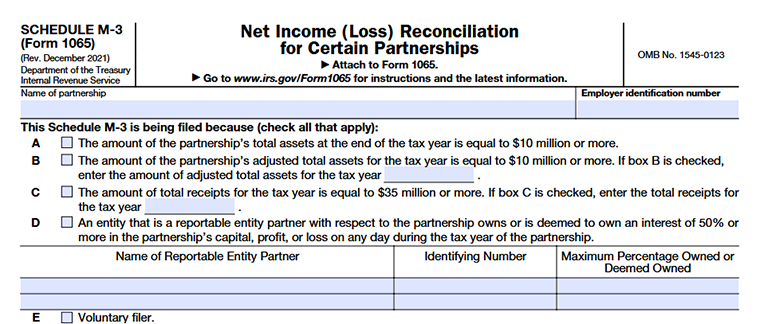
Name of Partnership
Enter the legal name of the partnership exactly as it appears on Form 1065.
Employer Identification Number (EIN)
Enter the nine-digit EIN issued by the IRS for the partnership. It must match what IRS has on file so there are no processing delays.
Box A – Total Assets Test
Check Box A if the partnership's total assets at the end of the tax year are $10 million or more.
Box B – Adjusted Total Assets Test
Check Box B if the partnership's adjusted total assets at the end of the tax year are $10 million or more.
Enter the partnership's adjusted total assets for the tax year.
Box C – Gross Receipts Test
Check Box C if the partnership's total receipts for the tax year are $35 million or more.
Enter the partnership's total receipts for the tax year.
Box D – Reportable Entity Partner
Check Box D if a reportable entity partner owns, or is deemed to own, 50% or more of the partnership's capital, profits, or losses at any time during the tax year.
If checked, provide
| Name of Reportable Entity Partner | Enter the legal name of the reportable entity partner. |
| Identifying Number | Enter the partner's EIN or other identifying number. |
| Maximum Percentage Owned or Deemed Owned | Enter the highest ownership percentage held during the tax year. |
Box E – Voluntary Filing
Check Box E if you are filing Schedule M-3 voluntarily, even though you are not required to file it.
Schedule M-3 Part I: Financial Information and Net Income (Loss) Reconciliation
Part I is the foundation of Schedule M-3. It establishes the starting point for the entire reconciliation by identifying the type of financial statements the partnership prepares and working from the most comprehensive (consolidated/worldwide) financial income down to the partnership's own standalone book income.
Line 1 — Type of Income Statement Prepared
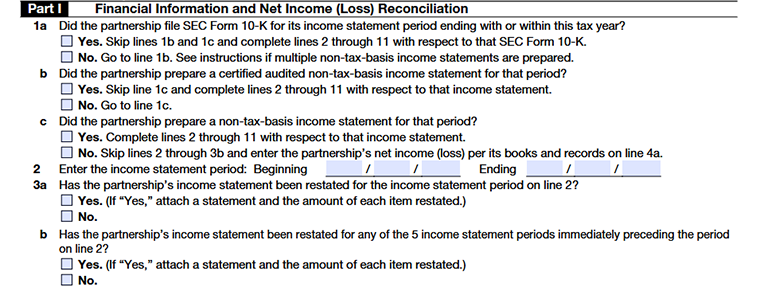
The partnership must indicate the highest-priority type of financial statement it prepares. The IRS establishes the following order of priority:
- SEC 10-K or Annual Statement filed with a Federal or State agency
- Certified Audited Non-Tax-Basis Financial Statements
- Non-Tax-Basis Financial Statements — Other
- Tax-Basis Financial Statements
- No Financial Statements Prepared
The type selected on Line 1 governs what goes into Column A throughout Parts II and III. A partnership that prepares GAAP financial statements uses GAAP income as its Column A basis. A partnership that only prepares tax-basis records uses those records.
Line 2 — Enter the Income Statement Period
Enter the beginning and ending dates of the income statement used to prepare Schedule M-3. The period should generally match the financial statements used for tax reporting.
Line 3a — Current Period Restatement
Select Yes if the income statement for the period on Line 2 has been restated.
If yes, attach a statement explaining the reason for the restatement and the amount of each item restated. Otherwise, select No.
Line 3b — Prior Five-Year Restatements
Indicate whether the partnership restated its income statement for any of the five immediately preceding income statement periods.
If yes, attach a statement describing each restatement and the related amounts. Otherwise, select No.
Line 4 — Worldwide Consolidated Net Income (Loss)
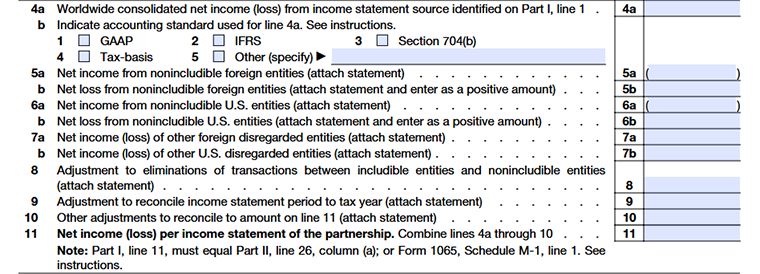
If the partnership is part of a broader consolidated financial reporting group, Line 4 captures the worldwide consolidated net income (loss) per the consolidated financial statements — the broadest possible starting point.
Line 5a — Net Income from Nonincludible Foreign Entities
Enter the net income of nonincludible foreign entities included in the partnership’s financial statement income. Attach a statement with the entity name, EIN (if applicable), and income amount removed.
Line 5b — Net Loss from Nonincludible Foreign Entities
Enter the net loss of nonincludible foreign entities as a positive amount. Attach a statement with the entity details and loss amount removed.
Line 6a — Net Income from Nonincludible U.S. Entities
Enter the net income of nonincludible U.S. entities included in the partnership’s financial statement income. Attach a statement with the entity name, EIN (if applicable), and income amount removed.
Line 6b — Net Loss from Nonincludible U.S. Entities
Enter the net loss of nonincludible U.S. entities as a positive amount. Attach a statement with the entity details and loss amount removed.
Lines 7a and 7b — Disregarded Entities
These lines address the income or loss of disregarded entities (entities that are not treated as separate for tax purposes) that are either included in or excluded from the partnership's financial statements.
Line 8 — Intercompany Eliminations
Adjustments are made here to reflect or reverse eliminations of intercompany transactions between includible and nonincludible entities — ensuring the partnership's book income figure is stated correctly on a standalone basis.
Line 9 — Period Adjustment
If the partnership's financial statement period differs from its tax year (for example, a fiscal-year partnership whose financials cover a different period), Line 9 reconciles the timing difference.
Line 10 — Other Adjustments
Any remaining adjustments needed to arrive at the partnership's standalone book income are reported here, with a supporting statement attached.
Line 11 — Net Income (Loss) per Income Statement of the Partnership
This is the key output of Part I — the partnership's standalone book net income (loss). This figure flows into Parts II and III as the starting point for Column A income and expense reconciliation. It must also match Line 1 of Schedule M-1 if the partnership completes M-1 in lieu of Parts II and III.
Line 12 – Total Assets and Liabilities of Entities Included or Removed on Part I, Lines 4–7

All partnerships filing Schedule M-3 must complete Line 12.
Report the total assets and total liabilities of all entities included or removed on Part I, Lines 4, 5, 6, and 7. Enter the total amount. Do not enter partnership ownership share. All amounts should be expressed as positive numbers.
- Line 12a: Total assets and liabilities of entities included in Part I, Line 4.
- Line 12b: Total assets and liabilities of entities removed on Part I, Line 5.
- Line 12c: Total assets and liabilities of entities removed on Part I, Line 6.
- Line 12d: Total assets and liabilities of entities included in Part I, Line 7.
For Line 12a, report on the worldwide consolidated total assets and liabilities of all entities included in Part I, Line 4.
Schedule M-3 Part II: Income Item Reconciliation
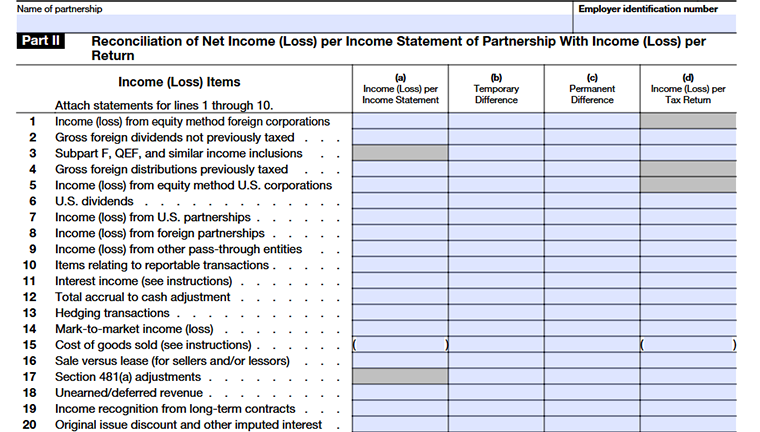
Part II reconciles all income and gain items between the partnership's financial statements and its tax return, line by line, across all four columns. Key lines include:
Lines 1–9 — Additional Information for Each Entity
Attach a supporting statement for each applicable line. Enter the name of the entity, EIN (if applicable), type of entity, and the amounts reported in columns (a) through (d) Additional information may be needed for some lines.
Lines 1–9 — Pass-Through and Investment Income: These lines address income from equity method investments in foreign corporations, foreign dividends, Subpart F inclusions, equity method income from U.S. corporations, U.S. dividends, income from domestic and foreign partnerships, and income from other pass-through entities. These items often carry significant book-to-tax differences because GAAP equity method accounting and U.S. tax law treat investment income very differently.
Line 1 — Income (Loss) From Equity Method Foreign Corporations
Report the financial income (loss) from foreign corporations accounted for using the equity method in column (a). Remove the amount in column (b) or (c), as applicable. Report related dividends or taxable foreign income on Lines 2–4.
Line 2 — Gross Foreign Dividends Not Previously Taxed
Report foreign dividends that have not been previously taxed. Enter the financial statement amount in column (a) and the taxable amount in column (d). Do not include previously taxed distributions or Subpart F/QEF income.
Line 3 — Subpart F, QEF, and Similar Income Inclusions
Report taxable income from Subpart F, Qualified Electing Funds (QEFs), Passive Foreign Investment Companies (PFICs), and similar foreign income inclusions in column (d).
Line 4 — Gross Foreign Distributions Previously Taxed
Report previously taxed foreign distributions in column (a)and remove them in column (b) or (c), as applicable. Since these amounts are not currently taxable, column (d) is not completed.
Line 5 — Income (Loss) From Equity Method U.S. Corporations
Report financial income (loss) from U.S. corporations accounted for using the equity method in column (a). Remove the amount in column (b) or (c), as applicable. Report related dividends on Line 6.
Line 6 — U.S. Dividends
Report U.S. corporation dividends included in the financial statements in column (a) and the taxable dividends in column (d). Attach additional information if the partnership owned 10% or more of the voting stock.
Line 7 — Income (Loss) From U.S. Partnerships
Report the partnership's share of income or loss from U.S. partnerships in columns (a)–(d), including any temporary or permanent differences. Attach a supporting statement for each partnership.
Line 8 — Income (Loss) From Foreign Partnerships
Report the partnership's share of income or loss from foreign partnerships using the same reporting method as Line 7. Attach a supporting statement for each foreign partnership.
Line 9 — Income (Loss) From Other Pass-Through Entities
Report income or loss from pass-through entities other than partnerships (excluding disregarded entities). Include any reconciliation differences and attach a supporting statement for each entity.
Line 11 — Interest Income: Interest income differences between book and tax are common, particularly for partnerships using the accrual method or holding debt instruments subject to original issue discount (OID) rules.
Line 12 — Total Accrual to Cash Adjustment: For partnerships that maintain books on the accrual method but file on the cash method — or vice versa — the aggregate timing difference between the two methods is captured here.
Line 13 — Hedging Transactions: Gain or loss from hedging transactions (such as interest rate swaps or foreign currency hedges) may be treated differently under GAAP vs. the tax code, creating book-to-tax differences that flow through Line 13.
Line 14 — Mark-to-Market Income (Loss): Partnerships in securities or commodities trading that use mark-to-market accounting under Section 475(f) recognize gains and losses on a current-year basis for tax — which may differ significantly from their GAAP financial statement treatment.
Line 15 — Cost of Goods Sold
Report amounts deducted as cost of goods sold (COGS) during the tax year, including inventory-related adjustments such as inventory valuation, Section 263A costs, inventory shrinkage, obsolescence reserves, and lower of cost or market (LCM) write-downs.
Line 16 — Sale Versus Lease (For Sellers and/or Lessors)
Use this line when a transaction is treated as a sale for financial reporting but as a lease for tax purposes, or vice versa.
- Report the financial statement amount in column (a).
- Report the federal tax amount in column (d).
- Use columns (b) and (c) to report any temporary or permanent differences.
Line 17 — Section 481(a) Adjustments
Report any Section 481(a) adjustment resulting from a change in accounting method, unless it is required to be reported elsewhere on Schedule M-3.
Use the appropriate columns to report any temporary or permanent differences.
Line 18 — Unearned/Deferred Revenue
Report revenue recognized in different periods for financial reporting and tax purposes.
Use columns (b) and (c) to reconcile any differences. Do not report income from long-term contracts on this line.
Line 19 — Income Recognition From Long-Term Contracts
Report income or loss from long-term contracts recognized for financial statement purposes and federal income tax purposes. Use the reconciliation columns to report any differences.
Line 20 — Original Issue Discount (OID) and Other Imputed Interest
Report Original Issue Discount (OID) and other forms of imputed interest, including amounts recognized under the applicable Internal Revenue Code provisions. Use the reconciliation columns to report any differences between book and tax amounts.
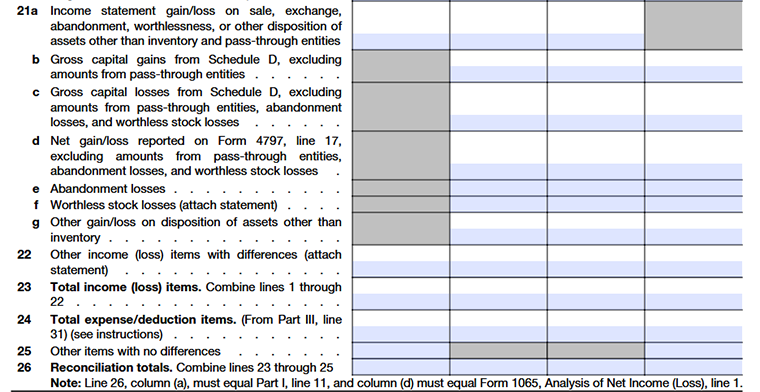
Lines 21a–21g — Disposition of Assets: A detailed sub-section captures every type of gain or loss from dispositions of assets — including capital gains and losses (Schedule D), Section 1231 gains and losses (Form 4797), abandonment losses, and worthless stock losses — comparing the book treatment to the tax return amounts across all four columns.
Line 22 — Other Income Items With Differences: A catch-all line for income items with book-to-tax differences not covered by the specific lines above. A supporting statement is required.
Line 26 — Income (Loss) per Return: The final output of Part II, Column D — which must equal Line 1 of the Analysis of Net Income (Loss) on Form 1065 — is one of the most critical tie-out points in the entire return. If this number does not match, there is an error that must be corrected before filing.
Schedule M-3 Part III: Expense and Deduction Item Reconciliation
Part III reconciles all expense and deduction items between the partnership's financial statements and its tax return. It mirrors Part II's structure but focuses on the expense side of the income statement. Key lines include:
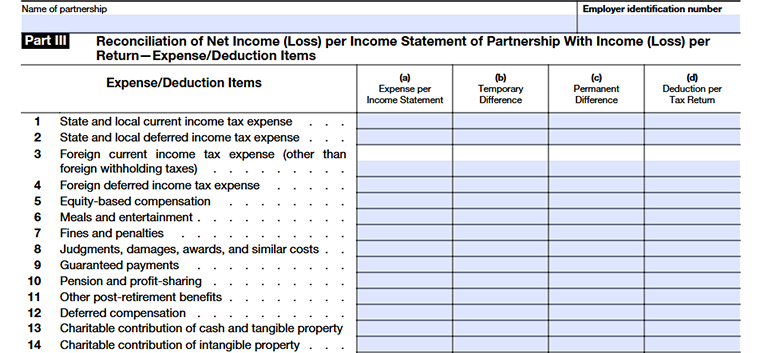
Lines 1–4 — Income Tax Expense: Federal, state, local, and foreign income tax expense recorded on the books is typically not deductible at the federal level for partnerships (since the partnership itself generally does not pay income tax). These book expenses are permanent differences that appear in Column C.
Line 5 — Equity-Based Compensation: Stock options, restricted stock units, and other equity-based compensation are often expensed for GAAP purposes when granted or vested, but may be deductible for tax at a different time or amount, creating both temporary and permanent differences.
Line 6 — Meals and Entertainment: The IRS limits the deduction for meal expenses to 50% of costs. Entertainment expenses are generally fully non-deductible. Book treatment is typically 100% of the cost. The non-deductible portion is a permanent difference in Column C.
Line 7 — Fines and Penalties: Fines and penalties paid to a government for violations of law are permanently non-deductible under Section 162(f). Book expense is recorded fully but must be backed out entirely in Column C.
Line 8 — Judgments, Damages, Awards, and Similar Costs: Settlements and damage awards may be fully deductible, partially deductible, or non-deductible depending on their nature. Restitution payments and disgorgement amounts ordered by certain government authorities are non-deductible under Section 162(f)(2).
Line 9 — Guaranteed Payments: Guaranteed payments to partners are deductible for tax purposes as business expenses, but their treatment under GAAP may differ — particularly in terms of timing.
Line 10 — Pension and Profit-Sharing: Differences between the pension expense recorded under GAAP (ASC 715) and the deductible contribution amount under the tax code (which is generally limited to amounts actually funded) create both temporary and permanent differences.
Line 11 — Other Post-Retirement Benefits: GAAP requires accrual of post-retirement benefit obligations (such as retiree medical benefits) as they are earned. The tax deduction, however, generally arises only when these costs are actually paid — a classic temporary difference.
Line 12 — Deferred Compensation: Nonqualified deferred compensation under Section 409A may be expensed for GAAP as it is earned, but is deductible for tax only when it is actually paid and includible in the employee's income — a timing difference that can span many years.
Line 13 – Charitable Contribution of Cash and Tangible Property
Report charitable contributions of cash and tangible property. Enter the book expense in column (a) and the deductible amount on the tax return in column (d). Report any book-to-tax differences in columns (b) or (c).
Line 14 – Charitable Contribution of Intangible Property
Report charitable contributions of intangible property, such as patents, copyrights, trademarks, securities, conservation easements, mineral rights, and other intangible assets.
Line 15 – Organizational Expenses
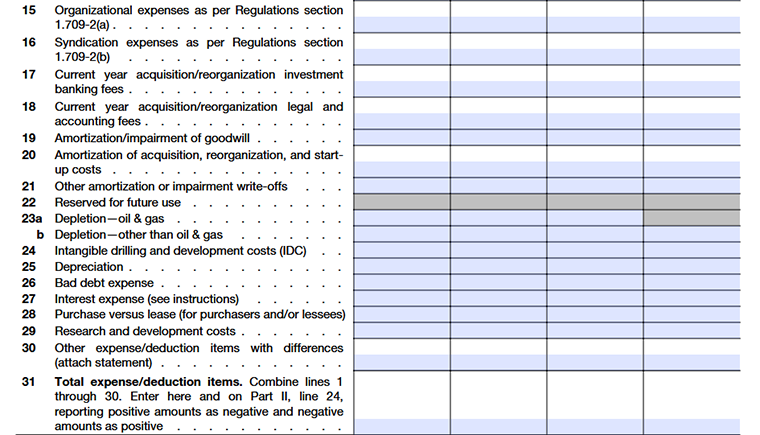
Report organizational expenses as defined in Regulations section 1.709-2(a). Enter the book expense in column (a) and the deductible amount under section 709(b) in column (d).
Line 16 – Syndication Expenses
Report syndication expenses as defined in Regulations section 1.709-2(b).
Line 17 – Acquisition/Reorganization Investment Banking Fees
Report investment banking fees paid or incurred for taxable or tax-free acquisitions or reorganizations, including fees for evaluating, investigating, or completing the transaction.
Line 18 – Acquisition/Reorganization Legal and Accounting Fees
Report legal and accounting fees related to taxable or tax-free acquisitions or reorganizations, including fees incurred during evaluation, investigation, or completion of the transaction.
Line 19 – Amortization/Impairment of Goodwill
Report goodwill amortization and any goodwill impairment losses .
Line 20 – Amortization of Acquisition, Reorganization, and Start-up Costs
Report amortization of acquisition, reorganization, and start-up costs. Include amounts amortizable under sections 167 or 195, where applicable.
Line 21 – Other Amortization or Impairment Write-Offs
Report any other amortization or impairment write-offs not reported elsewhere on Schedule M-3.
Lines 23a and 23b — Depletion: Partnerships in oil, gas, and mineral industries may claim percentage depletion for tax purposes that exceeds cost depletion recorded on the books, creating temporary differences that can be substantial in resource-heavy partnerships.
Line 24 — Intangible Drilling and Development Costs (IDC): Oil and gas partnerships may elect to deduct IDC immediately for tax purposes (Section 263(c)), while GAAP requires capitalization and amortization — a significant timing difference for energy partnerships.
Line 25 — Depreciation: Depreciation differences are among the most common items on Schedule M-3. Tax depreciation using MACRS, bonus depreciation (Section 168(k)), and Section 179 expensing typically results in larger early-year deductions than straight-line GAAP depreciation. See Form 4562 for how depreciation flows through the return.
Line 26 — Bad Debt Expense: GAAP requires an allowance for doubtful accounts (estimated bad debts), while the tax code generally allows a deduction only for specific bad debts that are actually charged off as worthless during the year. This creates a recurring temporary difference for partnerships with significant receivables.
Line 27 — Interest Expense: Interest expense differences arise from various sources — including Section 163(j) business interest expense limitations, original issue discount rules, and differences in the timing of interest accrual between GAAP and tax.
Line 28 — Purchase vs. Lease: For partnerships that enter into transactions that are treated as purchases for tax purposes but leases for GAAP (or vice versa), this line captures the resulting income and expense differences.
Line 29 — Research and Development Costs: For tax years beginning after December 31, 2021, specified R&D costs must be capitalized and amortized over five years (domestic) or fifteen years (foreign) for tax purposes under the Tax Cuts and Jobs Act change to Section 174. This creates a significant difference from GAAP, which continues to allow immediate expensing of R&D under ASC 730 in most circumstances. This is currently one of the most impactful book-to-tax difference items for R&D-intensive partnerships.
Line 30 — Other Expense/Deduction Items With Differences: A catch-all for any expense items with book-to-tax differences not covered by specific lines. Commonly disclosed items here include reserves, contingent liabilities, and comprehensive income items. A required statement must be attached.
Line 31 – Total Expense/Deduction Items
Combine the amounts from lines 1 through 30 and enter the total on line 31. Then report the same amounts on Part II, line 24, with the signs reversed:
- Report positive amounts as negative (in parentheses).
- Report negative amounts as positive.
Critical Tie-Outs: How Schedule M-3 Must Reconcile
Schedule M-3 is designed with specific mathematical tie-out points that must be satisfied before a return is filed. Tax professionals should verify these connections as part of every Schedule M-3 review:
| Tie-Out Point | What Must Match |
|---|---|
| M-3 Part I, Line 11 | Must equal Schedule M-1, Line 1 (if M-1 is used in lieu of Parts II and III) |
| M-3 Part II, Line 26, Column D | Must equal Line 1 of the Analysis of Net Income (Loss) on Form 1065 |
| M-3 Part III, Line 31, Column A | Must reconcile to total expense per the partnership's income statement |
| Column A totals (Parts II and III) | Must reconcile to the partnership's standalone income statement (M-3 Part I, Line 11) |
| Column D totals | Must reconcile to the taxable income items on Schedule K |
A return with Schedule M-3 tie-out failures will likely generate an IRS correspondence notice and may be subject to examination.
Schedule M-3 vs. Schedule M-1: Side-by-Side Comparison
| Feature | Schedule M-1 | Schedule M-3 |
|---|---|---|
| Who files | Partnerships with assets $1M–$10M or receipts $250K+ (not filing M-3) | Partnerships with $10M+ assets, $35M+ receipts, or REP ownership ≥50% |
| Number of lines | 9 summary lines | 3 parts, 60+ detailed lines |
| Column structure | None (single net amount) | Four columns (A: book, B: temp, C: perm, D: tax) |
| Temporary vs. permanent | Not required to distinguish | Required for every line item |
| Financial statement basis | Internal books | GAAP, SEC filings, or other formal financial statements |
| IRS audit exposure indicator | Moderate | High — detailed and directly scrutinized |
| Voluntary filing optio | N/A | Yes — smaller partnerships may voluntarily file |
Schedule M-3 and the IRS Large Business & International Division
Schedule M-3 was developed in coordination with the IRS Large Business & International (LB&I) Division, which is responsible for examining partnerships and corporations with assets over $10 million. LB&I examiners routinely use Schedule M-3 as a primary audit planning tool because it provides a detailed, line-by-line map of every difference between a partnership's financial reporting and its tax return.
Items that commonly attract LB&I attention on Schedule M-3 include:
- Large amounts in Line 22 (Other Income Items) or Line 30 (Other Expense Items) without adequate supporting statements
- Reportable transactions on Part II, Line 10
- Significant permanent differences that reduce taxable income substantially below book income
- Inconsistencies between the M-3 amounts and the amounts reported on related forms (Form 4562, Form 4797, Schedule D)
- R&D cost treatment on Part III, Line 29 (particularly since the 2022 Section 174 change)
Maintaining detailed workpapers for every M-3 line — including the source financial statement amounts, the rationale for each Column B (temporary) and Column C (permanent) classification, and the reconciliation to the tax return — is essential for partnerships subject to Schedule M-3.
Schedule M-3 and Schedule C (Form 1065)
Some filers of Schedule M-3 are also required to complete Schedule C (Form 1065) to provide additional information. Schedule C is used by partnerships that are part of a group that includes a Reportable Entity Partner and applies to additional disclosure obligations created by that relationship. Not all Schedule M-3 filers are required to file Schedule C — only those where the REP relationship triggers additional reporting under the IRS instructions.
Reportable Entity Partner (REP): A Detailed Look
The Reportable Entity Partner rule is one of the most technically complex aspects of Schedule M-3 for partnerships. A partner qualifies as a REP if it:
- Owns or is deemed to own (directly or indirectly) a 50% or greater interest in the partnership's income, loss, or capital on any day of the tax year, AND
- Was itself required to file Schedule M-3 with its most recently filed U.S. income tax or income return filed prior to that day.
Deemed ownership rules are broad. A parent corporation is deemed to own all interests owned by its consolidated group members and by entities in which it owns 50% or more by vote. This means a large corporate group can trigger the REP rule for many downstream partnerships even when no single entity directly holds a 50% interest.
Notification requirement: A REP must notify the partnership within 30 days of becoming a REP that it qualifies as such. The partnership then has a filing obligation for Schedule M-3 — regardless of whether it would otherwise meet the asset or receipts thresholds. This notification requirement makes it essential for partnership administrators to monitor their partner roster for REP status changes throughout the year.
Common Errors to Avoid on Schedule M-3
- Misclassifying temporary and permanent differences. The most frequent M-3 error is incorrectly placing a difference in Column B (temporary) when it belongs in Column C (permanent), or vice versa. Goodwill impairment, fines and penalties, and certain tax-exempt income are always permanent. Depreciation and pension differences are almost always temporary.
- Leaving Line 22 or Line 30 blank without a required statement. The IRS requires a separate statement listing each item when these catch-all lines are used. Filing without the required statements is a common deficiency.
- Failing to reconcile Column D to Schedule K. Column D represents taxable amounts that must flow consistently to Schedule K and Schedule K-1. Discrepancies between M-3 Column D and Schedule K are a strong audit flag.
- Not updating the Column A basis when financial statements are restated. If prior-period financial statements are restated, Line 3 of Part I must reflect this, and Column A amounts must be updated accordingly throughout Parts II and III.
- Incorrectly applying the $50 million completion threshold. Partnerships with less than $50 million in assets that choose to complete only Part I and use M-1 for the remainder must ensure M-1 Line 1 equals M-3 Part I, Line 11. Failing to make this link is a common filing error.
- Missing the REP notification. Partnerships that fail to identify a Reportable Entity Partner may inadvertently omit Schedule M-3 — exposing themselves to late-filing penalties and potential accuracy-related penalties.
- Incorrect treatment of R&D costs under Section 174. Since the Tax Cuts and Jobs Act change effective for tax years beginning after December 31, 2021, R&D costs must be capitalized and amortized for tax. Partnerships that continue to deduct R&D fully in the year incurred (consistent with prior law or GAAP) are reporting an error.
Frequently Asked Questions (FAQs)
1. Does Schedule M-3 replace Schedule M-1 entirely?
Not always. Partnerships with less than $50 million in total assets that are required to file M-3 (or voluntarily file it) may complete only Part I of M-3 and use Schedule M-1 for the remainder. Partnerships with $50 million or more must complete M-3 entirely, in which case M-1 is not required.
2. What financial statement basis should be used for Column A?
Column A should reflect the amounts from the partnership's highest-priority financial statements, following the IRS order of priority: SEC filings first, then certified audited GAAP statements, then other non-tax-basis statements, then tax-basis statements, and finally internal records where no formal financial statements exist.
3. Is Schedule M-3 filed separately from Form 1065?
No. Schedule M-3 is attached to and filed as part of the complete Form 1065 package. Partnerships required to file Schedule M-3 must use the Ogden, UT 84201-0011 mailing address if filing by paper, regardless of the partnership's location.
4. Does a partnership with no book income still need to file Schedule M-3?
Yes, if the filing thresholds are met. A partnership that meets the asset or receipts thresholds but reports a loss or zero net income must still complete Schedule M-3 for the tax year, since the filing requirement is based on size — not profitability.
5. What happens if a partnership does not file Schedule M-3 when required?
Failure to file a required Schedule M-3 is treated as an incomplete Form 1065 filing, which can trigger the same late-filing and accuracy-related penalties as failing to file a complete return. The IRS may also select the return for examination based on the missing schedule.
6. Does voluntary filing of Schedule M-3 increase audit risk?
Not necessarily. Many partnerships voluntarily file M-3 for reporting consistency within a corporate group. However, the additional disclosure does give the IRS more detailed information, so voluntary filers should ensure all M-3 amounts are accurate and properly documented.
7. How does Schedule M-3 interact with Schedule K-2 and K-3?
Schedules K-2 and K-3 address international tax items and are a separate reporting requirement from Schedule M-3. However, partnerships that file Schedule M-3 and have international operations will typically complete both. Items reported on K-2 and K-3 that have book-to-tax differences must still be reflected in the appropriate M-3 Part II or Part III lines.
Key IRS Resources for Schedule M-3 (Form 1065)
| Resource | Description | Link |
|---|---|---|
| Schedule M-3 (Form 1065) — Instructions | Official IRS instructions (November 2023) | View on IRS.gov |
| Form 1065 (PDF) | U.S. Return of Partnership Income | Download |
| Instructions for Form 1065 | Complete IRS filing instructions | View on IRS.gov |
| About IRS Form 1065 | IRS overview page with recent updates | View on IRS.gov |
| IRS Publication 541 — Partnerships | Comprehensive partnership tax guide | View on IRS.gov |
| Schedule C (Form 1065) | Additional information for REP group filers | View on IRS.gov |
| Schedules K-2 and K-3 Filing Requirements | International reporting for partnerships | View on IRS.gov |
| IRS Large Business & International Division | LB&I audit programs and resources | View on IRS.gov |