Understand the purpose of Schedule B (Form 1120-S) and how it collects important information about your S corporation's ownership, accounting methods, business activities, tax elections, and IRS reporting requirements.
Learn who must complete Schedule B and how filing requirements apply based on your corporation's assets, receipts, shareholder structure, foreign activities, and other disclosure obligations.
Explore how to complete Schedule B line by line, including accounting methods, business activity codes, ownership in other entities, shareholder information, digital assets, Form 1099 reporting, and other IRS disclosure questions.
Understand when additional IRS forms and schedules are required, such as Schedule B-1, Form 8990, Form 8996, Form 8281, and other supporting attachments based on your answers.
Schedule B (Form 1120-S) collects key information about your S corporation's business activities, ownership, tax elections, reporting obligations, and other IRS disclosure requirements. Answering these questions accurately helps determine whether you must file additional forms, attach supporting schedules, or report specific tax-related transactions.
IRS Schedule B (Form 1120-S) is an information schedule that accompanies Form 1120-S. It asks a series of questions about your S corporation's ownership, tax status, financial activities, and filing obligations. Your answers help the IRS determine whether additional forms, disclosures, or reporting requirements apply to your corporation
How Schedule B Differs From Other Schedules
Schedule
What It Reports
Schedule B
Ownership, accounting methods, shareholder loans, foreign ownership, and related disclosures (Other Information)
Schedule L
Balance Sheet per Books—assets, liabilities, and shareholder equity at beginning and end of the year
Schedule M-1
Reconciliation of Income (Loss) per Books with taxable income reported on Form 1120-S
Schedule M-2
Analysis of Accumulated Adjustments Account (AAA) and other retained earnings adjustments
Who Must Complete Schedule B?
Every S corporation filing Form 1120-S must complete Schedule B if they:
Have total assets of $250,000 or more at the end of the tax year, or
Report balance sheet data on Schedule L, or
Have foreign transactions, shareholder loans, or related-party activities.
If your corporation has total receipts and assets under $250,000, you may be exempt from completing Schedule L and certain parts of Schedule B, but you must still disclose relevant ownership and accounting method details on Schedule B.
Filing Deadlines
Schedule B must be filed alongside Form 1120-S by the S corporation’s tax filing deadline.
Step-by-Step Breakdown of Schedule B (Form 1120-S)
Complete Schedule B by answering each question that applies to your S corporation for the tax year. Your responses help the IRS determine whether additional schedules, forms, or disclosures are required with Form 1120-S.
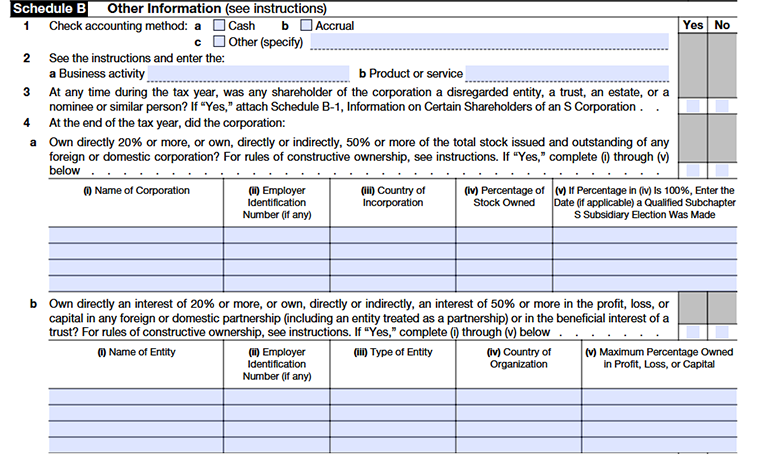
Line 1: Accounting Method
Select the accounting method your S corporation uses to report income and expenses.
Check Cash, Accrual, or Other if you use a different IRS-approved method. If you choose Other, specify the accounting method used.
Line 2a – Business Activity
Enter your corporation's primary business activity using the appropriate IRS Principal Business Activity (PBA) code. Choose the code that best matches the business activity that generates most of your revenue.
Example: If you operate a non-store retail business, select the PBA code based on the primary product
Line 2b – Product or Service
Describe the main product your corporation sells or the primary service it provides. Use a clear and specific description that accurately reflects your business operations.
Example: "Software Development", "Restaurant Services", "Construction", or "Retail Clothing".
Line 3 – Shareholders That Are Entities
Select "Yes" if, at any time during the tax year, any shareholder was a disregarded entity, trust, estate, nominee, or similar entity.
If "Yes", attach Schedule B-1 with the required shareholder information. Otherwise, check "No".
Note: Individual shareholders alone do not require Schedule B-1 unless they hold the stock through one of these entity types
Line 4a – Ownership in Other Corporations
Select "Yes" if your S corporation directly owned 20% or more, or directly or indirectly owned 50% or more, of another domestic or foreign corporation at the end of the tax year.
If "Yes", provide the corporation's name, EIN (if available), country of incorporation, ownership percentage, and QSub election date if applicable.
Line 4b – Ownership in Partnerships or Trusts
Select "Yes" if your corporation directly owned 20% or more, or directly or indirectly owned 50% or more, of a partnership's profits, losses, or capital, or a trust's beneficial interest.
If "Yes", enter the entity's name, EIN (if available), entity type, country of organisation, and the maximum ownership percentage.
Note: When calculating ownership, include any ownership interests attributed under the IRS constructive ownership rules.
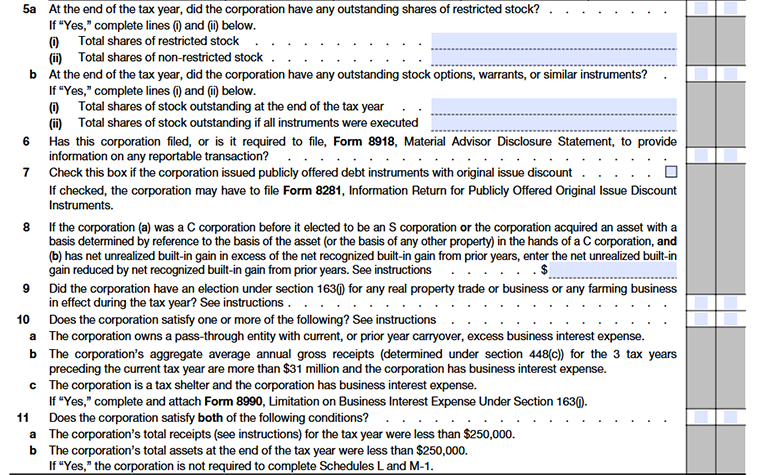
Line 5a – Restricted Stock
Indicate whether the corporation had any outstanding restricted stock at the end of the tax year.
If "Yes", report both the total number of restricted shares and the total number of non-restricted shares outstanding.
Line 5b – Stock Options, Warrants, or Similar Instruments
Select "Yes" if the corporation had any outstanding stock options, warrants, or similar instruments at year-end.
If "Yes", report the total shares currently outstanding and the total shares that would be outstanding if all instruments were exercised.
Line 6 – Form 8918 (Material Advisor Disclosure Statement)
Select "Yes" if your corporation has filed or is required to file Form 8918 to disclose information about a reportable transaction.
If this doesn't apply to your business, select "No".
Line 7 – Publicly Offered Debt Instruments
Check the box if your corporation issued publicly offered debt instruments with original issue discount (OID) during the tax year. If checked, you may also need to file Form 8281.
Note: This requirement usually applies to corporations that issue public debt securities. Most privately owned S corporations can leave this box unchecked.
Line 8 – Net Unrealized Built-In Gain
Complete this line only if your corporation was previously taxed as a C corporation before electing S corporation status or acquired assets from a C corporation. Enter the corporation's net unrealized built-in gain, reduced by any built-in gains recognized in prior years.
Note: This amount may affect the corporation's built-in gains tax under IRC Section 1374. If your corporation has multiple asset pools, attach a separate statement showing the calculation for each pool.
Line 9 – Section 163(j) Election
Select "Yes" if your corporation has an election in effect to exclude a qualifying real property trade or business or farming business from the business interest expense limitation under Section 163(j). Otherwise, select "No."
Note: This election is irrevocable and requires certain assets to be depreciated using the Alternative Depreciation System (ADS).
Line 10 – Form 8990 Filing Requirement
Determine whether your corporation meets any of the listed conditions related to business interest expense.
If you select "Yes" to any condition, complete and attach Form 8990 with your return.
Example: A corporation with average annual gross receipts of more than $31 million, tax shelters with business interest expense, or businesses that receive excess business interest expense from a pass-through entity generally must file Form 8990.
Line 11 – Small Corporation Exception
Select "Yes" if both of the following apply:
Total receipts for the tax year were less than $250,000.
Total assets at the end of the tax year were less than $250,000.
If both conditions are met, the corporation is not required to complete Schedules L and M-1.
Note: Total receipts include gross receipts, other income, rental income, and certain gains reported throughout the tax return, not just sales revenue.
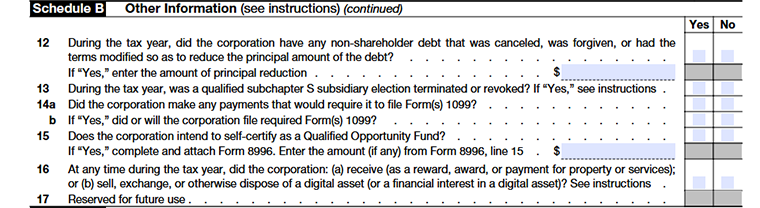
Line 12 – Cancellation or Reduction of Non-Shareholder Debt
Select "Yes" if the corporation had any non-shareholder debt that was cancelled, forgiven, or modified during the tax year in a way that reduced the principal amount owed. If "Yes," enter the amount of the principal reduction.
Note: This question does not include debt owed to shareholders. Only debt owed to outside parties should be reported here.
Line 13 – Termination or Revocation of QSub Election
Select "Yes" if a qualified subchapter S subsidiary (QSub) election was terminated or revoked during the tax year.
If "Yes," refer to the IRS rules for reporting requirements after the termination or revocation.
Line 14a – Payments Requiring Form 1099 Filing
Select "Yes" if the corporation made any payments during the tax year that require filing one or more Form 1099 information returns. Otherwise, select "No."
Example: Payments to independent contractors, certain service providers, or other recipients may require Form 1099 reporting.
Line 14b – Filing Required Form 1099s
If you Selected "Yes" to Line 14a, indicate whether the corporation filed or will file all required Form 1099s for those payments.
Line 15 – Qualified Opportunity Fund (QOF) Certification
Select "Yes" if the corporation intends to self-certify as a Qualified Opportunity Fund (QOF). If "Yes," attach Form 8996 and enter the amount reported on Form 8996, Line 15.
Note: A corporation must file Form 1120-S and attach Form 8996 even if it has no income or expenses to report for the QOF.
Line 16 – Digital Assets
Select "Yes" if the corporation received, sold, exchanged, transferred, or otherwise disposed of any digital asset or financial interest in a digital asset during the tax year. Otherwise, select "No."
Examples of digital asset transactions include:
Receiving cryptocurrency as payment for goods or services.
Selling or exchanging cryptocurrency for another digital asset.
Receiving digital assets through mining, staking, or similar activities.
Note: Simply holding digital assets in a wallet or transferring digital assets between wallets owned by the corporation generally does not require to select "Yes"
Line 17 – Reserved for Future Use
No entry is required for this line. It is reserved by the IRS for future updates or reporting requirements.
Common Mistakes to Avoid
Mistake
Impact
Failing to disclose all ownership details
IRS audits and penalties
Omitting shareholder loan disclosures
Tax compliance issues, penalties
Incorrect accounting method reporting
Errors in tax return and IRS inquiries
Not attaching required schedules (e.g., Schedule B-1)
Return rejections or delay
Reporting inconsistent information with Schedule L and M schedules
Return inquiries or audits
Best Practices for Schedule B Compliance
Maintain accurate bookkeeping and document ownership throughout the year.
Ensure all answers on Schedule B align with related schedules (L, M-1, M-2).
Transparently record and report all shareholder loans and advances.
Review past filings to maintain consistent accounting method disclosure.
Use TaxZerone’s guided e-filing platform to automatically include Schedule B with your Form 1120-S filing for maximum accuracy and IRS compliance.
Frequently Asked Questions (FAQs)
1. What is the purpose of Schedule B (Form 1120-S)?
It discloses your corporation’s ownership, accounting methods, shareholder relationship details, and other critical information supporting the Form 1120-S filing.
2. Who must file Schedule B?
Every S corporation with assets of $250,000 or more, balance sheet reporting, foreign ownership, or shareholder loans.
3. Is Schedule B the same as Schedule L or Schedule M-1?
No. Schedule B is an ownership and accounting questionnaire; Schedule L reports the balance sheet, and Schedule M-1 reconciles book income to taxable income.
4. Can Schedule B be e-filed?
Yes. When you e-file Form 1120-S using TaxZerone, Schedule B is generated and transmitted automatically.
5. What are the consequences of missing or incomplete Schedule B?
The IRS can reject or issue penalties for incomplete Form 1120-S returns missing Schedule B, potentially causing audit risk.
E-File Your Form 1120-S with Schedule B Using TaxZerone
Ensure your S corporation’s ownership, accounting method, and shareholder details are fully and accurately reported for IRS compliance and audit readiness.