
File California Form 100S Online — S Corporation Franchise or Income Tax Return
California S corporations have a separate state-level filing obligation beyond the IRS. TaxZerone makes it easy to complete and submit Form 100S to the FTB — accurately, on time, and without the guesswork.
- FTB-Compliant Filing
- Built-in Accuracy Checks
- Automatic Schedule K-1 (100S) Generation
- Trusted by S Corp Owners & CPAs Across California
File California Form 100S for Just $69.99
One flat fee. No hidden charges. Your complete Form 100S e-filing includes Schedule K-1 (100S) preparation for all shareholders and direct submission to the California Franchise Tax Board.
What Is California Form 100S?
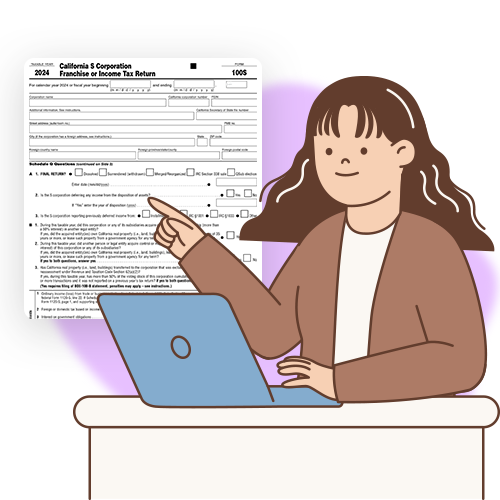
California Form 100S — officially the California S Corporation Franchise or Income Tax Return — is the annual state tax return filed by S corporations with the California Franchise Tax Board (FTB). It is California's counterpart to the federal Form 1120-S, but it is a completely separate filing with its own rules, deadlines, and tax calculations.
Every S corporation incorporated in California, registered to do business here, or deriving income from California sources must file Form 100S each year — regardless of whether the business was active or generated a profit.
The return captures the S corporation's California-sourced income, deductions, and credits, and serves as the basis for generating Schedule K-1 (100S) for each shareholder to report their individual share of the corporation's California activity.
California vs. Federal — What's Different?
Many S corporation owners assume their federal 1120-S filing covers everything.
It doesn't. Here's what makes Form 100S unique:
| Federal Form 1120-S | California Form 100S | |
|---|---|---|
| Filed with | IRS | California FTB |
| Minimum tax | None | $800/year minimum franchise tax |
| Due date (calendar year) | March 16, 2026 | March 16, 2026 |
| NOL rules | Federal rules apply | CA suspended NOL deductions (2024–2026) for corps with $1M+ taxable income |
| Built-in gains tax | Federal rate | 8.84% under California law |
| Apportionment | N/A | Schedule R required for multi-state income |
| Shareholder K-1 form | Schedule K-1 (1120-S) | Schedule K-1 (100S) |
What You'll Need to File
Form 100S
Gather these details before you start:
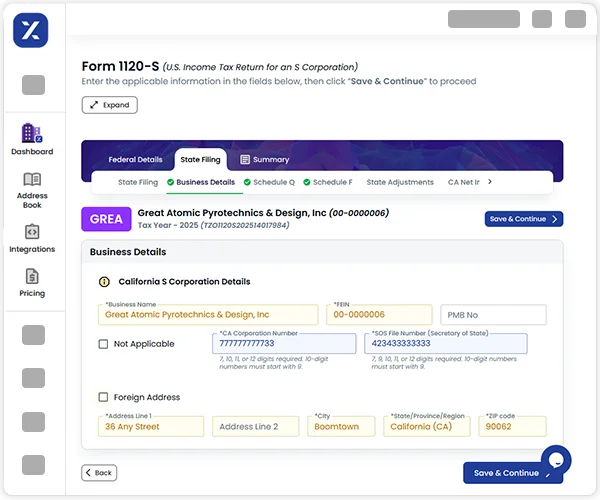
- Corporation Details: Name, California corporation number, FEIN, California Secretary of State file number
- Income & Deductions (if applicable): California-sourced revenue, cost of goods sold, operating expenses, and applicable deductions
- Shareholder Information: Name, TIN, ownership percentage, and distributions for each shareholder
- K-1 Allocations: Each shareholder's pro-rata share of California income, losses, deductions, and credits
- Balance Sheet Data (if applicable): Assets, liabilities, and equity at the beginning and end of the tax year
Eligibility Checklist — Does Your S Corporation Need to File Form 100S?
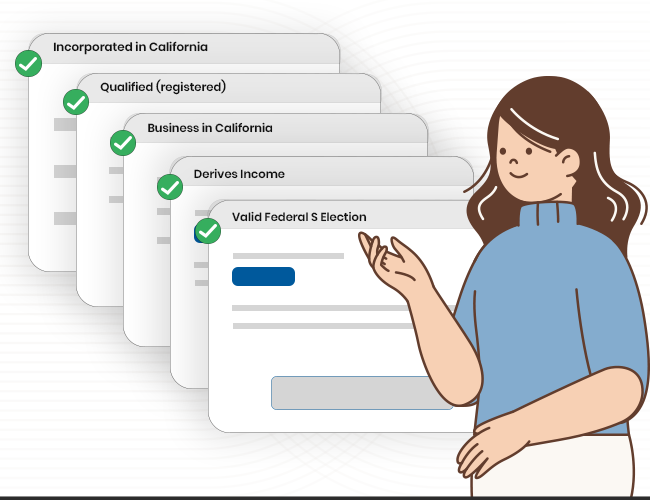
Your S corporation must file Form 100S if any of the following apply:
- Your S corporation is incorporated in California
- Your S corporation is qualified (registered) to do business in California
- Your S corporation is doing business in California, even if not formally registered here
- Your S corporation derives income from California sources
- Your S corporation had a valid federal S election in place for the taxable year
💡 "Doing business" in California includes S corporations whose California sales exceed $757,070 (or 25% of total sales), whose California property exceeds $75,707 (or 25% of total property), or whose California payroll exceeds $75,707 (or 25% of total payroll) — even without a physical office in the state.
Even if your S corporation was inactive during the year, you are still required to file and pay the $800 minimum franchise tax — with one important exception for brand-new corporations (see below).

The $800 Minimum Franchise Tax — Don't Miss It
Unlike the IRS, California imposes a minimum franchise tax of $800 per year on all S corporations subject to the franchise tax. This applies even if your corporation:
- Had zero revenue
- Operated at a net loss
- Was inactive for the entire year
- Filed a short-period return of less than 12 months
This $800 must be paid by the original due date — March 16, 2026 for calendar-year filers — even if you've filed an extension. Missing this payment triggers late payment penalties and interest on top of the amount owed.
First-Year Exception: A corporation that incorporates or qualifies through the California Secretary of State (SOS) is not subject to the $800 minimum franchise tax in its first taxable year. Instead, it pays tax based on its net income multiplied by the applicable tax rate. The minimum franchise tax applies starting in the second taxable year. Note that this exception does not apply to Qualified Subchapter S Subsidiaries (QSubs) or corporations that reorganize solely to avoid the minimum tax.
Form 100S Filing Deadlines — 2025 Tax Year
These deadlines apply to S corporations using a calendar year(January 1 – December 31, 2025):
| Filing Type | Deadline |
|---|---|
| Original return | March 16, 2026 (March 15 falls on a Sunday — shifted to next business day) |
| Shareholder K-1 (100S) distribution | March 16, 2026 |
| With automatic extension | September 15, 2026 (Tuesday — no shift needed) |
For Fiscal-Year S Corporations:
The original filing deadline is the 15th day of the 3rd month after the fiscal year ends. The extended filing deadline is the 15th day of the 9th month after the close of the taxable year.
Examples:
If your S corporation’s fiscal year ends on May 31, 2025, your original Form 100S due date is August 15, 2025. The extended filing deadline is February 15, 2026.
How to File Form 100S with TaxZerone

Step 1 — Create Your TaxZerone Account
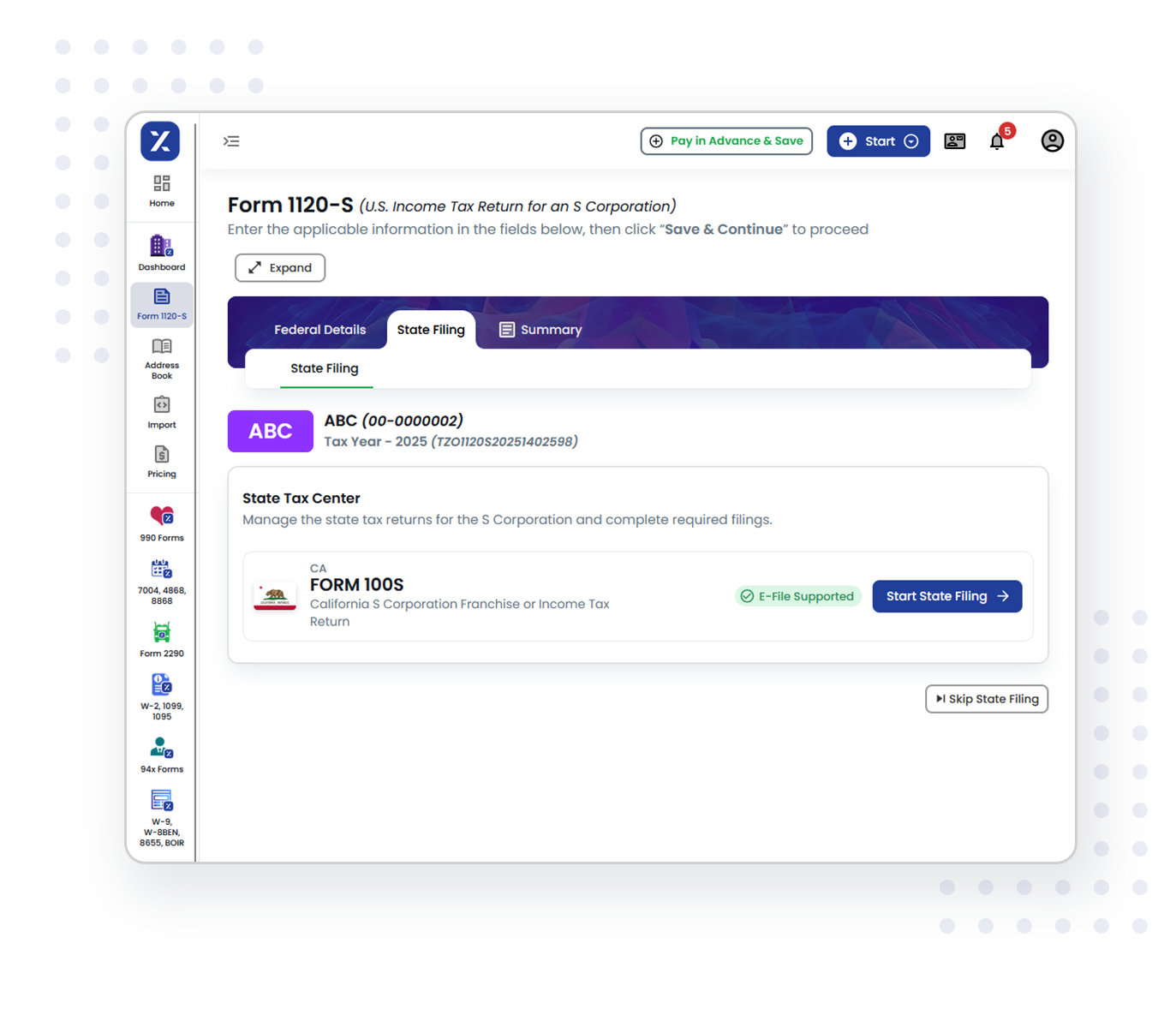
Sign up and select CA Form 100S from the business tax forms section.

Step 2 — Enter Corporation & Shareholder Details
Input your California corporation number, FEIN, Secretary of State file number, tax year, and shareholder information through our guided interface.

Step 3 — Report Income, Deductions & Credits
Enter your California-sourced income, allowable deductions, and applicable credits. TaxZerone automatically generates Schedule K-1 (100S) for each shareholder.

Step 4 — Validate Before You File
Our built-in error checks scan for missing TINs, calculation mismatches, and common FTB rejection triggers — giving you a clean return before submission.

Step 5 — Submit to the FTB & Distribute K-1s
File directly with the California Franchise Tax Board through TaxZerone. After filing, distribute K-1 (100S) copies to shareholders digitally via ZeroneVault (Secure portal) or by mail.
Why Choose TaxZerone for Form 100S?

FTB-Compliant Filing
File directly with the California Franchise Tax Board on a platform built for state-level accuracy and compliance.

Guided Step-by-Step Workflow
Whether you're filing Form 100S for the first time or the tenth, our system walks you through every section — no tax expertise required.

Auto-Generated Schedule K-1 (100S)
Shareholder K-1s are created automatically from your return data and ready for immediate digital or postal delivery.

Automatic Federal Data Import
If you filled federal Form 1120-S with TaxZerone, the necessary information can be automatically carried over to your CA Form 100S to reduce manual entry and speed up filing.

Advanced Error Checks
We scan for missing information, calculation errors, and California-specific compliance issues before your return reaches the FTB.

Transparent Flat-Fee Pricing
No hidden charges, no per-schedule fees. One clear price for your complete Form 100S filing.

Special Pricing for CPAs & Tax Professionals
Filing Form 100S for multiple California S corporations? TaxZerone offers exclusive bulk pricing, reusable client profiles, and dedicated support for tax professionals managing high-volume filings.
- Bigger filings = Bigger discounts
- Save time with reusable business profiles across clients
- White-glove support during peak filing season
📞 Contact Us Now to unlock your custom CPA pricing and make this California filing season your smoothest yet.
Common Mistakes to Avoid
(Pro Tips from a California Tax Expert)
- Don't assume your federal 1120-S covers California. Form 100S is a completely separate filing — missing it means FTB penalties on top of any federal issues.
- Pay the $800 minimum franchise tax on time. Most California S corporations must pay at least the $800 minimum franchise tax annually — even in loss years or with little business activity. Filing an extension does not extend the time to pay taxes owed.
- New corporation? Know your first-year exception. If you incorporated or qualified through the California SOS this year, your first taxable year is exempt from the $800 minimum. You pay tax on net income only. Starting year two, the $800 applies.
- Watch the shareholder penalty. The FTB doesn't just penalize based on unpaid tax — it also charges $18 per shareholder per month for late filing. The more shareholders your S corp has, the faster this adds up.
- Check California's NOL rules. California has suspended net operating loss deductions for tax years 2024–2026 for corporations with taxable income of $1 million or more. Federal NOL treatment may not carry over.
- Double-check all shareholder TINs. Incorrect TINs are one of the most common causes of FTB return rejections.
- Never operate while suspended. Failing to file or pay can lead to suspension — and operating while suspended adds a $2,000 penalty per year on top of everything else already owed.
File California Form 100S Before the Deadline
Prepare your return, generate shareholder K-1s, and meet California filing requirements with TaxZerone.
Frequently Asked Questions
Is California Form 100S the same as federal Form 1120-S?
No. Form 1120-S is filed with the IRS to meet federal obligations. Form 100S is a separate return filed with the California Franchise Tax Board. Both are required for California S corporations, and the taxable income figures can differ because California does not conform to all federal tax rules.
Do I have to file Form 100S if my S corporation had no income?
Yes. California S corporation must still file Form 100Seven if it had no income, no business activity, or operated at a loss during the year. California filing requirements are separate from the federal return requirement, and the corporation may still owe the minimum franchise tax unless it qualifies for a first-year exemption.
Additionally, failing to file Form 100S on time can result in late-filing penalties, including the $18 per shareholder per month penalty.
What is the filing deadline for California Form 100S?
For calendar-year S corporations, the 2025 return is due March 16, 2026 — March 15 falls on a Sunday, so the deadline shifts to the next business day. With California's automatic extension, the extended filing deadline is September 15, 2026. Fiscal year filers use the 15th day of the 3rd month after their tax year ends as their original due date.
Does a filing extension also extend my payment deadline?
No. California's automatic extension is a filing extension only. Any tax owed — including the $800 minimum franchise tax — must still be paid by March 16, 2026 to avoid late payment penalties and interest.