
IRS Schedule M-1 (Form 1120-S)
Last updated:
-by Nikhil Chowdary | TaxZerone
Schedule M-1 (Form 1120-S) at a glance
- Understand the purpose of Schedule M-1 (Form 1120-S) and how S corporations use it to reconcile differences between book income reported in financial records and taxable income reported on the IRS tax return.
- Explore how to complete Schedule M-1 line by line, including adjustments for income, expenses, depreciation, tax-exempt income, non-deductible expenses, and other book-to-tax differences.
- Understand temporary and permanent differences and how accounting methods, IRS tax rules, and timing adjustments affect the reconciliation between financial statement income and taxable income.
Schedule M‑1 (Form 1120‑S) is a critical part of an S corporation’s annual tax return, used to reconcile discrepancies between the net income shown in the company’s books and the taxable income reported to the IRS.
These differences emerge because financial accounting (GAAP) rules often differ from tax accounting requirements. Schedule M‑1 bridges that gap, providing the IRS with a transparent explanation of how your corporation arrived at its final taxable figure on Form 1120‑S.
Accurate reconciliation not only prevents errors but also supports audit readiness, ensuring that book income, tax returns, and financial statements align consistently.
Table of Contents
What Is Schedule M‑1 (Form 1120‑S)?
Schedule M‑1 is officially titled “Reconciliation of Income (Loss) per Books with Income (Loss) per Return.” It identifies and explains the timing and permanent differences between what your corporation records under GAAP and what’s reported to the IRS for tax purposes.
Common reasons for these differences include:
- Depreciation and amortization method variations
- Non‑deductible business expenses (e.g., meals, fines, penalties)
- Tax‑exempt income (e.g., municipal bond interest)
- Differences in recognizing bad debts, accrued expenses, or payouts
By explicitly itemizing these adjustments, Schedule M‑1 helps ensure your tax return reflects both financial reality and regulatory compliance.
Purpose of Schedule M‑1
Corporate income reported on financial statements rarely matches income reported on Form 1120‑S. The reasons fall into two main categories:
1. Temporary Differences
Items that reverse over time, such as:
- Accelerated tax depreciation vs. straight‑line book depreciation
- Accrued bonuses or wages deductible for tax only when paid
- Installment sale income recognized earlier for books than tax
2. Permanent Differences
Items that never reverse, such as:
- Non‑deductible entertainment expenses
- Federal income tax expense (disallowed deduction for S corps)
- Tax‑exempt interest income
Schedule M‑1 shows how these differences contribute to income variations between book accounting and tax reporting.
Who Must File Schedule M‑1?
An S corporation must complete Schedule M‑1 if it does not meet the small‑business exemption under Schedule B, Line 11. You must file Schedule M‑1 if either of these applies:
- Total assets exceed $250,000 at year‑end, or
- Total receipts (gross income) exceed $250,000 for the tax year.
Small S corporations under both thresholds can omit Schedules L and M‑1, but accurate recordkeeping is still strongly advised.
Schedule M-1 (Form 1120-S) Line-by-Line Guide
Use Schedule M-1 to explain the differences between the corporation's book income (financial records) and taxable income reported on the tax return.
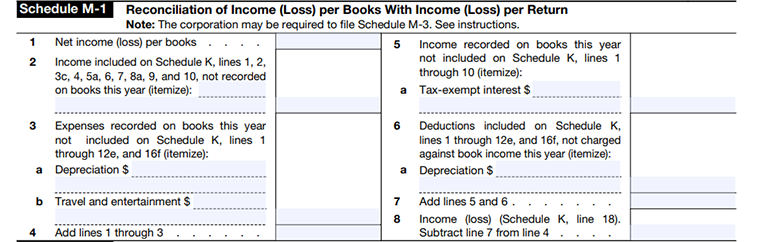
Line 1 – Net Income (Loss) per Books
Enter the corporation's net income(loss) as reflected in your financial (book) records for the tax year.
Line 2—Income Included on Schedule K, Lines 1, 2, 3c, 4, 5a, 6, 7, 8a, 9, and 10, Not Recorded on Books This Year
Enter any income amounts reported on Schedule K that were not recorded in the company's books during the year. List each item separately.
Line 3 – Expenses Recorded on Books This Year Not Included on Schedule K, Lines 1 Through 12e, and 16f
Enter expenses that appear in your books but are not deductible on Schedule K. Itemize each amount.
- Line 3a – Depreciation
Enter the depreciation amount recorded on the books that exceeds the depreciation claimed on the tax return. - Line 3b – Travel and Entertainment
Enter travel and entertainment expenses recorded in the books that are non-deductible for tax purposes.
Line 4—Total
Add Lines 1 through 3 Enter the total here.
Line 5 – Income Recorded on Books This Year Not Included on Schedule K, Lines 1 Through 10
Enter income amounts that appear in the corporation's books but are not reportable on Schedule K Lines 1 through 10.
- Line 5a – Tax-Exempt Interest
Enter any interest income that is exempt from federal income tax.
Line 6 – Deductions Included on Schedule K, Lines 1 Through 12e, and 16f, Not Charged Against Book Income This Year (Itemize)
Enter deductions taken on Schedule K that were not recorded as expenses in the books.
- Line 6a – Depreciation
Enter the amount by which tax depreciation claimed on the return exceeds the depreciation recorded in the books.
Line 7 – Add Lines 5 and 6:
Total Lines 5 and 6. Enter the combined sum here.
Line 8—Income (Loss) (Schedule K, Line 18)
Subtract Line 7 from Line 4 to arrive at the corporation's income or loss per the tax return. This figure must match the amount reported on Schedule K, Line 18.
Example: If Line 4 is $50,000 and Line 7 is $15,000, then Line 8 is $35,000 (50,000 − 15,000 = 35,000). Please ensure it matches Schedule K, Line 18.
Formula: Line 8 = Line 4 − Line 7
Example of Common M‑1 Adjustments
| Adjustment Type | Book Treatment | Tax Treatment | Typical Impact |
|---|---|---|---|
| Depreciation | Straight‑line expense over useful life | Accelerated method | Taxable income decreases |
| Meals & Entertainment | Deducted fully | 50% deductible or disallowed | Taxable income increases |
| Bad debts | Recorded on accrual | Deductible only when written off | Temporary timing difference |
| Federal income tax | Expense recorded | Not deductible | Increases taxable income |
| Tax‑exempt bond interest | Included in books | Excluded for tax | Decreases taxable income |
Relation to Schedules L and M‑2
Schedule M‑1 directly ties to Schedule L (Balance Sheet per Books) and Schedule M‑2 (Analysis of Accumulated Adjustments Account):
- Schedule L provides the beginning and ending balance sheet figures from which book income is derived.
- Schedule M‑1 translates those financial totals into tax adjustments.
- Schedule M‑2 explains how those adjustments affect the S corporation’s accumulated earnings and distributions.
The three schedules together show how your corporate income flows from book accounting to taxable income to shareholder equity.
Filing Deadlines
Schedule M‑1 must be filed as part of Form 1120‑S by the regular filing deadline for S‑corporations.
| Entity Type | Main Return | Filing Deadline (Tax Year 2025) | Extension Form |
|---|---|---|---|
| S Corporation | Form 1120‑S | March 16, 2026 * | Form 7004 |
If March 15 falls on a weekend, the deadline moves to the next business day. Filing Form 7004 gives a 6‑month extension—until September 15, 2026.
Common Mistakes to Avoid
| Error | Potential Issue | Prevention Tip |
|---|---|---|
| Skipping adjustments for tax‑exempt income | Book‑tax mismatch | Always list non‑taxable items clearly. |
| Incorrect depreciation treatment | IRS adjustment risk | Confirm methods per IRS Publication 946. |
| Double counting expenses | Overstated deductions | Reconcile supporting ledgers with trial balance. |
| Mismatch between Schedules L, M‑1, and M‑2 | IRS queries or notices | Align all values before filing electronically. |
Best Practices for Schedule M‑1 Compliance
- Reconcile book income with tax income before preparing other schedules.
- Maintain detailed supporting documentation for each reconciling item.
- Check consistency between depreciation schedules, expense categories, and financial statements.
- Use TaxZerone’s e‑filing solution to auto‑populate Schedule M‑1 from your bookkeeping data and ensure IRS‑ready accuracy.
Frequently Asked Questions (FAQs)
1. Why do book and tax income differ?
Accounting (GAAP) rules and tax laws recognize certain items differently—Schedule M‑1 reconciles these variations to explain the differences.
2. Is every S corporation required to file Schedule M‑1?
Only S corporations with total assets or receipts of $250,000 or more at year‑end must file Schedule M‑1.
3. Does Schedule M‑1 affect shareholder taxes?
Yes, indirectly. Accurate reconciliation ensures that the income flowing through to Schedule K‑1 is correctly calculated.
4. What’s the connection between Schedule M‑1 and Schedule M‑2?
Schedule M‑1 explains how book income converts to taxable income, while Schedule M‑2 tracks those results in retained earnings and shareholder equity accounts.