
Schedule M-3 (Form 1120-S): Complete IRS Guide to Net Income (Loss) Reconciliation for S Corporations
Last updated:
-by Nikhil Chowdary | TaxZerone
Schedule M-3 (Form 1120-S) at a Glance
It provides a detailed reconciliation between an S corporation's financial statement income (loss) and taxable income (loss) reported on Form 1120-S.
- Who Must File: S corporations with $10 million or more in total assets generally must file Schedule M-3.
- Under $10 Million: S corporations with less than $10 million in assets generally use Schedule M-1 but may file Schedule M-3 voluntarily.
- $50 Million or More: S corporations with $50 million or more in assets must complete Schedule M-3 in full, including detailed book-to-tax differences.
Schedule M-3 (Form 1120-S) provides a detailed reconciliation between an S corporation's financial statement income and the taxable income reported to the IRS. This guide explains when Schedule M-3 is required, how the reconciliation works, and the key reporting rules corporations must follow to ensure accurate tax compliance.
Table of Contents
What is Schedule M-3?
Schedule M-3 (Form 1120-S) is a detailed reconciliation schedule used by S corporations with significant assets to explain how financial statement net income (loss) converts into taxable income (loss) reported on Form 1120-S.
The schedule replaces simplified reconciliation methods by providing a structured comparison between:
- Financial accounting results
- Temporary book-to-tax differences
- Permanent tax adjustments
- Final tax return amounts
Schedule M-3 increases transparency by allowing the IRS to evaluate how accounting income is adjusted under tax rules.
Who Must File Schedule M-3?
An S corporation generally must attach Schedule M-3 if:
- Total assets reported on Schedule L equal or exceed $10 million at the end of the tax year.
Corporations below this threshold typically use Schedule M-1 unless they choose to complete Schedule M-3 voluntarily.
Completion Rules Based on Asset Size
- Under $10M assets: Use Schedule M-1; Schedule M-3 is voluntary. If filed voluntarily, the corporation may complete Part I while continuing Schedule M-1, or choose to complete the full Schedule M-3.
- $10M or more (but under $50M): Must complete Schedule M-3for book-to-tax reconciliation reporting, providing detailed disclosure of income, expense, and adjustment differences.
- $50M or more: Must complete Schedule M-3 in full, including expanded reporting of temporary and permanent differences between financial statement income and taxable income.
These thresholds determine the level of detail required in reconciliation reporting.
Line-by-Line Instruction for Schedule M-3
Before completing this part of Schedule M-3, Enter the following details at the top of each page of the form:
- Corporation Name: Enter the legal name of the S Corporation exactly as shown on Form 1120-S.
- Employer Identification Number (EIN): Enter the corporation's nine-digit EIN issued by the IRS.
Part I: Financial Information and Net Income (Loss) Reconciliation
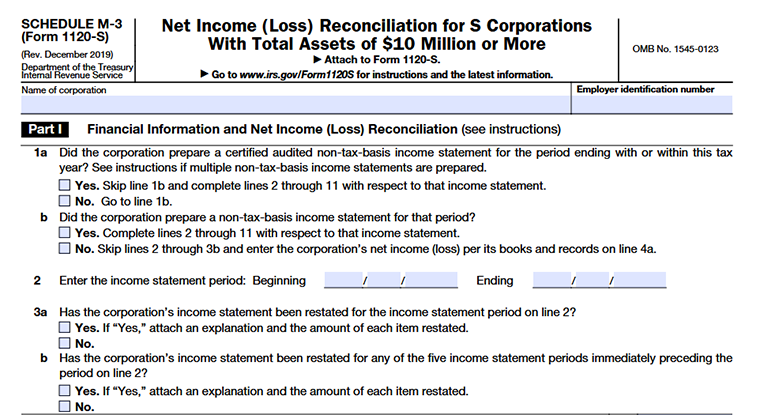
Line 1a: Certified Audited Non-Tax-Basis Income Statement
- Select Yes if your corporation prepared a certified audited financial statement (such as GAAP or IFRS) for the reporting period.
- If multiple certified statements exist, use the one with the highest IRS priority and complete Lines 2–11 using that statement.
Line 1b: Non-Tax-Basis Income Statement
- If you answered No on Line 1a, indicate whether your corporation prepared any other non-tax-basis financial statement by selecting the check box yes.
- If no such statement exists, skip Lines 2 and 3, and report the net income (loss) from your books and records on Line 4a.
Line 2: Income Statement Period
- Enter the beginning and ending dates of the financial statement used to complete Schedule M-3.
- The reporting period must end with or fall within the corporation's current tax year.
Line 3a: Restated Income Statement (Current Period)
- Select Yes if the financial statement used for the current reporting period has been restated.
- Attach a brief explanation describing the reason for the restatement and the original and revised net income amounts.
Line 3b: Restated Income Statement (Previous Five Periods)
- Select Yes if any financial statements for the previous five reporting periods were restated.
- Include a short explanation for each restatement along with the original and corrected net income figures.
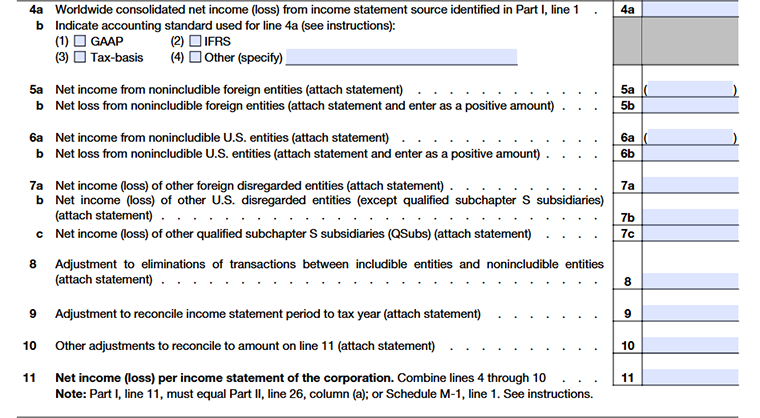
Line 4a: Worldwide Consolidated Net Income (Loss)
- Enter the corporation's worldwide consolidated net income (loss) from the financial statement selected in Line 1.
- If no non-tax-basis financial statement was prepared, use the net income (loss) from the corporation's books and records.
Line 4b: Accounting Standard Used
- Select the accounting standard used to prepare the amount reported on Line 4a.
- Choose GAAP, IFRS, tax basis, or other, whichever matches your financial statements.
Line 5a: Net Income from Nonincludible Foreign Entities
Enter the net income of foreign entities included in your financial statements but not included in your U.S. tax return. Attach a statement identifying each entity and the amount removed.
Line 5b: Net Loss from Nonincludible Foreign Entities
Enter the net loss from nonincludible foreign entities as a positive amount. Include a supporting statement with details for each entity.
Line 6a: Net Income from Nonincludible U.S. Entities
Report the net income of U.S. entities that appear in your financial statements but are not part of the U.S. tax return. Attach a statement listing each entity and its income.
Line 6b: Net Loss from Nonincludible U.S. Entities
Enter the net loss from nonincludible U.S. entities as a positive amount. Include a supporting statement explaining the adjustments.
Line 7a: Other Foreign Disregarded Entities
Report the net income or loss of foreign disregarded entities that are included in the tax return but not in the financial statements. Attach a statement with the required entity details.
Line 7b: Other U.S. Disregarded Entities
Enter the income or loss of U.S. disregarded entities (other than QSubs) that are not included in the consolidated financial statements. Provide a supporting statement for each entity.
Line 7c: Qualified Subchapter S Subsidiaries (QSubs)
Report the income or loss of QSubs that are included in the tax return but excluded from the financial statements. Attach a statement listing each QSub and its financial information.
Line 8: Adjustment to Elimination Entries
Enter adjustments needed to reverse or add consolidation and intercompany elimination entries. These adjustments ensure only the correct entities and transactions are reflected in the reconciliation.
Line 9: Adjustment to Reconcile Income Statement Period to Tax Year
If your financial statement period differs from the tax year, enter the adjustment needed to align the financial statement income with the corporation's tax year. Attach an explanation of the adjustment.
Line 10: Other Reconciliation Adjustments
Report any additional adjustments required to reconcile the amount on Line 4a to the final net income reported on Line 11. Attach a statement explaining each adjustment.
Line 11: Net Income (Loss) per Income Statement of the Corporation
Enter the corporation's final reconciled net income (or loss) after all adjustments from Lines 5 through 10. This amount should include only entities that are part of the U.S. tax return.
Line 12: Total Assets and Liabilities of Included and Removed Entities

Line 12a: Assets and Liabilities Included on Line 4
Report the total worldwide assets and liabilities of the entities included in Line 4. Use the same financial statement or books and records used for the income reported on Line 4a.
Line 12b: Assets and Liabilities Removed on Line 5
Enter the total assets and liabilities of the nonincludible foreign entities removed on Line 5. Report the full amounts, not just the corporation's ownership share.
Line 12c: Assets and Liabilities Removed on Line 6
Report the total assets and liabilities of the nonincludible U.S. entities removed on Line 6. Enter all values as positive amounts.
Line 12d: Assets and Liabilities Included on Line 7
Enter the total assets and liabilities of the disregarded entities and QSubs included on Line 7. Report the full entity amounts as positive values.
Part II: Reconciliation of Net Income (Loss) per Income Statement of the Corporation with Total Income (Loss) per Return
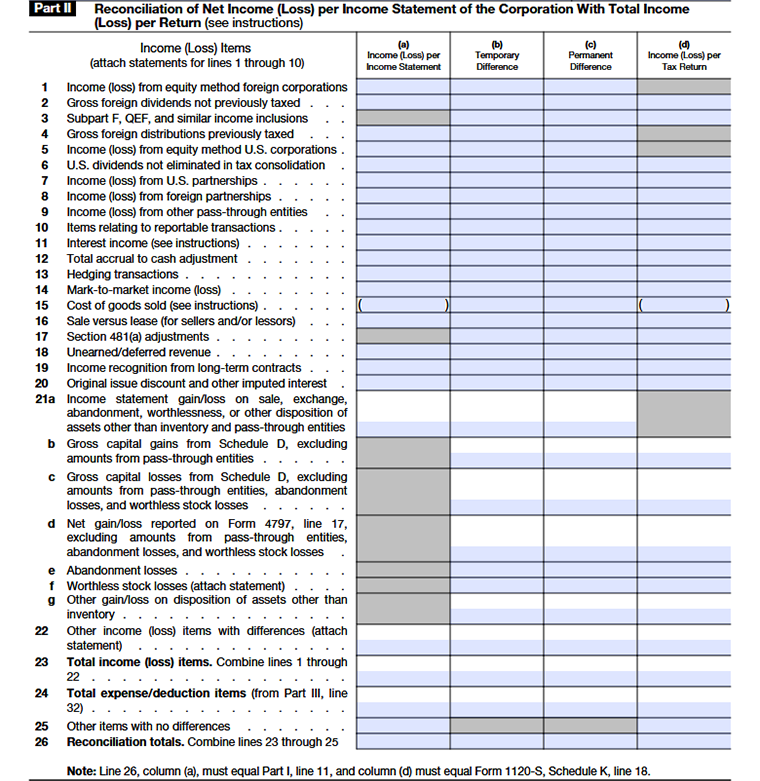
Line 1: Income (Loss) From Equity Method Foreign Corporations
Report the corporation's share of income or loss from foreign corporations accounted for under the equity method. Complete all applicable columns and attach a supporting statement with the required details.
Line 2: Gross Foreign Dividends Not Previously Taxed
Enter the total gross foreign dividends that have not been previously taxed. Report the amount in the appropriate columns to reconcile book and tax differences.
Line 3: Subpart F, QEF, and Similar Income Inclusions
Report income recognized under Subpart F, Qualified Electing Fund (QEF), or similar tax provisions. Include any temporary or permanent differences between book and tax reporting.
Line 4: Gross Foreign Distributions Previously Taxed
Enter gross foreign distributions that were previously taxed under U.S. tax rules. Report any reconciliation differences, if applicable.
Line 5: Income (Loss) From Equity Method U.S. Corporations
Report the corporation's share of income or loss from U.S. corporations accounted for under the equity method. Include any book-to-tax adjustments in the appropriate columns.
Line 6: U.S. Dividends Not Eliminated in Tax Consolidation
Report U.S. dividend income that was not eliminated in tax consolidation. Record any related temporary or permanent differences.
Line 7: Income (Loss) From U.S. Partnerships
Enter the corporation's share of income or loss from U.S. partnerships. Report the related reconciliation adjustments, if required.
Line 8: Income (Loss) From Foreign Partnerships
Report income or loss from foreign partnerships included in the corporation's financial records. Complete the applicable reconciliation columns.
Line 9: Income (Loss) From Other Pass-Through Entities
Report income or loss from other pass-through entities, such as LLCs, trusts, or estates. Include any differences between book income and taxable income.
Line 10: Items Relating to Reportable Transactions
Report income or loss from reportable transactions that require IRS disclosure. Attach a supporting statement with the necessary information.
Line 11: Interest Income
Report all interest income recognized during the tax year. Include any temporary or permanent differences between financial statement and tax reporting.
Line 12: Total Accrual to Cash Adjustment
Enter the adjustment required when reconciling accrual-basis financial statements to a cash-basis tax return. Report the net adjustment amount.
Line 13: Hedging Transactions
Report income or loss from hedging transactions. Include any book-to-tax differences resulting from these transactions.
Line 14: Mark-to-Market Income (Loss)
Report income or loss recognized under the mark-to-market method. Enter any temporary or permanent differences in the appropriate columns.
Line 15: Cost of Goods Sold
Report the Cost of Goods Sold (COGS) reflected in the financial statements and tax return. Include any reconciliation adjustments required.
Line 16: Sale Versus Lease
Report adjustments for transactions treated differently as a sale or a lease for book and tax purposes. Enter any related reconciliation differences.
Line 17: Section 481(a) Adjustments
Report any Section 481(a) adjustment resulting from a change in accounting method. Include the amount recognized for the current tax year.
Line 18: Unearned/Deferred Revenue
Report differences related to unearned or deferred revenue between financial statements and the tax return. Enter the required reconciliation adjustment.
Line 19: Income Recognition From Long-Term Contracts
Report income recognized from long-term contracts. Include any differences between financial statement reporting and tax reporting.
Line 20: Original Issue Discount (OID) and Other Imputed Interest
Report Original Issue Discount (OID) and other imputed interest recognized during the tax year. Record any applicable reconciliation differences.
Line 21a: Income Statement Gain (Loss) on Disposition of Assets
Report the gain or loss recorded in the financial statements from the disposition of assets, excluding inventory and pass-through entities. Include any related reconciliation adjustments.
Line 21b: Gross Capital Gains
Enter gross capital gains reported on Schedule D, excluding amounts from pass-through entities. Complete the applicable reconciliation columns.
Line 21c: Gross Capital Losse
Report gross capital losses from Schedule D, excluding pass-through entity amounts, abandonment losses, and worthless stock losses. Record any applicable differences.
Line 21d: Net Gain (Loss) Reported on Form 4797
Enter the net gain or loss reported on Form 4797, Line 17, excluding specified items. Include any temporary or permanent differences.
Line 21e: Abandonment Losses
Report deductible abandonment losses recognized during the tax year. Include any reconciliation adjustments, if required.
Line 21f: Worthless Stock Losses
Report deductible worthless stock losses and attach a supporting statement. Record any related book-to-tax differences.
Line 21g: Other Gain (Loss) on Disposition of Assets
Report any other gains or losses from the disposition of assets not reported on the previous lines. Include the required reconciliation adjustments.
Line 22: Other Income (Loss) Items With Differences
Report any other income or loss items that create book-to-tax differences and are not reported elsewhere. Attach a supporting statement describing each item.
Line 23: Total Income (Loss) Items
Combine Lines 1 through 22 and enter the total income (loss). The total should reflect all reconciliation adjustments reported in Part II.
Line 24: Total Expense/Deduction Items
Enter the total expense and deduction amount from Part III, Line 32. Ensure the amount agrees with the corresponding reconciliation.
Line 25: Other Items with No Differences
Report items that have no difference between the financial statements and the tax return. These amounts require no reconciliation adjustment.
Line 26: Reconciliation Totals
Combine Lines 23 through 25 to determine the final reconciliation totals. Column (a) must equal Part I, Line 11,and Column (d) must equal Form 1120-S, Schedule K, Line 18.
Part III: Reconciliation of Expense/Deduction Items
Lines 1–6: Income Tax Expenses
Report current and deferred federal, state, local, and foreign income tax expenses in the applicable lines. If your financial statements do not separate current and deferred taxes, report the entire amount as current tax expense.
Line 7: Equity-Based Compensation
Report expenses related to equity-based compensation, such as stock options, restricted stock, ESPPs, stock appreciation rights, and similar awards. Include only amounts not reported elsewhere on Schedule M-3.
Line 8: Meals and Entertainment
Report all meal, beverage, and entertainment expenses included in your financial statements, regardless of how they are classified. Do not include amounts already reported on another Schedule M-3 line.
Line 9: Fines and Penalties
Report fines and penalties paid or accrued for violating any law, including civil or criminal penalties. Also report any taxable recovery of previously recorded fines in the appropriate column.
Line 10: Judgments, Damages, Awards, and Similar Costs
Report judgments, settlements, damages, awards, and similar costs recorded in your financial statements. Include both estimated and actual amounts, along with any related book-to-tax adjustments.
Line 11: Pension and Profit-Sharing
Report expenses related to pension, profit-sharing, and other qualified retirement plans. Include only amounts not reported elsewhere on Schedule M-3.
Line 12: Other Post-Retirement Benefits
Report expenses for retiree benefits other than pensions, such as retiree health, dental, or life insurance coverage.
Line 13: Deferred Compensation
Report compensation expenses recognized for financial reporting but not currently deductible for tax purposes. Also report compensation deducted on the tax return but not included in book income for the current year.
Line 14: Charitable Contribution of Cash and Tangible Property
Report charitable contributions of cash and tangible property. Include any differences between the financial statement expense and the tax deduction.
Line 15: Charitable Contribution of Intangible Property
Report charitable contributions of intangible property, such as patents, copyrights, trademarks, securities, conservation easements, or mineral rights.
Lines 16–18: Acquisition or Reorganization Costs
Report investment banking fees, legal and accounting fees, and other acquisition or reorganization costs incurred during the year. Include costs related to acquisitions, reorganizations, spin-offs, liquidations, or initial public offerings.
Line 19: Amortization or Impairment of Goodwill
Report goodwill amortization or impairment losses recognized during the tax year.
Line 20: Amortization of Acquisition, Reorganization, and Start-Up Costs
Report amortization related to acquisition, reorganization, and start-up costs. Include amounts amortized under the applicable tax provisions.
Line 21: Other Amortization or Impairment Write-Offs
Report amortization or impairment expenses not reported elsewhere in Part III.
Line 22: Reserved
This line is reserved by the IRS and should be treated as zero when completing Schedule M-3 or related worksheets.
Lines 23a–23b: Depletion
Report depletion expenses for oil and gas properties on Line 23a and all other depletion expenses on Line 23b, if not reported elsewhere.
Line 24: Depreciation
Report depreciation expenses not already included on another Schedule M-3 line. Include any book-to-tax differences in the appropriate columns.
Line 25: Bad Debt Expense
Report bad debt expenses recognized in your financial statements and the deductible bad debt amount allowed for tax purposes under Section 166.
Line 26: Interest Expense
Report total interest expense from your financial statements and the corresponding tax deduction. Complete Form 8916-A if required and report any book-to-tax adjustments in the appropriate columns.
Line 27: Corporate-Owned Life Insurance Premiums
Report premiums paid for corporate-owned life insurance policies where the corporation is directly or indirectly the beneficiary. Report only the deductible portion in Column (d).
Line 28: Purchase Versus Lease
Report adjustments when a transaction is treated as a leasefor financial reporting but as a purchase for tax purposes, or vice versa. Include related depreciation and interest adjustments on the appropriate lines.
Line 29 – Research and Development Costs
Report research and development expenses recognized in your financial statements and the corresponding tax deduction under Section 174. Include temporary or permanent differences where applicable.
Line 30: Section 118 Exclusion
Report any non-shareholder capital contributions or inducements received during the year. Attach a statement describing the property, cash, or tax credits received, even if no amount is reported.
Line 31: Other Expense/Deduction Items With Differences
Report any expense or deduction not reported elsewhere that creates a book-to-tax difference. Attach a statement describing each item and showing the amounts reported in Columns (a) through (d).
Line 32: Total Expense/Deduction Items
Combine Lines 1 through 31 and enter the total expense or deduction. Report the opposite sign of these amounts on Part II, Line 24, as required by the IRS.
Schedule M-3 vs Schedule M-1
| Feature | Schedule M-1 | Schedule M-3 |
|---|---|---|
| Purpose | Provides a summary-level reconciliation of income (loss) per books with income (loss) per tax return | Provides a detailed reconciliation of financial statement income with taxable income |
| Reporting Detail | Reports overall book-to-tax differences | Reports differences line by line with more detailed information |
| Who Uses It | Generally used by S corporations that are not required to file Schedule M-3 | Required for certain S corporations with total assets of $10 million or more; may also be filed voluntarily by smaller S corporations |
| IRS Reporting | Provides basic information about differences between book and tax reporting | Provides greater transparency and detailed information for IRS review |
| Complexity | Simpler reconciliation process | Requires more detailed financial and tax information |
Common Book-to-Tax Adjustments Seen on Schedule M-3
Frequent reconciliation items include:
- Depreciation differences between book and tax
- Deferred revenue adjustments
- Interest expense limitations
- Equity compensation timing
- Goodwill impairment vs tax amortization
- Long-term contract revenue recognition
These adjustments explain why financial statement income differs from taxable income.
Common Filing Mistakes to Avoid
Businesses often encounter issues such as:
- Mixing income and expense items between Parts II and III
- Failing to attach required supporting statements
- Leaving temporary or permanent difference columns incomplete
- Not reconciling Part I totals with Part II totals
- Incorrect treatment of disregarded entities or QSubs
Because Schedule M-3 is highly structured, incomplete reconciliation may trigger IRS inquiries.
FAQs About Schedule M-3 (Form 1120-S)
1. Is Schedule M-3 required every year once the asset threshold is met?
Yes. If total assets reach or exceed $10 million, Schedule M-3 generally replaces Schedule M-1 for that tax year.
2. Can a corporation choose to file Schedule M-3 voluntarily?
Yes. Some corporations file Schedule M-3 below the threshold to maintain consistent reconciliation reporting.
3. Why does Schedule M-3 require temporary and permanent difference columns?
These columns allow the IRS to distinguish between timing differences that reverse later and permanent adjustments that permanently affect taxable income.
4. Do disregarded entities need separate reporting on Schedule M-3?
Generally no. Their activity is included through the parent S corporation unless specific adjustments require disclosure.
Ready to e-file Form 1120-S with Schedule M-3?
Streamline your S corporation tax compliance today.