Understand the purpose of Schedule K-1 (Form 1120-S) and how S corporations use it to report each shareholder’s share of income, deductions, credits, losses, and other tax items.
Learn who must prepare and receive Schedule K-1 and how every S corporation filing Form 1120-S must issue a separate Schedule K-1 to each shareholder and submit it with the corporate return.
Explore how to complete Schedule K-1 step by step, including corporation details, shareholder information, ownership percentages, and the reporting of income, deductions, credits, and basis adjustments.
Understand the relationship between Schedule K and Schedule K-1 and how corporate totals are allocated to individual shareholders for accurate pass-through tax reporting.
Schedule K-1 (Form 1120-S) is used by S corporations to report each shareholder’s share of income, deductions, credits, and other tax items from the corporation. Whether you are filing Form 1120-S for the first time or managing multiple shareholders, this guide helps you prepare Schedule K-1 accurately and stay compliant with IRS requirements.
Schedule K-1 (Form 1120-S) is a tax document issued by an S corporation to its shareholders. It reports each shareholder’s share of the corporation’s income, losses, deductions, and credits for the year.
The IRS uses Schedule K-1 to ensure the income reported by the corporation aligns with what shareholders report individually on their Form 1040.
Learn more about how S corporations file their main return using Form 1120-S
Why Schedule K-1 Matters
Pass-Through Taxation
Ensures income and deductions “pass through” from the S corporation to shareholders without being taxed twice.
IRS Compliance
Accurate K-1 reporting prevents mismatches between corporate and shareholder returns.
Shareholder Transparency
Each shareholder can see exactly how much income, loss, or credit they must report on their individual tax return.
Accurate Financial Reporting
Helps the corporation reconcile Schedule K totals with Schedule K-1 distributions for all shareholders.
Who Must File Schedule K-1?
Every S corporation that files Form 1120-S must also prepare a Schedule K-1 for each shareholder.
You must issue Schedule K-1 if:
Your business elected S corporation status with the IRS
The corporation had income, deductions, credits, or other tax items during the tax year
There are one or more shareholders during the year
Each shareholder receives a separate Schedule K-1, and the corporation must file all K-1s with the IRS along with 1120s form.
Information Included on Schedule K-1
Section
Details Reported
Part I: Information About the Corporation
Name, EIN, address, and IRS filing details
Part II: Information About the Shareholder
Name, address, ownership percentage, and type of stock owned
Part III: Shareholder’s Share of Income, Deductions, Credits, etc.
Share of ordinary income, rental income, capital gains, credits, foreign transactions, and deductions
Key Relationship Between Schedules K & K-1
Schedule K (Form 1120-S) shows total amounts of income, deductions, and credits for the entire corporation.
Schedule K-1 breaks down those totals into each shareholder’s share.
In short, Schedule K = summary for the corporation, and Schedule K-1 = detailed allocation per shareholder.
Learn more about the purpose of Schedule K (Form 1120-S)
Filing Deadlines
Schedule K-1 must be issued to shareholders and filed with the IRS along with Form 1120-S.
Learn how to extend your S corporation filing deadline using Form 7004
How to Complete Schedule K-1 (Form 1120-S)
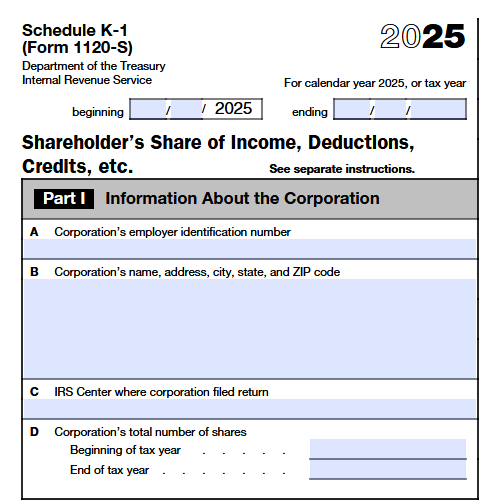
Part I: Information About the Corporation
It provide the S corporation's identifying information. It helps the IRS and shareholders identify the corporation that issued Schedule K-1 and links the shareholder's allocated tax items to the correct Form 1120-S return.
Item A: Corporation's Employer Identification Number (EIN)
Enter the corporation's EIN exactly as assigned by the IRS. This unique number identifies the S corporation for tax reporting purposes.
Item B: Corporation's Name, Address, City, State, and ZIP Code
Enter the complete legal name and mailing address of the S corporation. Ensure the information matches the corporation's Form 1120-S filing.
Item C: IRS Center Where Corporation Filed Return
Enter the IRS service center where the corporation filed its Form 1120-S tax return. This identifies the IRS office processing the return.
Item D: Corporation's Total Number of Shares
Enter the total number of shares outstanding for the S corporation during the tax year. This information helps determine each shareholder's ownership interest.
Beginning of Tax Year: Enter the first day of the corporation's tax year covered by Schedule K-1.
End of Tax Year: Enter the last day of the corporation's tax year covered by Schedule K-1. This identifies the reporting period for the shareholder's allocated tax items.
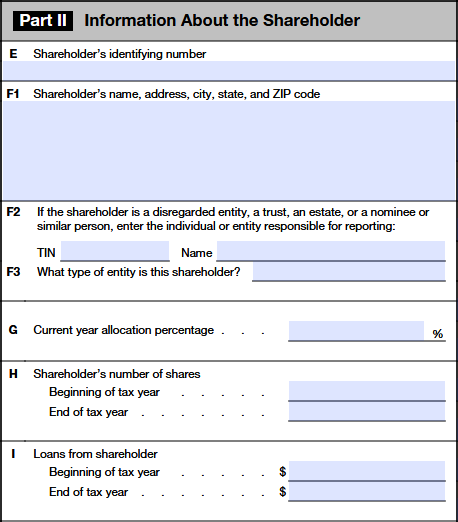
Part II: Information About the Shareholder
It dentifies the shareholder receiving Schedule K-1 and reports ownership details used to allocate the shareholder's share of the S corporation's income, deductions, credits, and other tax items.
Item E: Shareholder's Identifying Number
Enter the shareholder's Taxpayer Identification Number (TIN), such as a Social Security Number (SSN), Individual Taxpayer Identification Number (ITIN), or Employer Identification Number (EIN), as applicable.
Item F1: Shareholder's Name, Address, City, State, and ZIP Code
Enter the shareholder's full legal name and current mailing address. The information should match the shareholder's tax records.
Item F2: If the Shareholder Is a Disregarded Entity, Trust, Estate, or Nominee
If the shareholder is a disregarded entity, trust, estate, nominee, or similar person, enter the name and TIN of the individual or entity responsible for reporting the Schedule K-1 information on the tax return.
Item F3: What Type of Entity Is This Shareholder?
Enter the shareholder's entity type, such as an individual, estate, trust, partnership, corporation, or other eligible shareholder. This helps determine the applicable tax reporting requirements.
Item G: Current Year Allocation Percentage
Enter the shareholder's percentage of stock ownership for the current tax year. This percentage is generally used to determine the shareholder's share of the corporation's tax items.
Item H: Shareholder's Number of Shares
Enter the number of shares owned by the shareholder at the beginning and end of the corporation's tax year. If ownership changed during the year, report the applicable share amounts.
Item I: Loans From Shareholder
Enter the outstanding balance of loans the shareholder made directly to the corporation at the beginning and end of the tax year. Report only bona fide loans and update the balances to reflect any repayments or additional loans made during the year.
Part III: Shareholder's Share of Current Year Income, Deductions, Credits, and Other Items
This reports each shareholder's share of the S corporation's income, deductions, credits, and other tax items for the tax year. Shareholders use this information to complete their individual tax returns.
Line 1: Ordinary Business Income (Loss)
Enter the shareholder's share of ordinary business income or loss from the S corporation. Report this amount on the appropriate form or schedule, subject to any applicable limitations.
Line 2: Net Rental Real Estate Income (Loss)
Enter the shareholder's share of net rental real estate income or loss. This amount may be subject to passive activity rules.
Line 3: Other Net Rental Income (Loss)
Enter the shareholder's share of net income or loss from rental activities other than real estate. Apply any applicable passive activity limitations.
Line 4: Interest Income
Enter the shareholder's share of taxable interest income received by the S corporation during the tax year.
Line 5a: Ordinary Dividends
Enter the shareholder's share of ordinary dividends received by the S corporation.
Line 5b: Qualified Dividends
Enter the shareholder's share of qualified dividends eligible for the applicable tax rates.
Line 6: Royalties
Enter the shareholder's share of royalty income received by the S corporation during the tax year.
Line 7: Net Short-Term Capital Gain (Loss)
Enter the shareholder's share of net short-term capital gain or loss. Report it with other short-term capital transactions.
Line 8a: Net Long-Term Capital Gain (Loss)
Enter the shareholder's share of net long-term capital gain or loss. Report it with other long-term capital transactions.
Line 8b: Collectibles (28%) Gain (Loss)
Enter the shareholder's share of collectibles gain or loss subject to the 28% capital gains tax rate.
Line 8c: Unrecaptured Section 1250 Gain
Enter the shareholder's share of unrecaptured section 1250 gain from the sale of depreciable real property.
Line 9: Net Section 1231 Gain (Loss)
Enter the shareholder's share of net section 1231 gain or loss from business property transactions.
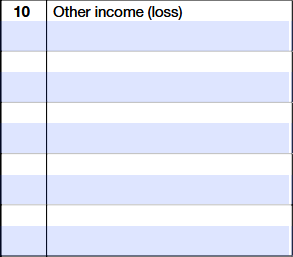
Line 10: Other Income (Loss)
Enter other income or loss items not reported on Lines 1 through 9. Use the applicable code and statement if required.
Line 11: Section 179 Deduction
Enter the shareholder's share of the Section 179 deduction. This deduction may be limited based on the shareholder's individual tax situation.
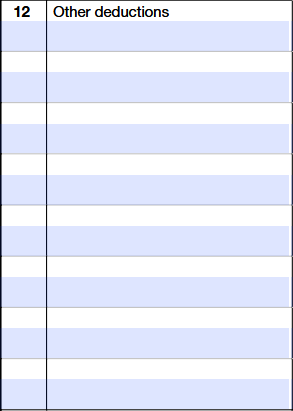
Line 12: Other Deductions
Enter the shareholder's share of deductible expenses not reported elsewhere. Use the applicable code and attached statement, if required.
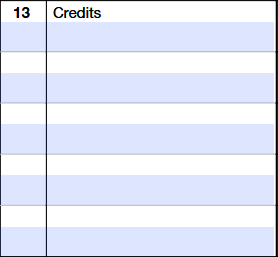
Line 13: Credits
Enter the shareholder's share of tax credits passed through by the S corporation. Report each credit using the applicable code.
Line 14: Schedule K-3 Is Attached, If Checked
Check this box if Schedule K-3 is attached to report the shareholder's international tax information.
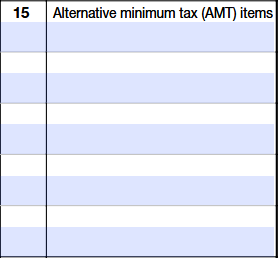
Line 15: Alternative Minimum Tax (AMT) Items
Enter the shareholder's share of AMT-related items. Use the applicable codes and statements to report these amounts.
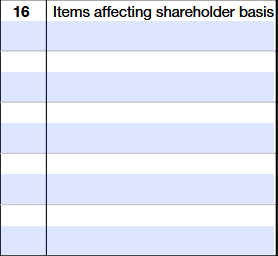
Line 16: Items Affecting Shareholder Basis
Enter items that increase or decrease the shareholder's stock or debt basis. Report each item using the applicable code.
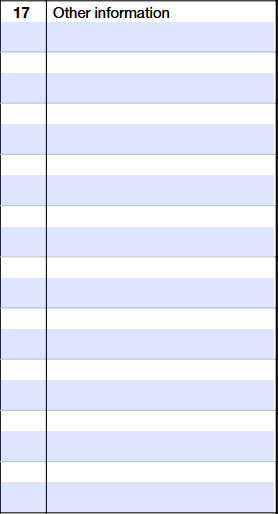
Line 17. Other Information
Enter additional tax information not reported elsewhere on Schedule K-1. Include the applicable code and any required statement.
Line 18. More Than One Activity for At-Risk Purpose
Check out this box if the shareholder has more than one at-risk activity. See the attached statement for activity details.
Line 19. More Than One Activity for Passive Activity Purposes
Check this box if the shareholder has more than one passive activity. See the attached statement for activity details.
Common Mistakes to Avoid
Error
Impact
Reporting shareholder shares that don’t match ownership percentages
IRS mismatches and notices
Forgetting to include shareholder basis adjustments
Incorrect taxable income
Failing to reconcile Schedule K totals with all K-1s
Inaccurate corporate reporting
Late distribution of Schedule K-1 to shareholders
Shareholders miss tax filing deadlines
Not filing K-1 copies with the IRS
Incomplete 1120-S filing and penalties
Best Practices for Compliance
Keep accurate records of shareholder ownership and contributions.
Verify that Schedule K totals match the sum of all Schedule K-1s.
Provide K-1s to shareholders well before their individual filing deadlines.
Maintain separate K-1s for current-year and prior-year ownership changes.
Use TaxZerone’s guided e-filing to automatically generate and attach all Schedule K-1s when filing Form 1120-S.
Frequently Asked Questions (FAQs)
1. What is the purpose of Schedule K-1 (Form 1120-S)?
It reports each shareholder’s share of the S corporation’s income, deductions, credits, and other tax items.
2. Who receives a Schedule K-1?
Every shareholder in an S corporation receives one, reflecting their share of the corporation’s annual financial activity.
3. When are Schedule K-1s due?
They must be filed with the IRS and provided to shareholders by the due date of Form 1120-S (March 15, 2025).
4. Can Schedule K-1 be e-filed?
Yes. When you e-file Form 1120-S through TaxZerone, all shareholder K-1s are automatically generated and transmitted to the IRS.
5. What if a shareholder doesn’t receive their K-1 on time?
The S corporation may face penalties, and shareholders could need to file for an extension using Form 4868 or Form 7004.
E-File Your Form 1120-S with Schedule K-1 Using TaxZerone
Ensure each shareholder’s income, deductions, and credits are accurately reported and IRS-compliant.