Understand the purpose of Schedule D (Form 1120-S) and how S corporations report capital gains, capital losses, and built-in gains from the sale or exchange of capital assets.
Learn who must file Schedule D and when it is required for reporting transactions involving stocks, bonds, real estate, digital assets, installment sales, and built-in gains tax.
Explore how to complete Schedule D step by step, including reporting short-term and long-term capital gains and losses, Qualified Opportunity Fund (QOF) transactions, and built-in gains tax calculations.
Understand how Schedule D works with Form 8949, Form 1099-DA, Form 4797, Form 6252, Schedule K, and Schedule K-1 to ensure accurate reporting of capital transactions and shareholder allocations.
When an S corporation sells or exchanges capital assets such as stocks, bonds, or property, the IRS requires those transactions to be reported on Schedule D (Form 1120-S). This schedule summarizes the corporation’s short-term and long-term capital gains and losses, and helps calculate any built-in gains tax that may apply.
Properly completing Schedule D ensures that gains or losses are passed through to shareholders accurately and that the corporation remains compliant with IRS reporting requirements.
With Schedule D (Form 1120-S) S corporations can:
Report all capital asset transactions
Distinguish between short-term and long-term gains
Calculate and report built-in gains tax, if applicable
Transfer results to Schedule K andeach shareholder’s Schedule K-1
Accurate reporting through Schedule D is essential for IRS compliance and for correctly distributing income, deductions, and credits to shareholders.
What’s New for Schedule D (Form 1120-S) — Digital Assets
Beginning with Tax Year 2025 filings, the IRS has expanded Schedule D (Form 1120-S) to support digital asset reporting,such as cryptocurrency and other blockchain-based assets.
The IRS has added new transaction codes G, H, I, J, K, and L on Schedule D lines 1b, 2, 3, 8b, 9, and 10 to properly classify digital asset sales and exchanges.
If your S corporation traded, sold, or disposed of digital assets during the year, those transactions must now be reported using:
Form 1099-DA – Digital Asset Proceeds From Broker Transactions
Form 8949 – Sales and Other Dispositions of Capital Assets
Schedule D (Form 1120-S) using the new digital asset codes
These changes ensure that crypto and digital asset gains or losses are treated the same way as stocks, securities, and other capital assets for tax purposes.
Failing to use the correct codes may cause:
IRS return rejections
Mismatched Form 1099-DA records
Incorrect shareholder K-1 reporting
What Is IRS Form 1120-S Schedule D?
Schedule D (Form 1120-S) is used by S corporations to report capital gains and losses from sales or exchanges of capital assets. It also determines the built-in gains tax under Section 1374 for corporations that were previously C corporations.
It consolidates all transactions from Form 8949(Sales and Other Dispositions of Capital Assets) and helps determine how these gains or losses impact the corporation’s and shareholders’ overall tax obligations.
Common Transactions Reported on Schedule D
Sale of stocks, bonds, or mutual funds held for investment
Sale or exchange of real estate or business property
Gains or losses reported on Form 4797 (transferred here when applicable)
Disposition of assets received through installment sales (Form 6252)
Built-in gains from assets held when converting from C corporation to S corporation
Add below short paragraph inside your “Common Transactions Reported on Schedule D” section:
Digital asset transactions (cryptocurrency, NFTs, or blockchain-based assets) reported through Form 1099-DA and Form 8949 using the new Schedule D codes G–L
Why Schedule D Matters
Accurate Capital Gain Calculation
It ensures correct reporting of all capital transactions, helping avoid misclassification between short-term and long-term gains.
Shareholder Transparency
Since S corporations are pass-through entities, accurate Schedule D reporting ensures shareholders receive correct K-1 allocations.
IRS Compliance
Omitting or incorrectly reporting gains can trigger IRS notices or audits, especially for built-in gains.
Tax Efficiency
Understanding gain classification allows corporations to optimize the timing and structure of asset sales.
Who Must File Schedule D (Form 1120-S)?
Every S corporation that has capital gains, losses, or built-in gains during the tax year must complete Schedule D and attach it to Form 1120-S.
Learn how S corporations file their main return using Form 1120-S
Step-by-Step Breakdown of Schedule D (Form 1120-S)
Schedule D (Form 1120-S) is used to report an S corporation's capital gains and losses from the sale or exchange of capital assets. Follow the instructions below to complete each section and report the required information accurately
Basic Information
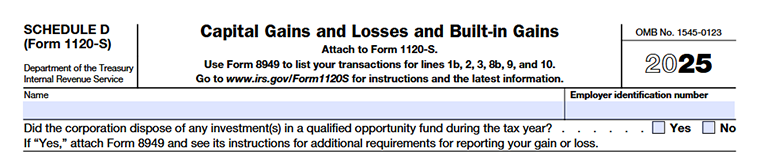
Name and Employer Identification Number (EIN)
Enter the corporation’s legal name and Employer Identification Number (EIN) as shown on Form 1120-S.
Qualified Opportunity Fund (QOF) Investment Disposal
Check “Yes” if the corporation disposed of any investment in a Qualified Opportunity Fund (QOF) during the tax year.
If "Yes", attach Form 8949 and follow its instructions for reporting the related gain or loss. If no QOF investments were disposed of, check "No".
Understand the Four Key Columns
Column
Description
Column (d): Proceeds (Sales Price)
Enter the total amount received from the sale or exchange of the asset.
Column (e): Cost (or Other Basis)
Enter the asset's cost or other adjusted basis used to calculate the gain or loss.
Column (g): Adjustments
Enter any adjustments to the gain or loss reported on Form 8949, Part I, line 2, column (g), if applicable.
Column (h): Gain or (Loss)
Calculate the gain or loss by subtracting column (e) from column (d) and then applying any adjustment from column (g). Enter losses as negative amounts (in parentheses).
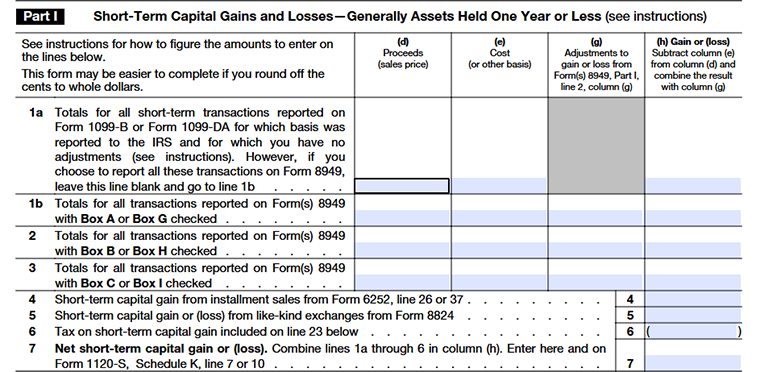
Part I: Short-Term Capital Gains and Losses
Use Part I to report short-term capital gains and losses from the sale or exchange of capital assets held for one year or less. If you disposed of an investment in a Qualified Opportunity Fund (QOF) during the tax year, answer the question at the top of Schedule D and attach Form 8949 if required.
Note: Before completing the applicable lines in this section, prepare Form 8949 for any transactions that must be reported there.
Line 1a: Transactions Not Reported on Form 8949
Enter the total proceeds, cost or other basis, and gain or loss for short-term transactions reported on Form 1099-B or Form 1099-DA when the basis was reported to the IRS and no adjustments are required.
If you choose to report these transactions on Form 8949, leave this line blank and report them on Line 1b instead.
Line 1b: Transactions Reported on Form 8949 (Box A or Box G)
Enter the totals from Form 8949 for short-term transactions with Box A or Box Gchecked. Transfer the proceeds, basis, adjustments, and gain or loss from Form 8949 to the corresponding columns on this line.
Line 2: Transactions Reported on Form 8949 (Box B or Box H)
Enter the totals from Form 8949 for short-term transactions with Box B or Box H checked. Report the amounts exactly as summarized on Form 8949.
Line 3: Transactions Reported on Form 8949 (Box C or Box I)
Enter the totals from Form 8949 for short-term transactions with Box C or Box I checked. Include the total proceeds, basis, adjustments, and resulting gain or loss from Form 8949.
Line 4: Short-Term Capital Gain from Installment Sales
Enter the short-term capital gain from Form 6252, line 26 or 37, if applicable. Only include the amount reported on Form 6252.
Line 5: Short-Term Capital Gain or Loss from Like-Kind Exchanges
Enter the short-term capital gain or loss from Form 8824 for any reportable like-kind exchanges completed during the tax year.
Line 6: Tax on Short-Term Capital Gain Included on Line 23
Enter the portion of the built-in gains tax attributable to short-term capital gains. Report this amount as a negative value (loss) on this line.
Line 7: Net Short-Term Capital Gain or Loss
Combine the amounts reported in column (h) on Lines 1a through 6 to determine your net short-term capital gain or loss. Enter the result on this line and report it on Form 1120-S, Schedule K, as instructed.
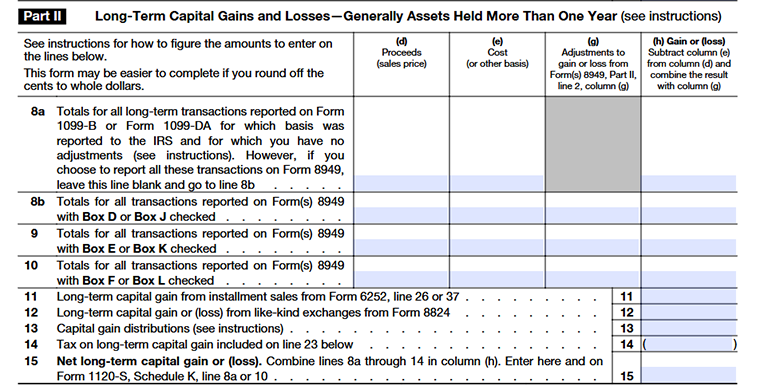
Part II: Long-Term Capital Gains and Losses
Part II is used to report long-term capital gains and losses from assets held for more than one year. Enter transaction details from Form 8949, Form 1099-B, Form 1099-DA, or other applicable forms. Round amounts to whole dollars if preferred.
Line 8a: Transactions Reported on Form 1099-B or Form 1099-DA (Basis Reported to IRS)
Enter the totals for long-term transactions reported on Form 1099-B or Form 1099-DA where the basis was reported to the IRS and no adjustments apply.
If these transactions are instead reported on Form 8949, please leave this line blank.
Line 8b: Transactions Reported on Form 8949 (Box D or Box J)
Enter the totals from Form 8949 for long-term transactions with Box D or Box J checked. Report the proceeds, basis, adjustments, and gain or loss as shown on Form 8949.
Line 9: Transactions Reported on Form 8949 (Box E or Box K)
Enter the totals from Form 8949 for long-term transactions with Box E or Box K checked. Include the total proceeds, basis, adjustments, and resulting gain or loss from Form 8949.
Line 10: Transactions Reported on Form 8949 (Box F or Box L)
Enter the totals from Form 8949 for long-term transactions with Box F or Box L checked. Include the total proceeds, basis, adjustments, and resulting gain or loss from Form 8949.
Line 11: Long-Term Capital Gain From Installment Sales
Enter the long-term capital gain from installment sales reported on Form 6252, line 26 or 37, if applicable. Only include the amount reported on Form 6252.
Line 12: Long-Term Capital Gain or Loss From Like-Kind Exchanges
Enter the long-term capital gain or loss from Form 8824 for any reportable like-kind exchanges completed during the tax year.
Line 12: Long-Term Capital Gain or Loss From Like-Kind Exchanges
Enter the long-term capital gain or loss from Form 8824 for any reportable like-kind exchanges completed during the tax year.
Line 13: Capital Gain Distributions
Enter capital gain distributions received during the tax year as reported in the instructions.
Line 14: Tax on Long-Term Capital Gain Included on Line 23
Enter the portion of the built-in gains tax related to long-term capital gains included on Line 23. Report this amount as a negative value (loss) on this line.
Line 15: Net Long-Term Capital Gain or Loss
Combine the amounts reported in column (h) on Lines 8a through 14 to determine your net long-term capital gain or loss. Enter the result on this line and report it on Form 1120-S, Schedule K, as instructed.
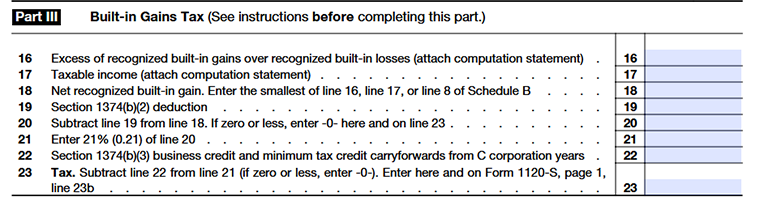
Part III: Built-in Gains Tax
Part III is used to calculate the built-in gains tax that may apply to an S corporation that was previously a C corporation. Complete this section only if the corporation has recognized built-in gains or lossessubject to Section 1374 rules.
Line 16: Excess of Recognized Built-in Gains Over Recognized Built-in Losses
Enter the excess of recognized built-in gains over recognized built-in losses. Attach the required computation statement showing how the amount was calculated.
Line 17: Taxable Income
Enter the corporation’s taxable income. Attach the required computation statement supporting the amount reported.
Line 18: Net Recognized Built-in Gain
Enter the smallest amount from Line 16, Line 17, or Schedule B, Line 8. This amount represents the net recognized built-in gain subject to tax.
Line 19: Section 1374(b)(2) Deduction
Enter the allowable deduction under Section 1374(b)(2), if applicable.
Line 20: Net Taxable Built-in Gain
Subtract Line 19 from Line 18. If the result is zero or less, enter 0 on this line and Line 23.
Line 21: Tax on Net Recognized Built-in Gain
Multiply the amount on Line 20 by 21% (0.21) to calculate the built-in gains tax before credits.
Line 22: Business Credit and Minimum Tax Credit Carryforwards
Enter any available Section 1374(b)(3) business credit and minimum tax credit carryforwards from the corporation’s C corporation years.
Line 23: Built-in Gains Tax
Subtract Line 22 from Line 21. If the result is zero or less, enter 0 Report the final amount here and on Form 1120-S, page 1, line 23b.
Filing Deadline for Schedule D
Schedule D must be filed along with Form 1120-S by the S corporation filing deadline: