
Last updated:
- by Nikhil Chowdary | TaxZeroneForm 1065 at a Glance
Form 1065 is filed by partnerships with IRS to report income, deductions, credits, and other tax items. Income generally passes through to partners and is reported on Schedule K-1.
- Due Date: March 15 for calendar-year partnerships. Fiscal-year partnerships generally file by the 15th day of the 3rd month after the tax year ends
- Extension: File Form 7004 by the original due date for an automatic 6-month extension.
- Late Filing Penalties: The IRS may charge $245 per partner per month for late filing, plus penalties for missing or incorrect Schedule K-1s.
If you operate a partnership or a multi-member LLC, Form 1065 is the IRS return that reports your business’s annual financial activity. While partnerships generally do not pay federal income tax at the entity level, they are still required to file this return to disclose income, deductions, credits, and—most importantly—how those items are allocated among partners.
Every amount reported on Form 1065 ultimately flows to partners through Schedule K-1, which they use to complete their individual or business tax returns. This makes accuracy critical: an error on Form 1065 almost always becomes an error on every partner’s return.
This instruction guide is designed to walk you through Form 1065 step by step, explaining what each section means, why the IRS requires it, and how the information flows across schedules.
Table of Contents
What Is Form 1065 and Why It Matters
Form 1065, U.S. Return of Partnership Income, is the annual federal tax return filed with the Internal Revenue Service by partnerships and entities taxed as partnerships.
Form 1065 is used to report:
- Total partnership income and expenses
- Ordinary business profit or loss
- Separately stated income and deduction items
- Credits and other tax attributes
- Balance sheet information
- Capital account activity for each partner
- Allocation of all items to partners via Schedule K-1
Why Form 1065 Is So Important
- Compliance
Filing Form 1065 is a legal requirement for most partnerships, and failure to meet the Form 1065 deadline can result in penalties calculated per partner, per month. - Partner reporting accuracy
Partners rely entirely on Schedule K-1 generated from 1065 form. Any mistake directly affects partners’ personal or business tax returns. - Transparency to the IRS
The IRS uses 1065 tax form to evaluate ownership structure, capital movements, foreign activity, and compliance with partnership tax rules. - Audit risk reduction
Accurate completion of Schedules B, K, L, M-1, and M-2 helps reduce the likelihood of IRS inquiries.
Who Must File Form 1065?
You must file Form 1065 if your business meets any of the following conditions during the tax year:
- It is a domestic partnership
- It is a multi-member LLC that has not elected corporate taxation
- It had two or more partners at any time during the year
- It had income, expenses, gains, losses, or credits, even if net income is zero
Entities Commonly Required to File
- General partnerships
- Limited partnerships (LPs)
- Limited liability partnerships (LLPs)
- Multi-member LLCs taxed as partnerships
Entities That Generally Do NOT File Form 1065
- Sole proprietorships
- Single-member LLCs (unless electing partnership treatment)
- C Corporations (Form 1120)
- S Corporations (Form 1120-S)
Filing Deadlines, Extensions, and Penalties
Standard Filing Deadline
- Calendar-year partnerships: March 16, 2026 (for the 2025 tax year)
- Fiscal-year partnerships: The 15th day of the 3rd month after the tax year ends
If the due date falls on a weekend or federal holiday, the deadline shifts to the next business day.
Filing an Extension (Form 7004)
Partnerships can request an automatic 6-month extension by filing Form 7004.
- No explanation is required
- The extension moves the deadline to September 15, 2026
- The extension applies to filing only, not to paying any required taxes
Penalties for Late or Incorrect Filing
| Situation | Penalty | How It Applies |
|---|---|---|
| Late filing | $245 per partner, per month | Up to 12 months |
| Missing Schedule K-1s | Additional penalties | Per partner |
| Incomplete or inconsistent return | IRS notices & audits | Common trigger |
| Failure to furnish K-1s to partners | Separate penalties | Even if 1065 is filed |
Example: A partnership with 4 partners that files 3 months late could face penalties exceeding $2,800, even if no tax is owed.
Key Documents You Need Before Filing Form 1065
Before starting taxes form 1065, gather and organize the following records. Having these ready prevents errors and saves time during filing.
Financial Records
- Profit & Loss statement for the tax year
- Balance sheet (beginning and end of year)
- Cost of goods sold details (if applicable)
- Depreciation and amortization schedules
Partner Information
- Partner names and addresses
- Ownership percentages
- Profit, loss, and capital allocation agreements
- Capital contributions and withdrawals
- Guaranteed payment amounts
Prior-Year Information
- Last year’s Form 1065
- Prior-year Schedule K-1s
- Carryforward amounts (losses, credits, depreciation)
Comparison: Form 1065 vs Form 1120 vs Form 1120-S
This comparison is provided for context, not marketing, and helps filers confirm they are using the correct form.
| Form | Who Files | Core Difference |
|---|---|---|
| 1065 | Partnerships & multi-member LLCs | Pass-through taxation; partner-level reporting |
| 1120 | C Corporations | Corporation pays tax at entity level |
| 1120-S | S Corporations | Pass-through, but corporate ownership structure |
Form 1065 Line-by-Line Instructions
Basic Information Section (Lines A–K) + Income Section (Lines 1a–8)
This section establishes the identity, structure, and filing context of the partnership. Errors here commonly cause IRS notices or return rejections.
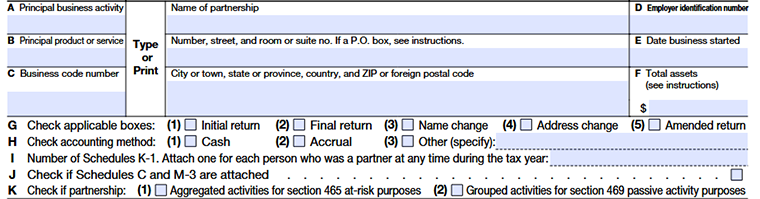
Name of Partnership
Enter the legal name of the partnership exactly as shown on IRS EIN records.
Enter:
- Legal partnership or LLC name
Do NOT enter:
- DBA or trade name unless it matches IRS records
Why this matters:
The IRS matches this field against the EIN database. Any mismatch may delay processing.
Address (Street, City, State, ZIP / Country)
Provide the partnership’s current mailing address.
- P.O. Box is allowed only if mail is not delivered to a street address
- Foreign partnerships must include country and postal code
Common mistake:
Using an old address without checking the “Address change” box (Line G).
Line A — Principal Business Activity
Describe the main activity that generates income.
Examples:
- “Management consulting services”
- “Residential real estate rental”
- “Software development”
Do NOT:
- Use vague terms like “business” or “services”
Why IRS asks this:
To classify business operations and compare them against industry norms.
Line B — Principal Product or Service
Explain what the partnership actually sells or provides.
Examples:
- “Web application development”
- “Commercial property leasing”
- “Tax preparation services”
Difference from Line A:
- Line A = type of activity
- Line B = specific output
Line C — Business Code Number (NAICS)
Enter the 6-digit NAICS code that best matches your activity.
Examples:
- 541511 – Custom Computer Programming Services
Why this matters:
Incorrect codes may affect IRS risk scoring and industry comparisons.
Line D — Employer Identification Number (EIN)
Enter the 9-digit EIN assigned to the partnership.
Line E — Date Business Started
Enter the date the partnership began operations, not the EIN issuance date.
Examples:
- Partnership agreement signed: May 10, 2023
- Business activity began: June 1, 2023 Enter June 1, 2023
Line F — Total Assets (End of Year)
Enter the total book value of assets at the end of the tax year.
Includes:
- Cash
- Receivables
- Equipment
- Property
- Investments
Do NOT:
- Use market value
- Leave blank if assets exist
Flow impact:
This number must match Schedule L, End of Year – Total Assets.
Line G — Type of Return (Check All That Apply)
Check applicable boxes:
- Initial return – First year filing
- Final return – Partnership closed
- Name change – Legal name changed
- Address change – Mailing address changed
- Amended return – Correcting a previously filed return
Example:
If the partnership closed in 2025 Check Final return
Line H — Accounting Method
Choose one:
- Cash – Income reported when received
- Accrual – Income reported when earned
- Other Specify (e.g., hybrid method)
Important:
Method must match prior-year filings unless IRS approval was obtained.
Line I — Number of Schedules K-1
Enter the total number of partners at any time during the year.
Include:
- Partners who joined or left mid-year
Why IRS asks this:
To confirm all partners receive a Schedule K-1.
Line J — Schedules C and M-3 Attached
Check if either is attached.
- Schedule M-3 is typically required for large partnerships
Line K — Activity Grouping Elections
Check applicable boxes if:
- Activities are aggregated for at-risk rules (Section 465)
- Activities are grouped for passive activity rules (Section 469)
Why IRS asks this:
Affects how losses are limited and reported to partners.
Income Section (Lines 1a–8)

This section reports the partnership’s gross income and operating results before expenses.
š ï¸ Only trade or business income belongs here. Investment income is usually reported separately on Schedule K.
Line 1a — Gross Receipts or Sales
Enter total sales or service income before any deductions.
Example:
- Client billings during year: $750,000
Line 1b — Returns and Allowances
Enter refunds, discounts, or returned goods.
Example:
- Client refunds issued: $20,000
Line 1c — Balance (Net Sales)
Automatically calculated
Line 1c = Line 1a – Line 1b
Example:
$750,000 – $20,000 = $730,000
Line 2 — Cost of Goods Sold (COGS)
Enter the cost of producing or acquiring goods sold.
Attach:
Includes:
- Inventory costs
- Direct labor
- Materials
Do NOT include:
- Operating expenses (rent, admin salaries)
Line 3 — Gross Profit
Calculated as:
Line 3 = Line 1c – Line 2
Example:
$730,000 – $280,000 = $450,000
Line 4 — Ordinary Income (Loss) from Other Partnerships, Estates, and Trusts
Report pass-through income from:
- Other partnerships
- Estates or trusts
Attach statement listing each source.
Line 5 — Net Farm Profit (Loss)
Enter farm income or loss.
Attach:
Most non-farm partnerships leave this blank.
Line 6 — Net Gain (Loss) from Form 4797
Report gains or losses from sales of:
- Equipment
- Vehicles
- Business property
Attach:
Line 7 — Other Income (Loss)
Report income not listed elsewhere, such as:
- Cancellation of debt income
- Refunds
- Miscellaneous business income
Attach statement explaining each item.
Line 8 — Total Income (Loss)
Add Lines 3 through 7.
Report income not listed elsewhere, such as:
- Gross profit (Line 3): $450,000
- Other partnership income (Line 4): $15,000
- Asset gain (Line 6): $10,000
Total Income (Line 8): $475,000
How These Numbers Flow Next
- Line 8 feeds into the Deductions Section
- Final result becomes Ordinary Business Income (Line 23)
- Line 23 flows to:
- Schedule K, Line 1
- Each partner’s Schedule K-1
Deductions Section (Lines 9–23) & Tax and Payments (Lines 24–32)
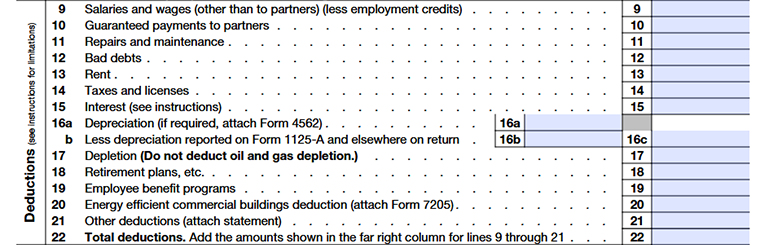
Deductions Section (Lines 9–23)
This section reports ordinary and necessary business expenses incurred by the partnership. These deductions reduce the partnership’s taxable income, which directly impacts each partner’s Schedule K-1.
Line 9 — Salaries and Wages (Other Than to Partners)
Report wages paid to non-partner employees only.
Include:
- Employee salaries and hourly wages
- Bonuses paid to employees
- Taxable fringe benefits
- Employer-paid payroll taxes (after credits)
Do NOT include:
- Payments to partners
- Guaranteed payments (those go on Line 10)
Example:
- Office staff wages: $180,000
- Payroll tax credits used: $10,000
- Amount entered: $170,000
Why IRS separates this:
Partners cannot be treated as W-2 employees for federal tax purposes.
Line 10 — Guaranteed Payments to Partners
Guaranteed payments are amounts paid to partners without regard to partnership income.
Common guaranteed payments include:
- Compensation for services
- Payments for use of capital
Example:
- Partner A receives $60,000 annually for managing operations Guaranteed payment
Important tax treatment:
- Deductible by the partnership
- Taxable to the partner
- Subject to self-employment tax
K-1 impact:
Reported separately on Schedule K and each partner’s Schedule K-1.
Line 11 — Repairs and Maintenance
Costs to keep property in normal operating condition.
Include:
- Equipment repairs
- Routine maintenance
- Painting, servicing, fixing
Do NOT include:
- Improvements that increase value or extend life (capitalize instead)
Example:
- Equipment servicing: $7,500
Line 12 — Bad Debts
Deduct debts that:
- Were previously included in income, and
- Are now uncollectible
Important:
Most partnerships use the specific charge-off method, not estimates.
Example:
- Client invoice of $4,000 written off as uncollectible
Line 13 — Rent
Report rent paid for:
- Office space
- Equipment
- Vehicles
Do NOT include:
- Rent paid to a partner (may require special disclosure)
Example:
- Office lease: $30,000 annually
Line 14 — Taxes and Licenses
Include:
- State and local business taxes
- Payroll taxes
- Business licenses and permits
Exclude:
- Federal income taxes
- Penalties and fines
Example:
- State franchise tax: $9,000
Line 15 — Interest
Interest paid on:
- Business loans
- Mortgages
- Lines of credit
Do NOT include:
- Personal interest of partners
Special rule:
Business interest may be limited under Section 163(j) in some cases.
Line 16 — Depreciation
Line 16a — Depreciation
Enter total depreciation expense.
Line 16b — Depreciation reported elsewhere
Subtract depreciation already included in COGS or other lines.
Line 16c — Net Depreciation
Automatically calculated.
Attach:
Example:
- Equipment depreciation: $18,000
Line 17 — Depletion
Used by businesses extracting natural resources.
Do NOT deduct oil & gas depletion here (reported elsewhere).
Line 18 — Retirement Plans, etc.
Include employer contributions to:
- SEP IRAs
- SIMPLE plans
- Qualified retirement plans
Example:
- SEP contributions: $14,000
Line 19 — Employee Benefit Programs
Include:
- Health insurance
- Life insurance
- Disability insurance
Exclude:
- Retirement benefits (Line 18)
Line 20 — Energy Efficient Commercial Buildings Deduction
Deduct qualifying energy-efficient building improvements.
Attach:
Line 21 — Other Deductions
Report expenses not listed elsewhere.
Examples:
- Legal and accounting fees
- Advertising
- Office supplies
- Utilities
- Software subscriptions
Attach a statement itemizing each category.
Line 22 — Total Deductions
Add Lines 9 through 21.
Line 23 — Ordinary Business Income (Loss)
Subtract total deductions from total income:
Line 23 = Line 8 – Line 22
Example:
- Total income (Line 8): $475,000
- Total deductions (Line 22): $430,000
- Ordinary income: $45,000
Flow impact:
- Reported on Schedule K, Line 1
- Allocated to partners on Schedule K-1
Tax and Payments Section (Lines 24–32)
Most partnerships do not pay federal income tax, but these lines apply in special situations.

Line 24 — Interest Due (Look-Back Method – Long-Term Contracts)
Used only if the partnership applies the look-back method.
Attach:
Line 25 — Interest Due (Income Forecast Method)
Applies to income forecast property.
Attach:
Line 26 — BBA AAR Imputed Underpayment
Used when partnership audit adjustments result in entity-level tax.
Important:
This applies under the centralized partnership audit regime.
Line 27 — Other Taxes
Includes:
- Excise taxes
- Recapture taxes
- Other partnership-level taxes
Line 28 — Total Balance Due
Add Lines 24 through 27.
Line 29 — Elective Payment Election Amount
Credits elected for direct payment (from Form 3800, if applicable).
Line 30 — Payment
Enter any tax payments made with:
- Extensions
- Estimated payments
Line 31 — Amount Owed
If payments are less than balance due, enter the difference.
Line 32 — Overpayment
If payments exceed balance due, enter the excess.
How Phase 3 Connects to the Rest of the Return
- Line 23 feeds Schedule K
- Guaranteed payments flow separately to partners
- Deductions affect partner basis
- Incorrect classification here often causes K-1 errors
Schedule B (Form 1065) — Other Information
Question-by-Question Instructions & IRS Logic
Schedule B is not a financial schedule — it is a compliance, disclosure, and risk-assessment schedule.
The Internal Revenue Service uses Schedule B to determine:
- Ownership concentration
- Foreign exposure
- Audit regime applicability
- Disclosure compliance
- Whether additional forms are required
Question 1 — Type of Entity Filing the Return
You must identify the legal structure of the partnership.
Options include:
- Domestic general partnership
- Domestic limited partnership
- Domestic limited liability company (LLC)
- Domestic limited liability partnership (LLP)
- Foreign partnership
Why IRS asks this:
Different partnership structures are subject to different liability, reporting, and audit rules.
Common mistake:
Checking “ form 1065 for LLC” without confirming the entity is taxed as a partnership.
Question 2 — Ownership of 50% or More
2(a) — Entity Ownership (Corporations, Trusts, Governments)
Answer Yes if any entity directly or indirectly owned 50% or more of profits, losses, or capital.
- Includes constructive ownership
- Includes indirect chains
If “Yes”:
- You must attach Schedule B-1
2(b) — Individual or Estate Ownership
Answer Yes if any individual or estate owned 50% or more.
Why this matters:
High ownership concentration increases IRS scrutiny of:
- Allocation accuracy
- Disguised compensation
- Basis manipulation
Question 3 — Ownership of Other Entities
3(a) — Ownership of Corporations
Answer Yes if the partnership owned:
- 20% or more directly, OR
- 50% or more directly or indirectly
You must report:
- Corporation name
- EIN
- Country
- Ownership percentage
3(b) — Ownership of Other Partnerships or Trusts
Answer Yes if the partnership owned:
- 20% or more of profits/losses/capital, OR
- 50% or more directly or indirectly
Why IRS tracks this:
To identify tiered partnership structures, which are high-risk for income shifting.
Question 4 — Small Partnership Exception
Answer Yes only if all four conditions are met:
- Gross receipts < $250,000
- Total assets < $1 million
- All form 1065 k1 filed on time
- Not required to file Schedule M-3
If “Yes”:
- You may skip:
- Schedule L
- Schedule M-1
- Schedule M-2
- Item F (Total Assets)
Common error:
Claiming this exception while still having foreign activity or complex allocations.
Question 5 — Publicly Traded Partnership (PTP)
Answer Yes if interests are traded on:
- Public markets, OR
- Secondary markets
PTPs are subject to special passive activity rules.
Question 6 — Canceled or Modified Debt
Answer Yes if any partnership debt:
- Was forgiven
- Was canceled
- Had principal reduced
If “Yes”:
- Cancellation of Debt (COD) income may apply
- Additional reporting may be required
Question 7 — Reportable Transactions (Form 8918)
Answer Yes if the partnership participated in a reportable transaction.
These are transactions the IRS considers potential tax avoidance.
If “Yes”:
- Form 8918 must be filed
Question 8 — Foreign Financial Accounts (FBAR)
Answer Yes if the partnership had:
- Foreign bank accounts
- Foreign securities accounts
- Signing authority over foreign accounts
If “Yes”:
- FBAR (FinCEN Form 114) may be required
- Country name must be listed
Common misconception:
This is not reported on the tax return itself — but failure to disclose here is penalized.
Question 9 — Foreign Trust Transactions
Answer Yes if the partnership:
- Received distributions from a foreign trust
- Transferred assets to a foreign trust
If “Yes”:
- Form 3520 may be required
Question 10 — Section 754 & Basis Adjustments
10(a) — Section 754 Election
Answer Yes if the partnership has an active Section 754 election.
Why this matters:
This election allows basis adjustments when:
- Partners enter or exit
- Interests are transferred
- Assets are distributed
Once made, the election generally cannot be revoked without IRS consent.
10(b) — Section 743(b) Adjustments
Answer Yes if basis was adjusted for partner-level transfers.
You must report:
- Net positive adjustments
- Net negative adjustments
10(c) — Section 734(b) Adjustments
Applies to property distributions.
Used when distributions trigger basis adjustments at the partnership level.
10(d) — Mandatory Basis Adjustments
Answer Yes if adjustments were required due to:
- Substantial built-in loss
- Substantial basis reduction
Failure to comply here is a high-risk audit issue.
Questions 11–12 — Property Distributions
Question 11 — Like-Kind Exchange Property
Answer Yes if property from a like-kind exchange was:
- Distributed, OR
- Contributed to another entity
Question 12 — Tenancy-in-Common Interests
Answer Yes if undivided property interests were distributed.
These transactions require careful capital and basis tracking.
Questions 13–18 — Foreign Reporting Forms
Includes:
- Form 8858 (Foreign branches)
- Form 8805 (Foreign partner withholding)
- Form 8865 (Foreign partnerships)
- Form 5471 (Foreign corporations)
If “Yes”:
- You must enter the number of forms attached
Question 19 — Forms 1042 / 1042-S (Withholding)
Answer Yes if the partnership made payments to foreign persons subject to withholding.
Question 20 — Form 8938 (FATCA)
Answer Yes if the partnership is required to disclose specified foreign financial assets.
Questions 21–24 — Interest Limitation & Tax Shelter Rules
Covers:
- Section 721(c) partnerships
- Disallowed interest deductions
- Section 163(j) elections
- Form 8990 requirements
These questions identify earnings-stripping and interest abuse.
Questions 25–26 — Opportunity Zones & Foreign Transfers
Includes:
- Qualified Opportunity Fund certification (Form 8996)
- Transfers triggering Section 864(c)(8)
Questions 27–29 — Advanced Compliance Areas
Covers:
- Related-party transfers
- Inversion transactions
- Excise tax on stock repurchases (Form 7208)
Question 30 — Digital Asset Transactions
Answer Yes if the partnership:
- Received digital assets as payment, OR
- Sold or exchanged digital assets
This includes cryptocurrencies and certain tokens.
Question 32 — Election Out of Subchapter K
Rare election allowing partnerships to opt out of standard partnership tax rules.
Question 33 — Centralized Partnership Audit Regime
If “Yes”:
- You must complete Schedule B-2
- Partnership elects out of centralized audits
If “No”:
- You must designate a Partnership Representative (PR)
Designation of Partnership Representative (PR)
The PR:
- Has sole authority to deal with IRS audits
- Does not need to be a partner
- Can bind the partnership legally
Important:
This role replaces the old “tax matters partner.”
Why Schedule B Errors Are Dangerous
- Triggers IRS notices
- Forces amended returns
- Causes K-1 corrections
- Increases audit probability
Schedules K, K-1, L, M-1, and M-2
Detailed Line-by-Line Partnership Reporting Guide
These schedules explain how partnership results are summarized, allocated, reconciled, and tracked. Errors here almost always lead to partner notices, amended K-1s, or audits by the Internal Revenue Service.
Schedule K — Partners’ Distributive Share Items (Summary Level)
Schedule K reports the total partnership amounts for each category of income, deduction, credit, and other tax item.
Nothing here is partner-specific — allocations happen later on Schedule K-1.
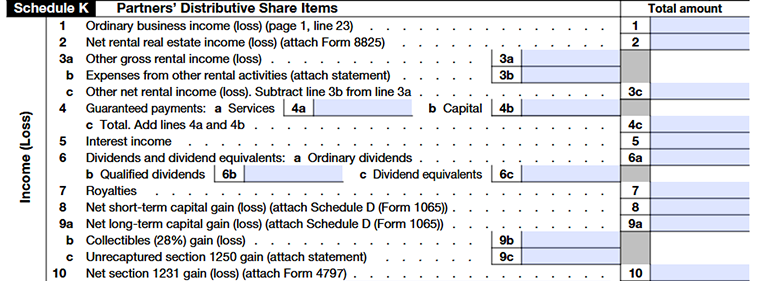
Schedule K — Income (Loss)
Line 1 — Ordinary Business Income (Loss)
This comes directly from Page 1, Line 23.
What it represents:
Net operating profit or loss from the partnership’s core business.
Example:
- Ordinary business income: $120,000
This amount is later split among partners based on the partnership agreement.
Line 2 — Net Rental Real Estate Income (Loss)
Income or loss from rental real estate activities.
Attach:
Why IRS separates this:
Rental real estate is subject to passive activity rules.
Line 3 — Other Rental Income (Loss)
For rental activities not involving real estate, such as equipment leasing.
- 3a: Gross rental income
- 3b: Expenses
- 3c: Net rental income (loss)
Line 4 — Guaranteed Payments
Total guaranteed payments made to partners.
- 4a: For services
- 4b: For capital
- 4c: Total
Important:
Guaranteed payments are not allocated like profits — they are reported separately.
Line 5 — Interest Income
Interest earned on:
- Bank accounts
- Notes receivable
- Investments
Line 6 — Dividends
Interest earned on:
- 6a: Ordinary dividends
- 6b: Qualified dividends
- 6c: Dividend equivalents
Qualified dividends may receive preferential tax rates at the partner level.
Line 7 — Royalties
Income from intellectual property, mineral rights, or licensing agreements.
Lines 8–10 — Capital Gains and Section 1231 Items
Includes:
- Short-term capital gains
- Long-term capital gains
- Collectibles gains
- Unrecaptured Section 1250 gains
- Section 1231 gains/losses
Attach:
- Schedule D (Form 1065)
- Form 4797 (when applicable)
Line 11 — Other Income (Loss)
Income not classified elsewhere.
Examples:
- Cancellation of debt income
- Litigation settlements
- Insurance proceeds
Attach statements specifying each item.
Schedule K — Deductions

Line 12 — Section 179 Deduction
Immediate expensing of qualifying assets.
Attach:
- Form 4562
Line 13 — Charitable Contributions & Investment Interest
Includes:
- Cash charitable contributions
- Noncash contributions
- Investment interest expense
- Section 59(e) expenditures
- Other deductions
Each item may have partner-level limitations.
Schedule K — Self-Employment, Credits & International
Line 14 — Self-Employment Income

Reports amounts subject to self-employment tax for partners.
Line 15 — Credits

Includes:
- Low-income housing credits
- Rehabilitation credits
- Other business credits
Credits may be limited by partner basis or at-risk rules.
Line 16 — International Tax Items

Requires Schedule K-2 and impacts partner Schedule K-3.
Line 17 — AMT Items

Alternative Minimum Tax adjustments, such as:
- Depreciation differences
- Depletion
- Oil and gas income
Lines 18–21 — Other Information

Includes:
- Tax-exempt income
- Nondeductible expenses
- Distributions
- Investment income/expenses
- Foreign taxes paid
Schedule K-1 — Partner-Level Allocation
Each Schedule K-1 shows a partner’s share of every Schedule K item.
What Determines Allocation
Allocations are based on:
- Ownership percentage
- Profit-sharing ratios
- Special allocations in the partnership agreement
Example Allocation
Partnership facts:
- Ordinary income (Schedule K, Line 1): $120,000
- Two partners:
- Partner A: 60%
- Partner B: 40%
form 1065 k-1 reporting:
- Partner A: $72,000
- Partner B: $48,000
Why K-1 Accuracy Is Critical
- 1065 K 1 form errors require amended partner returns
- Late K-1s trigger per-partner penalties
- IRS compares form 1065 k 1 totals directly to Schedule K
Schedule L — Balance Sheets per Books
Schedule L shows the partnership’s financial position, not tax values.
It must be completed unless the partnership qualifies for the small partnership exception.
Assets Section (Beginning & End of Year)
Includes:
- Cash
- Accounts receivable (net of bad debts)
- Inventory
- Investments
- Loans to partners
- Depreciable assets (net of depreciation)
- Intangible assets
- Other assets (itemized)
Liabilities & Capital
Includes:
- Accounts payable
- Short-term and long-term debt
- Loans from partners
- Other liabilities
- Partners’ capital accounts
Rule: Total assets must equal total liabilities plus capital.
Schedule M-1 — Book vs Tax Reconciliation
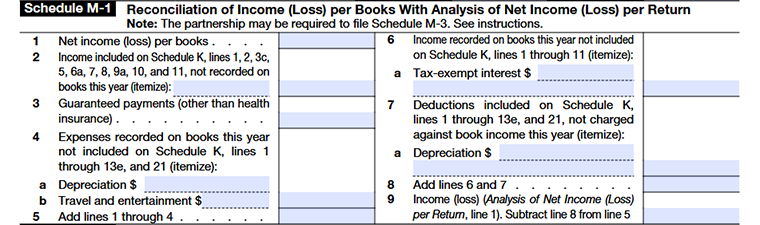
Schedule M-1 explains why book income ‰ taxable income.
Key M-1 Differences
Common reconciling items:
- Depreciation differences
- Nondeductible expenses
- Tax-exempt income
- Guaranteed payments
Example
- Book income: $150,000
- Tax depreciation exceeds book depreciation: $20,000
- Nondeductible expenses: $5,000
Taxable income:
$150,000 – $20,000 + $5,000 = $135,000
Schedule M-2 — Analysis of Partners’ Capital Accounts

Schedule M-2 tracks how partner capital changes during the year.
This is far more important for partnerships than AAA is for S Corps.
Capital Account Components
- Beginning capital
- Capital contributions
- Net income or loss
- Distributions
- Other increases or decreases
Example (Single Partner)
- Beginning capital: $80,000
- Net income: $45,000
- Distribution: $25,000
Ending capital:
$80,000 + $45,000 – $25,000 = $100,000
Why Schedule M-2 Matters
- Determines partner basis
- Affects deductibility of losses
- Impacts taxation of distributions
- Closely reviewed in IRS audits
How All Schedules Connect
| Schedule | Purpose |
|---|---|
| Page 1 | Calculates partnership income |
| Schedule K | Summarizes tax items |
| Schedule K-1 | Allocates items to partners |
| Schedule L | Shows financial position |
| Schedule M-1 | Explains book vs tax differences |
| Schedule M-2 | Tracks partner capital |
A mistake in any one of these schedules often cascades into all others.
Common Form 1065 Filing Mistakes (and How to Avoid Them)
These are real-world errors that frequently trigger IRS notices, rejected e-files, or amended Schedule K-1s.
1. Treating Partners Like Employees
Mistake: Paying partners wages and reporting them on Line 9.
Correct treatment:
- Partner compensation must be reported as Guaranteed Payments (Line 10)
- Partners are not W-2 employees for federal tax purposes
Why IRS cares:
Misclassification affects self-employment tax and income allocation.
2. Incorrect Partner Ownership Percentages
Mistake: Using year-end ownership instead of weighted ownership when partners join or leave mid-year.
Correct approach:
- Allocate income based on the partnership agreement
- Reflect partial-year ownership correctly on Schedule k-1 form 1065
Impact:
Incorrect allocations lead to amended K-1s and partner tax corrections.
3. Schedule K Does Not Match Total of K-1s
Mistake: Schedule K totals do not reconcile with all issued K-1s.
IRS cross-check:
The IRS system automatically validates:
- Schedule K totals
- Aggregate K-1 totals
Any mismatch = notice.
4. Ignoring Schedule B Disclosures
Mistake: Answering “No” to foreign, ownership, or audit questions without review.
High-risk areas:
- Foreign bank accounts (FBAR-related)
- Section 754 elections
- Partnership Representative designation
- Digital asset transactions
Result:
Schedule B errors are among the top audit triggers for partnerships.
5. Capital Accounts Not Reconciled (Schedule M-2)
Mistake: Ending capital balances do not match:
- Schedule L
- Prior-year ending balances
- Partner records
Why this matters:
Capital account accuracy affects:
- Partner basis
- Loss deductibility
- Distribution taxation
6. Missing or Late Schedule K-1s
Mistake: Filing Form 1065 but delaying K-1 distribution.
Penalty exposure:
- Penalties may apply per partner even if the 1065 form is filed on time.
Best practice:
Prepare K-1s before e-filing Form 1065.
Lesser-Known Forms Commonly Required With Form 1065
Many partnerships file 1065 a form correctly — but miss required attachments, leading to IRS follow-ups.
| Form | When Required |
|---|---|
| Form 1125-A | Form 1125-A If reporting Cost of Goods Sold |
| Form 4562 | Depreciation or Section 179 deduction |
| Form 4797 | Sale of business property |
| Form 8825 | Rental real estate activities |
| Form 8697 / 8866 | Look-back interest |
| Schedule K-2 / K-3 | International tax items |
| Form 8990 | Business interest limitation |
| Form 8996 | Qualified Opportunity Fund |
| Form 3520 | Foreign trust transactions |
| FinCEN Form 114 | Foreign bank accounts (FBAR) |
Filing Checklist Before Submitting Form 1065
Use this checklist to reduce errors and rejections:
- Partnership name & EIN match IRS records
- Accounting method consistent with prior year
- Schedule K totals match all K-1s
- Capital accounts reconcile (M-2 †” L)
- Schedule B answered completely and accurately
- Required attachments included
- K-1s prepared for all partners
- Extension filed (Form 7004) if needed
Frequently Asked Questions (Instruction-Specific,
Non-Overlapping)
1. Does a partnership with no income still need to file Form 1065?
Yes. Many partnerships are required to file even with zero income, especially if they have expenses, partners, or ongoing legal existence.
2. Can a partnership report a loss on Form 1065?
Yes. Losses pass through to partners and may be deductible, subject to:
- Basis rules
- At-risk rules
- Passive activity limitations
3. What is the difference between Guaranteed Payments and Profit Allocation?
- Guaranteed Payments: Fixed, paid regardless of profits; subject to self-employment tax
- Profit Allocation: Based on ownership or agreement; depends on partnership results
They are reported separately and taxed differently.
4. Is Schedule M-2 required every year?
Not always. It is generally required when:
- Assets or receipts exceed IRS thresholds, or
- The partnership has significant capital activity
However, maintaining capital accuracy is always recommended.
5. Who should be the Partnership Representative?
The PR should be someone who:
- Understands partnership tax rules
- Can respond to IRS inquiries
- Has authority to bind the partnership
The PR does not have to be a partner.
6. Can partners file their tax returns before receiving Schedule K-1?
No. Partners must wait for Schedule K1 form 1065, as it contains essential income and deduction details.
7. What happens if a Schedule K-1 is wrong?
The partnership must issue:
- Corrected K-1s, and
- Potentially file an amended Form 1065
A smarter way to file your partnership tax return
From income reporting to partner allocations, TaxZerone supports every step of Form 1065 filing.
- IRS-authorized partnership e-filing
- Real-time error checks to avoid rejections
- Automatic Schedule K-1 generation for all partners
- Secure cloud storage (ZeroneVault)
- Affordable pricing for partnerships of all sizes