
IRS Form 1125-A Cost of Goods Sold (COGS)
Last updated:
-by Nikhil Chowdary | TaxZerone
IRS Form 1125-A at a glance
- Understand the purpose of IRS Form 1125-A and how businesses calculate and report Cost of Goods Sold (COGS) on Form 1065, Form 1120, and Form 1120-S.
- Learn who must file Form 1125-A and how inventory requirements apply to partnerships, S corporations, and corporations that manufacture or sell products.
- Explore Form 1125-A line-by-line instructions, including beginning inventory, purchases, labour costs, Section 263A costs, other expenses, ending inventory, and COGS calculation.
- Understand inventory valuation methods and IRS rules, including cost method, lower of cost or market, LIFO, and Section 263A capitalization requirements.
If your business manufactures products or purchases inventory for resale, IRS Form 1125-A helps you calculate and report your Cost of Goods Sold (COGS) when filing Form 1065, Form 1120, or Form 1120-S. Accurately reporting inventory costs is essential because COGS directly affects your taxable income.
This guide explains who must file Form 1125-A, the information required to complete it, how inventory is calculated, filing requirements, and common mistakes to avoid. Whether you're a partnership or corporation, Ta xZerone provides the resources you need to prepare your business tax return with confidence and stay compliant with IRS requirements.
Table of Contents
Who Must File Form 1125-A?
Form 1125-A is mandatory for businesses maintaining physical inventory for resale or production of goods, including:
You must file Form 1125-A if:
- Your business produces goods or purchases goods for resale, and
- You maintain an inventory during the tax year.
Entities required to complete this form include:
- C Corporations filing Form 1120
- S Corporations filing Form 1120-S
- Partnerships filing Form 1065
Service-based businesses that don’t maintain an inventory (like consultants, designers, or marketing agencies) don’t need to file Form 1125-A.
Filing Deadlines for Form 1125-A
The deadline for submitting Form 1125-A depends on the filing due date of the main return it’s attached to:
- C Corporations (Form 1120): April 15, 2026
- S Corporations (Form 1120-S): March 16, 2026
- Partnerships (Form 1065): March 16, 2026
If you need more time, you can file an extension using Form 7004 before the original due date.
Purpose of Form 1125-A
- Provides a clear computation for deducting the cost of goods sold, which directly affects taxable income and gross profit reporting.
- Ensures businesses accurately comply with IRS inventory and cost capitalization rules, such as Section 263A.
Step-by-Step Guide to Form 1125-A Completion
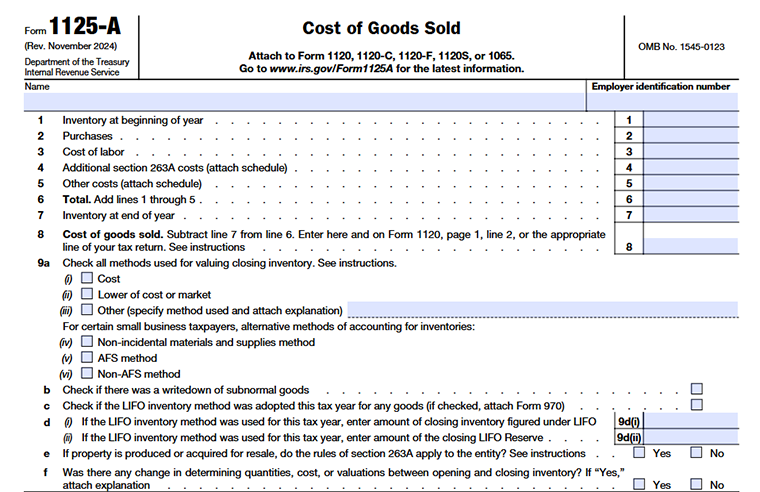
Line 1 – Inventory at Beginning of Year
- Enter the total value of inventory available at the beginning of the tax year. This amount is generally the same as the prior year’s ending inventory.
- If you change your accounting method, enter the recalculated beginning inventory using the new method and attach an explanation for any required Section 481(a) adjustment.
Line 2 – Purchases
- Enter the total cost of inventory purchased during the tax year for resale or production. Reduce the amount by any items withdrawn for personal use, returns, allowances, or discounts.
- For partnerships, personal-use items should be reported as distributions to partners on Schedule K and Schedule K-1.
Line 3 – Cost of Labor
- Enter the direct labor costs incurred to produce or manufacture goods during the tax year. Include wages and related costs for employees directly involved in production.
- Do not include indirect labor costs unless required under Section 263A.
Line 4 – Additional Section 263A Costs
- Enter any additional Section 263A costs that must be included in inventory but are not reported on Lines 2, 3, or 5.
- These may include certain production, storage, purchasing, handling, or administrative costs. Attach a schedule with the details of these costs.
Line 5 – Other Costs
- Enter any additional inventory costs paid or incurred during the tax year that are not included on Lines 2 through 4.
- Attach a statement listing the details of these costs. For cooperatives, please include eligible per-unit retain allocations and provide the required details.
Line 6 – Total
Add Lines 1 through 5 and enter the total cost of inventory available for sale or production during the tax year.
Line 7 – Inventory at End of Year
Enter the value of inventory remaining at the end of the tax year. Include any required Section 263A costs when determining the ending inventory amount.
Line 8 – Cost of Goods Sold
Subtract Line 7 from Line 6 and enter the result as your Cost of Goods Sold (COGS). Report this amount on the appropriate line of your tax return (such as Form 1120, 1120-C, 1120-S, 1065, or 1120-F).
Line 9a – Inventory Methods
Check the applicable method used to value closing inventory:
- Cost: Inventory is valued at purchase or production cost.
- Lower of Cost or Market: Inventory is valued at the lower of cost or market value.
- Other: Enter the approved method used and attach an explanation.
- Alternative Methods (Small Businesses): Check the applicable method if using non-incidental materials and supplies, AFS, or non-AFS inventory methods.
Line 9c – LIFO Method Adoption
Check the box if you adopted the LIFO inventory method during the tax year. Attach Form 970 if required.
Line 9d(i) – Closing Inventory Under LIFO
Enter the ending inventory value calculated using the LIFO method.
Line 9d(ii) – LIFO Reserve
Enter the difference between the FIFO value and the LIFO value of the ending inventory.
Line 9e – Section 263A Rules
Check “Yes” if Section 263A capitalization rules apply to inventory produced or acquired for resale.
Line 9f – Inventory Changes
Check “Yes” if there is any change in determining inventory quantities, costs, or valuations. Attach an explanation of the change.
Example Calculation Method
The basic COGS formula used for Form 1125-A is:
Cost of Goods Sold = Beginning Inventory + Purchases + Direct Costs − Ending Inventory
For example, if beginning inventory is $200,000, ending inventory is $100,000, and direct costs incurred total $50,000, COGS would be $150,000.
Required Documentation
- Accurate inventory valuation (beginning and end of year).
- Records of purchases, labor costs, freight, and other direct expenses.
- Details for Section 263A capitalized costs (when applicable).
- Schedules for other costs, if needed.
Common Pitfalls and Penalties
Failing to file Form 1125-A when required or submitting unsubstantiated entries may result in:
- Financial penalties.
- Additional IRS scrutiny or audits.
- Incorrect taxable income calculation and potentially increased liability.
Key Tips for Compliance
- Maintain thorough records of inventory, purchases, and production costs throughout the year.
- Attach all supporting schedules required by IRS instructions.
- Review IRS updates each year for changes to methods, deadlines, or additional documentation needs.
- Seek professional tax counsel when implementing new accounting methods or if COGS calculation is complex.
Frequently Asked Questions (FAQs)
1. Do all businesses have to file Form 1125-A?
No. Only businesses that sell or produce physical goods and maintain inventory must file it.
2. What inventory valuation methods are accepted by the IRS?
You can use FIFO (First-In, First-Out), LIFO (Last-In, First-Out), or the cost method, as long as it’s applied consistently each year.
3. Can I e-file Form 1125-A separately?
No. Form 1125-A is filed as part of your main business tax return (Form 1120, 1120-S, or 1065). When you e-file your return with TaxZerone, Form 1125-A will be automatically included.
4. What happens if I forget to file Form 1125-A?
If you fail to include it when required, your return could be considered incomplete, and your reported gross income may be questioned by the IRS.
5. Can service-based businesses file Form 1125-A voluntarily?
No, the form only applies if your business maintains inventory. Service-only entities should not file it.