
IRS Form 1125-E : Compensation of Officers
Last updated:
-by Nikhil Chowdary | TaxZerone
IRS Form 1125-E at a glance
- Understand the purpose of IRS Form 1125-E (Compensation of Officers) and how corporations use it to report officer salaries, ownership details, and compensation deductions on Form 1120 and Form 1120-S.
- Learn who must file Form 1125-E and how IRS requirements apply to C corporations and S corporations that report officer compensation and meet the applicable gross receipts threshold.
- Explore how to complete Form 1125-E line by line, including officer information, ownership percentages, compensation amounts, deductions reported elsewhere, and the final compensation deduction.
- Understand IRS reasonable compensation rules and how factors such as officer responsibilities, business size, industry standards, and services provided affect compensation reporting.
If you’re filing a corporate income tax return, such as Form 1120-S, and paid salaries to your corporate officers, you may need to include IRS Form 1125-E, Compensation of Officers.
This form helps the IRS verify that the salaries deducted on your return are reasonable, accurately reported, and reflect actual business services rendered.
Table of Contents
What is IRS Form 1125-E?
IRS Form 1125-E, Compensation of Officers, is an informational attachment required by the IRS for corporations that report officer salaries as part of their deductions. It lists each corporate officer, their ownership percentage, time devoted to business, and total compensation.
The IRS uses this information to ensure that salaries are not artificially inflated to reduce taxable corporate income.
Businesses must complete Form 1125-E when their total receipts are $500,000 or more and officer compensation is deducted on their return.
The form applies to:
- S Corporations filing Form 1120-S and
- You C Corporations filing Form 1120.
It is not required for partnerships, sole proprietorships, or corporations under the $500,000 receipts threshold.
Purpose of IRS Form 1125-E
The purpose of Form 1125-E is twofold:
- Tax Transparency: It discloses how much compensation was paid to each officer and how much ownership each officer holds.
- IRS Oversight: It enables the IRS to assess whether salaries are “reasonable” as per Internal Revenue Code Section 162(a)(1), which permits deductions only for “ordinary and necessary” business expenses, including reasonable salaries for services actually performed.
This helps prevent abuse—such as distributing profits disguised as salaries to avoid double taxation in C corporations or underpaying S corporation officers to reduce employment taxes.
Who Must File Form 1125-E?
Form 1125-E is required for corporations that meet all three criteria below:
- The corporation files Form 1120-S or Form 1120.
- The corporation’s total receipts are $500,000 or more for the tax year.
- The corporation paid compensation to officers during that tax year.
Corporations Required to File
- S Corporations reporting officer salaries on Form 1120-S
- C Corporations reporting deductions on Form 1120
Corporations Not Required to File
- Partnerships (Form 1065)
- Sole proprietorships (Schedule C)
- Corporations with total receipts under $500,000
- LLCs that are not taxed as corporations
Filing Deadlines for Form 1125-E
Form 1125-E must be filed along with your main corporate income tax return.
| Entity Type | Main Return | Due Date |
|---|---|---|
| C Corporations | Form 1120 | April 15, 2026 |
| S Corporations | Form 1120-S | March 16, 2026 |
If you need more time, you can file for an automatic extension using Form 7004 before the original due date.
Detailed Line-by-Line Instructions for Form 1125-E
Each section of the form captures essential details about officer compensation. Let’s break it down line by line:
Line 1 – Officer Information
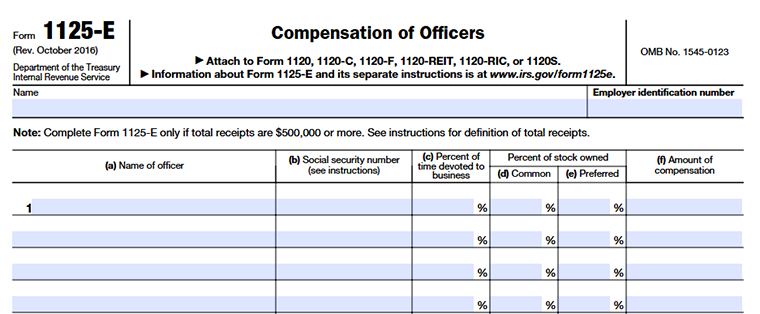
Complete columns (a) through (f) for every corporate officer.
- Column (a): Enter the officer's name.
- Column (b): Enter the officer's Social Security Number (SSN). You may enter only the last four digits if you choose.
- Column (c): Enter the percentage of time the officer devoted to the business during the tax year.
- Columns (d) and (e): Enter the percentage of common and preferred stock owned by the officer.
- Column (f): Enter the officer's total deductible compensation, including salaries, commissions, bonuses, and taxable fringe benefits. For S corporations, include fringe benefits provided to officers who own more than 2% of the corporation's stock. Do not include fringe benefits for officers owning 2% or less, as those are deducted elsewhere on the tax return.
Line 2 – Total Compensation of Officers

Add the compensation amounts from column (f) for all officers and enter the total on line 2.
Line 3 – Compensation Deducted Elsewhere

Complete columns (a) through (f) for every corporate officer.
- Compensation included in cost of goods sold (COGS).
- Elective contributions to a section 401(k) plan.
- Contributions made under a salary reduction SEP agreement.
- Contributions to a SIMPLE IRA plan.
If the corporation claims certain wage-related tax credits, it may need to reduce its compensation deduction under IRC section 280C. Also, do not include depreciation or other expenses for taxable fringe benefits that are deducted elsewhere on the return.
Line 4 – Compensation Deduction to Report

Subtract line 3 from line 2. Enter the result on line 4 and report the same amount on Form 1120, page 1, line 12, or the corresponding compensation line on the applicable business tax return.
Supporting Schedule Attachments
If the corporation has more than four officers, attach an additional sheet with the same information for each additional officer.
Example of Officer Compensation Reporting
Example:
XYZ Tech Inc., an S Corporation, earned $1.2 million in gross receipts for the year. The company paid:
| Officer | Role | Ownership | Time Devoted | Compensation |
|---|---|---|---|---|
| John Miller | President | 60% | 100% | $120,000 |
| Lisa Brown | CFO | 40% | 100% | $95,000 |
The total officer compensation of $215,000 is reported on Form 1125-E and carried over to Form 1120-S, Line 12 (Compensation of Officers).
What Counts as “Officer Compensation”?
Officer compensation includes all taxable wages and fringe benefits provided in exchange for services, such as:
- Salaries and bonuses
- Commission-based pay
- Company-paid health insurance premiums
- Employer contributions to retirement plans
- Certain taxable fringe benefits (e.g., personal vehicle use)
It does not include:
- Dividend distributions
- Return of capital
- Reimbursement of expenses (if properly documented)
Reasonable Compensation — A Key IRS Focus
The IRS carefully examines whether officer compensation is “reasonable” based on several factors, such as:
- The officer’s role and responsibilities
- The size and complexity of the business
- Comparable salaries in the same industry
- The company’s gross receipts and profitability
- The officer’s time commitment and skills
If compensation is deemed excessive or unreasonable, the IRS may:
- Reclassify part of it as nondeductible dividends (for C corps), or
- Treat underpaid salaries in S corps as taxable wages subject to employment tax.
Example:
An S Corporation where the sole shareholder pays themselves only $10,000 in salary but withdraws $100,000 in distributions is likely to face IRS scrutiny. The IRS may reclassify part of the distributions as wages, triggering payroll taxes and penalties.
Required Documentation
To ensure compliance and support deductions claimed on Form 1125-E, corporations should maintain:
- Officer employment agreements or board resolutions approving pay
- Maintain payroll records and W-2 forms (File Form W-2 for all officers).
- Documentation of bonuses, insurance premiums, and benefits
- Ownership records and stock certificates
- Minutes of board meetings discussing officer compensation
- Benchmark data on comparable salary levels
Maintaining thorough documentation will help defend your deductions during an IRS review.
Common Errors and Penalties
Frequent filing mistakes:
- Failing to file Form 1125-E when required
- Mismatch between officer compensation on Form 1125-E and Form 1120-S/1120
- Missing SSNs or incomplete ownership details
- Reporting salaries that appear unreasonably high or low
Possible consequences:
- IRS disallowance of compensation deduction
- Reclassification of wages or dividends
- Additional taxes, penalties, or interest charges
To avoid issues, always reconcile your payroll data with the total officer compensation reported.
Key Tips for Compliance
- Ensure compensation aligns with fair market value and business size.
- Keep accurate payroll and shareholder ownership records.
- Attach supporting documentation if more than four officers are listed.
- Double-check totals to ensure consistency with Form 1120 or 1120-S.
- File Form 7004 for an extension if you need more time.
- Review updated IRS instructions annually before filing.
Frequently Asked Questions (FAQs)
1. Do all corporations have to file Form 1125-E?
No. Only C and S corporations with total receipts of $500,000 or more that deduct officer compensation must file this form.
2. What does the IRS consider “reasonable compensation”?
It’s the amount an independent employer would pay for similar services under similar circumstances. Factors include business size, complexity, duties, and time spent.
3. How many officers can be listed on Form 1125-E?
Up to four. If you have more than four officers, attach a supplemental schedule providing identical information.
4. Can I e-file Form 1125-E separately?
No. It must be filed along with your Form 1120 or Form 1120-S. When you e-file your corporate return with TaxZerone, Form 1125-E is automatically included if required.
5. What happens if I underpay myself as an S Corporation officer?
The IRS may reclassify part of your distributions as wages, making them subject to Social Security and Medicare taxes.
6. Are benefits like health insurance included in officer compensation?
Yes, if the corporation pays these benefits on behalf of the officer and includes them as taxable income on the officer’s W-2.
7. What if no officers received compensation during the year?
If no salaries or wages were paid to officers, Form 1125-E is not required.