
Form 1065 Schedule M-1: Reconciliation of Income (Loss) per Books With Income (Loss) per Return
Last updated:
-by Nikhil Chowdary | TaxZerone
Schedule M-1 (Form 1065) at a Glance
- Understand the purpose of Schedule M-1 (Form 1065) and how partnerships use it to reconcile differences between book income reported in financial records and taxable income reported on the partnership tax return.
- Explore how Schedule M-1 works with Form 1065 by understanding each reconciliation line, including income adjustments, deductible expenses, non-deductible items, and other book-to-tax differences.
- Understand the difference between book income and tax income, including temporary and permanent differences such as depreciation adjustments, meals and entertainment limitations, tax-exempt income, and timing differences.
Every partnership that prepares financial statements also keeps a set of internal accounting records — commonly referred to as "books." However, the way income and expenses are recorded in those books does not always match the way they are treated under the Internal Revenue Code. Tax rules apply specific limitations, timing requirements, and special treatments that can cause the taxable income on a partnership's return to differ — sometimes significantly — from the net income shown in its accounting records.
Schedule M-1 is the section of Form 1065 that bridges this gap. Its full name is Reconciliation of Income (Loss) per Books With Analysis of Net Income (Loss) per Return, and its purpose is straightforward: to explain, line by line, why book income and taxable income are different. When correctly completed, Schedule M-1 gives the IRS — and the partnership's own tax team — a clear, transparent picture of every adjustment made between the two figures.
This guide covers everything partnerships, partners, and tax professionals need to know about Schedule M-1 — from who must file it, to a line-by-line breakdown, to the most common book-to-tax differences, and how it connects to the rest of Form 1065.
Table of Contents
What Is Schedule M-1?
Schedule M-1 is a one-page reconciliation schedule that appears near the end of Form 1065. It works as follows:
- Line 1 starts with net income (or loss) as recorded on the partnership's books — essentially the bottom line from the partnership's income statement.
- Lines 2 through 7 add back or subtract items that explain the difference between book income and tax income.
- Line 9 arrives at the income (or loss) per the tax return — the figure that must match Line 1 of the Analysis of Net Income (Loss) on Form 1065, page 5.
Think of Schedule M-1 as a formal bridge: it starts on one side (book income) and arrives on the other side (taxable income), with each line representing a specific crossing point where the two systems diverge.
Who Is Required to File Schedule M-1?
Not every partnership must complete Schedule M-1. According to the IRS Instructions for Form 1065 , a partnership is exempt from completing Schedules L, M-1, and M-2 only if it satisfies all four of the following conditions, as answered on Schedule B, Line 4:
| Exemption Condition | Threshold |
|---|---|
| Total receipts for the tax year | Less than $250,000 |
| Total assets at end of tax year | Less than $1 million |
| Schedule K-1s filed with return and furnished to partners | On or before the due date (including extensions) |
| Not filing or required to file Schedule M-3 | N/A |
If the partnership fails to meet even one of these four requirements, it must complete Schedule M-1. This means partnerships that grow beyond the $250,000 receipts or $1 million asset threshold in any given year must begin filing Schedule M-1 for that year and all future years until they qualify for the exemption again.
Schedule M-1 vs. Schedule M-3: What's the Difference?
Larger partnerships are subject to a more expansive reconciliation requirement. Schedule M-3 (Net Income (Loss) Reconciliation for Certain Partnerships) is required when a partnership's total assets equal or exceed $10 million at year-end. Schedule M-3 provides a far more granular breakdown of book-to-tax differences than Schedule M-1 and requires the partnership to reconcile to consolidated financial statements where applicable.
| Feature | Schedule M-1 | Schedule M-3 |
|---|---|---|
| Who files | Partnerships with $1M+ assets or $250K+ receipts (that don't file M-3) | Partnerships with $10M+ in total assets |
| Detail level | Summary (9 lines) | Highly detailed (multi-page) |
| Financial statement basis | Internal books | Consolidated or audited financials |
| Required with | Form 1065 | Form 1065 |
If your partnership is required to file Schedule M-3, it uses that form instead of Schedule M-1 to fulfill the reconciliation requirement for items covered by M-3. For those items, Schedule M-1 lines are generally left blank. For more context, Schedule M-2 — the Analysis of Partners' Capital Accounts — works alongside Schedule M-1 and must also reconcile consistently with it.
Understanding Book Income vs. Tax Income
Before diving into the line-by-line breakdown, it helps to understand the two fundamental accounting systems that Schedule M-1 reconciles.
Book Income (GAAP or Internal Accounting Records): Book income is the net profit or loss a partnership reports in its internal financial records. These records typically follow Generally Accepted Accounting Principles (GAAP) or a similar internal accounting method. Book income governs how the partnership presents its financial results to partners, lenders, and investors. There are no IRS limitations on what a partnership records in its books.
Tax Income: Tax income — also called income per return — is calculated according to the Internal Revenue Code. Tax rules impose limits on certain deductions, require specific timing for income recognition, and create permanent and temporary differences from book accounting. The partnership's tax income is what flows through to partners via Schedule K-1 and ultimately affects each partner's individual tax return.
Types of Book-to-Tax Differences:
There are two broad categories of book-to-tax differences that appear on Schedule M-1:
Permanent Differences — Items that are recognized differently under GAAP and the tax code on a permanent basis, with no future reversal. Examples include:
- Meals and entertainment expenses (only 50% deductible for tax; 100% for books)
- Tax-exempt income (included in books; excluded from taxable income)
- Non-deductible fines and penalties
- Life insurance premiums on key partners (non-deductible for tax)
Temporary Differences — Items where the timing of recognition differs between books and tax, but the total recognized over time is the same. Examples include:
- Depreciation differences (accelerated or bonus depreciation for tax vs. straight-line for books)
- Deferred revenue (recognized when earned for books; sometimes recognized earlier for tax)
- Prepaid expenses (expensed immediately for tax; amortized for books)
Schedule M-1 Line-by-Line Breakdown
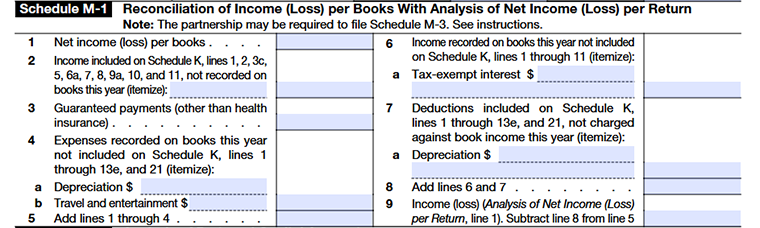
Here is a detailed explanation of each line on Schedule M-1 for Form 1065:
Line 1 — Net Income (Loss) per Books
This is the starting point of Schedule M-1 and represents the partnership's net income or loss as it appears in the partnership's accounting records (books) — not the tax return. This amount is taken directly from the partnership's income statement or profit and loss statement for the year.
If the partnership's books and tax return report the same income with no adjustments, then Lines 2 through 7 would all be zero and Line 9 would equal Line 1. In practice, however, most partnerships with any meaningful activity will have at least some adjustments.
Line 2 — Income Included on Schedule K, Lines 1, 2, 3c, 5, 6a, 7, 8, 9a, 10, and 11, Not Recorded on Books This Year
This line captures income that the tax return recognizes but the books do not — at least not in the same tax year. These are situations where tax rules require income to be reported on the return earlier than the partnership would record it on its books.
Common examples include:
- Advance payments and prepaid income: The IRS may require certain advance payments to be included in taxable income in the year received, even if the partnership's books defer recognition until the service or goods are delivered.
- Mark-to-market adjustments: Partnerships in securities or commodities trading may be required to recognize unrealized gains under Section 475(f) that are not yet reflected in book income.
- Installment sale income: Where the partnership uses the installment method for books but recognizes the full gain in the current year for tax purposes.
Line 3 — Guaranteed Payments
Guaranteed payments are amounts paid to a partner for services rendered or for the use of capital, regardless of whether the partnership earned a profit. They are treated as deductible business expenses on the partnership's tax return under Section 707(c), but they reduce taxable income (and therefore reduce the income per return figure).
On Schedule M-1, guaranteed payments are added back on Line 3 because they are already deducted in arriving at net income per the tax return but need to be reconciled against book treatment, where they may be recorded differently or in a different period.
For reference, guaranteed payments are reported on Schedule K, Line 4, and flow through to each partner's Schedule K-1, Box 4.
Line 4 — Expenses Recorded on Books This Year Not Included on Schedule K
This line reports book expenses that are not deductible on the tax return — either because they are permanently disallowed under the tax code or because they will be deducted in a future year (temporary differences).
Line 4 is typically broken into two sub-lines:
Line 4a — Depreciation:
This is one of the most common book-to-tax differences for partnerships with significant fixed assets. The tax return often uses accelerated depreciation methods — such as the Modified Accelerated Cost Recovery System (MACRS), bonus depreciation (Section 168(k)), or the Section 179 immediate expensing election — which front-load larger deductions in the early years of an asset's life. In contrast, the partnership's books may use straight-line depreciation spread evenly over the asset's useful life.
When book depreciation exceeds tax depreciation, the difference is entered on Line 4a. When tax depreciation exceeds book depreciation (which is common with bonus depreciation), the difference appears on Line 6 instead (as a tax deduction not yet recorded on books).
For more detail on how depreciation deductions flow through the return, see Form 4562.
Line 4b — Travel and Entertainment:
The IRS limits the deductibility of meal expenses to 50% of the actual cost (or 80% for certain transportation workers). Some entertainment expenses are entirely nondeductible. The partnership's books, however, may record the full 100% of these costs as an expense.
The non-deductible portion — the amount recorded on books but disallowed on the return — is entered on Line 4b. This is a permanent difference: the disallowed amount will never be deducted on any future return.
Line 5 — Other Expenses Recorded on Books This Year Not Included on Schedule K
This catchall line captures additional book expenses that are not deductible on the current-year tax return and are not covered by the specific categories in Lines 4a or 4b. A separate statement must be attached listing each item.
Common examples include:
- Federal income taxes: While partnerships are pass-through entities and generally do not pay federal income taxes at the entity level, certain state-level entity taxes recorded on the books may not be deductible for federal tax purposes.
- Non-deductible fines and penalties: Fines paid to a government for violating a law are specifically disallowed under Section 162(f).
- Excess charitable contributions: Contributions that exceed the applicable percentage limitation.
- Life insurance premiums: Premiums paid on key-person life insurance where the partnership is the beneficiary are not deductible.
- Accrued expenses not yet deductible: Under the economic performance rules of Section 461(h), certain accrued liabilities may be recorded on the books but cannot be deducted until economic performance has occurred.
- Capitalized costs: Some costs that are expensed on the books must be capitalized and amortized over time for tax purposes (e.g., certain startup or organizational costs under Sections 195 and 709).
Line 6 — Income Recorded on Books This Year Not Included on Schedule K
This line captures the reverse of Line 2 — income the books have recorded in the current year that is not included on the tax return for this year.
Common examples include:
- Tax-exempt income: Interest income from state and municipal bonds is included in book income but is excluded from federal taxable income. This is a permanent difference. It is also reported on Schedule K, Line 18a.
- Deferred gain recognition: In some cases, gain recognized on the books may be deferred for tax purposes (e.g., installment sales where the book and tax treatment differ in timing).
- Life insurance proceeds: Proceeds received on a key-person life insurance policy are included in book income but excluded from federal taxable income.
Line 7 — Deductions on Schedule K Not Charged Against Book Income This Year
This line captures deductions taken on the tax return that have not yet been recorded as expenses in the partnership's books. These are typically temporary differences that will reverse in future years.
Common examples include:
- Bonus depreciation and Section 179 expensing: These accelerated tax deductions may far exceed the book depreciation for the same assets, resulting in a tax deduction that has no corresponding book entry in the current year.
- Prepaid expenses deducted for tax: Under the 12-month rule, certain prepaid expenses paid for services or benefits extending no more than 12 months beyond the payment date may be deducted immediately for tax purposes but amortized on the books.
- Depletion allowances: Oil, gas, and mineral partnerships may claim percentage depletion for tax purposes that exceeds cost depletion recorded on the books.
Line 8 — Add Lines 6 and 7
This is a simple arithmetic subtotal — the sum of Lines 6 and 7, representing the total of income not taxed plus deductions not yet charged to books.
Line 9 — Income (Loss) per Return
Line 9 is the final reconciled figure — the partnership's income or loss as reported on the tax return. This amount must equal Line 1 of the Analysis of Net Income (Loss) on Form 1065, page 5.
The formula is:
Line 1 (Net income per books) + Lines 2, 3, 4, 5 (Add: items that increase taxable income vs. books) − Line 8 (Subtract: items that decrease taxable income vs. books) = Line 9 (Income per return)
If Line 9 does not reconcile to the Analysis of Net Income (Loss), there is an error somewhere in the return that must be found and corrected before filing.
Common Book-to-Tax Differences at a Glance
| Item | Book Treatment | Tax Treatment | Where on M-1 |
|---|---|---|---|
| Straight-line depreciation (books) vs. bonus depreciation (tax) | Smaller deduction | Larger deduction | Line 7 |
| Accelerated depreciation (books) vs. straight-line (tax) | Larger deduction | Smaller deduction | Line 4a |
| Meals and entertainment (50% limit) | 100% expensed | 50% deductible | Line 4b |
| Municipal bond interest | Recorded as income | Tax-exempt | Line 6 |
| Fines and penalties | Expensed on books | Non-deductible | Line 5 |
| Life insurance proceeds received | Recorded as income | Tax-exempt | Line 6 |
| Life insurance premiums paid | Expensed on books | Non-deductible | Line 5 |
| Prepaid expenses (12-month rule) | Amortized on books | Deducted immediately for tax | Line 7 |
| Deferred revenue (advance payments) | Deferred on books | Taxable when received | Line 2 |
| Section 179 expensing | Not on books | Immediate tax deduction | Line 7 |
How Schedule M-1 Connects to the Rest of Form 1065
Schedule M-1 does not stand alone — it is tightly linked to several other schedules and forms within the Form 1065 package:
Schedule L (Balance Sheet per Books): The beginning and ending balance sheet figures in Schedule L must be consistent with the income reconciliation shown in Schedule M-1. Changes in asset values (particularly depreciation) and partner equity should be consistent across both schedules.
Schedule M-2 (Analysis of Partners' Capital Accounts): The net income (loss) entered in Schedule M-2, Line 3 must equal the book net income (loss) from Schedule M-1, Line 1 — not the tax income on Line 9. This is a critical and frequently misunderstood linkage. Schedule M-2 tracks changes in partners' capital accounts on a book basis, not a tax basis.
Schedule K (Partners' Distributive Share Items): The total income and deduction items reported on Schedule K must be consistent with the tax income figure on Schedule M-1, Line 9. Together, they represent the same taxable income of the partnership — one in total (Schedule K) and one as a reconciled figure (M-1, Line 9).
Form 4562 (Depreciation and Amortization): Depreciation differences are one of the most common drivers of Schedule M-1 adjustments. The depreciation amounts computed on Form 4562 flow to Schedule M-1 as the "tax" side of the depreciation comparison.
Form 4797 (Sales of Business Property): Gains and losses on property sales may be recognized differently for book and tax purposes, particularly for installment sales or like-kind exchanges, requiring M-1 adjustments.
Schedule M-1 and the IRS Audit Perspective
The IRS uses Schedule M-1 as an analytical tool when reviewing partnership returns. Large or unusual M-1 adjustments — particularly unexplained items on Lines 5 and 7 — can draw scrutiny because they indicate that significant book income is not being reported as taxable income. Examiners routinely compare M-1 Line 1 (book income) to the return's taxable income to assess whether the reconciliation is reasonable given the nature and size of the partnership's business.
Partnerships should be prepared to provide:
- The underlying financial statements supporting Line 1 book income
- Documentation for each item on Lines 2 through 7
- Workpapers reconciling depreciation between books and tax
- Supporting schedules for any "other" items claimed on Lines 5 and 7
Accurate, well-documented Schedule M-1 workpapers are one of the most effective tools a partnership can maintain to demonstrate compliance and reduce audit exposure.
Schedule M-1 and the Capital Account Reporting Requirement
Starting with the 2020 tax year, the IRS required all partnerships to report partners' capital accounts on a tax basis in Schedule M-2 and on the partner's Schedule K-1, Part II. This change has heightened the importance of clearly distinguishing book income (used in Schedule M-2, Line 3) from tax income (used in Schedule K and Schedule M-1, Line 9).
Partnerships that previously maintained capital accounts on a GAAP or Section 704(b) basis were required to compute and disclose the tax basis equivalent going forward. The M-1 reconciliation plays a central role in this process, as it defines the tax income figure that drives tax-basis capital account adjustments.
Common Errors to Avoid on Schedule M-1
- Using tax income instead of book income on Line 1. Line 1 must reflect the income per the partnership's books — not the tax return. Using the wrong figure makes the entire reconciliation incorrect.
- Omitting items on Lines 5 or 7 without a supporting statement. The IRS expects a detailed breakdown of any "other" items. Vague or missing statements for these lines are a common deficiency in audits.
- Failure to reconcile Line 9 to the Analysis of Net Income (Loss). If these two figures don't match, there is a mathematical or categorization error that must be resolved. Filing a return with a reconciliation that doesn't tie is a red flag.
- Confusing book depreciation with tax depreciation. Partnerships with significant fixed assets must carefully track both sets of depreciation figures. Using the wrong number on Lines 4a or 7 will cause both Schedule M-1 and Schedule L to be incorrect.
- Misclassifying permanent vs. temporary differences. Permanent differences (like disallowed meals) and temporary differences (like timing differences in depreciation) require different treatment in long-term basis tracking and deferred tax analysis.
- Forgetting that Schedule M-2 ties to book income (Line 1), not tax income (Line 9). This is one of the most common errors on partnership returns and is a frequent trigger for IRS correspondence.
Frequently Asked Questions (FAQs)
1. Does every partnership have to file Schedule M-1?
No. Partnerships that meet all four conditions on Schedule B Line 4 — receipts under $250,000, assets under $1 million, timely K-1 distribution, and no Schedule M-3 requirement — are exempt from Schedule M-1.
2. What if our partnership's book income and tax income are identical?
You still need to complete Schedule M-1 if your partnership is required to file it. Simply enter book income on Line 1 and leave Lines 2 through 7 blank. Line 9 will equal Line 1, confirming there are no differences.
3. What does it mean when Schedule M-1 doesn't balance?
A Schedule M-1 that doesn't reconcile — meaning Line 9 does not equal Line 1 of the Analysis of Net Income (Loss) — indicates an error in the return. This must be corrected before filing. Common causes include misclassified income items, omitted adjustments, or errors in the depreciation schedule.
4. Is Schedule M-1 the same as Schedule M-3?
No. Schedule M-1 is a concise 9-line reconciliation for small to mid-sized partnerships. Schedule M-3 is a more detailed multi-page reconciliation required for partnerships with $10 million or more in total assets.
5. What accounting basis should Line 1 reflect?
Line 1 should reflect the partnership's net income or loss as recorded on its books, using whatever accounting method the partnership uses (GAAP, cash basis, or other internal method). It should not be adjusted to reflect tax rules.
6. How does Schedule M-1 relate to Schedule K-1?
Schedule M-1 reconciles the partnership's total book-to-tax income difference. The tax income on Line 9 feeds into Schedule K, which then allocates each partner's share via Schedule K-1. Partners report their K-1 amounts — based on the tax income figure — on their own returns.
7. Can I e-file Form 1065 with Schedule M-1?
Yes. Schedule M-1 is included as part of the electronic Form 1065 submission. TaxZerone supports complete e-filing of Form 1065 including all required schedules.
Key IRS Resources for Schedule M-1
| Resource | Description | Link |
|---|---|---|
| Form 1065 (PDF) | U.S. Return of Partnership Income | Download |
| Instructions for Form 1065 | IRS line-by-line instructions including Schedule M-1 | View on IRS.gov |
| Schedule M-3 (Form 1065) | Extended reconciliation for large partnerships | About Schedule M-3 |
Related TaxZerone Resources
| Resource | Description |
|---|---|
| E-File Form 1065 Online | Securely e-file your partnership return including all schedules |
| Form 1065 Instructions | Complete walkthrough of the Form 1065 return |
| Form 1065 Filing Deadlines & Penalties | Key filing dates and late-filing penalty details |
| Form 7004 — Business Tax Extension | Request a 6-month filing extension for Form 1065 |