
Form 1120 Schedule D
Last updated:
-by Peter Samuel | TaxZerone
Schedule D (Form 1120) at a Glance
- Purpose: Schedule D (Form 1120) is used by corporations to report capital gains and losses from sales or exchanges of capital assets during the tax year.
- Who Must File? Corporations filing Form 1120 generally must complete Schedule D when they have capital gains or losses that must be reported separately from ordinary business income.
- What Is Reported? Schedule D reports short-term and long-term capital gains and losses, including gains or losses from the sale or exchange of stocks, securities, real property, and other capital assets.
- Capital Gain or Loss: The information reported on Schedule D is used to determine the corporation's net capital gain or loss, which is then reflected on Form 1120 as required.
Table of Contents
What is Schedule D (Form 1120)?
Schedule D (Form 1120) is a tax form used by corporations to report capital gains and losses. The form requires detailed information about each transaction, including the description of the asset, date of acquisition, date of sale, sales price, and cost or other basis.
Schedule D provides a detailed breakdown of a corporation's capital gains and losses over the tax year. It helps the IRS determine the corporation's overall net capital gain or loss, which ultimately impacts their taxable income.
Who must file Schedule D (Form 1120)?
Any corporation that has capital gains or losses during the tax year must file Schedule D (Form 1120) along with their Form 990-T return. This includes:
- Corporations that bought and sold capital assets.
- Corporations that received distributions from investment funds that report capital gains.
- Corporations that experienced involuntary conversions of property (e.g., due to casualty or theft).
Complete your Schedule D (Form 1120) filing requirements and e-file your Form 990-T return with TaxZerone. It's simple and easy!
Schedule D (Form 1120) Filing requirements

Below, we have provided Form 1120 Schedule D filing requirements for each part.
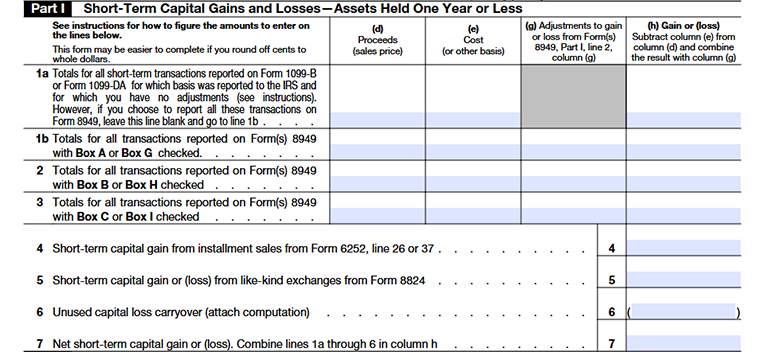
Part I-Short-term Capital Gains and Losses-Assets Held One Year or Less
Column (d)
This is the total amount you received when you sold the asset.
Column (e)
This is what you originally paid for the asset, including certain fees.
Column (g)
This includes any corrections or special adjustments from Form 8949 that change your gain or loss amount
For example, wash sales or other IRS-required changes.
Column (h)
This is your final result.
Formula:
Column(d)-Column(e) = result
Combine the result with Column(g)
Line 1a
Enter totals for short-term transactions reported on Form 1099-B or 1099-DA where:
- The IRS already received your cost basis, AND
- You have no adjustments to make.
If you report everything on Form 8949 instead, leave this line blank.
Line 1b
Enter totals from Form 8949 where Box A or Box G is checked. These usually involve transactions where basis was reported to the IRS, but adjustments may apply.
Line 2
Enter totals from Form 8949 where Box B or Box H is checked. These are usually transactions where the cost basis was not reported to the IRS.
Line 3
Enter totals from Form 8949 where Box C or Box I is checked. These are transactions that were not reported on Form 1099-B.
Line 4
Short-term gain from installment sales (from Form 6252). If you’re receiving payments over time from a sale, the short-term portion goes here.
Line 5
Short-term gain or loss from like-kind exchanges (from Form 8824). If you exchange property and there’s a short-term result, enter it here.
Line 6
If you had capital losses from previous years that you couldn’t fully use, enter the unused portion here. This reduces your current year gain.
Line 7
Add everything from lines 1a through 6 (column h).
Part II - Long-Term Capital Gains and Losses
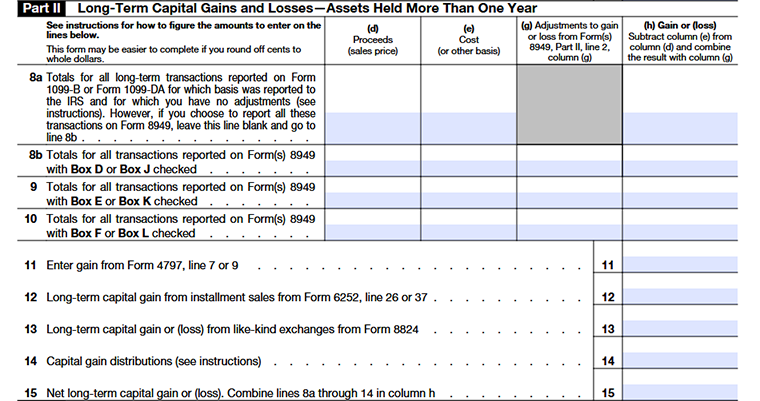
The columns(d-h) in Part II are the same as the columns explained earlier in Part I, they follow the same meaning and calculation method described above.
Line 8a
Use this line to report the total of long-term sales shown on Form 1099-B or Form 1099-DA when the cost basis was already reported to the IRS and no adjustments are needed. Instead of listing each transaction on Form 8949, the corporation can combine them and report the totals directly here.
Line 8b
This line is used to transfer the total amounts from Form 8949 for long-term transactions where Box D or Box J is checked. These transactions were already detailed on Form 8949, so here you simply enter the combined totals.
Line 9
Enter the total of long-term transactions from Form 8949 where Box E or Box K is checked. These usually represent transactions where the cost basis was not reported to the IRS, so they must first be reported on Form 8949 before being summarized here.
Line 10
Use this line to report the totals from Form 8949 for transactions with Box F or Box L checked. These are long-term sales that were not reported on a Form 1099, so they must be listed on Form 8949 and then summarized on this line.
Line 11
Enter the capital gain amount from Form 4797 (line 7 or line 9). This usually relates to profits from the sale of certain business property, which must be included with long-term capital gains.
Line 12
Report the long-term gain from installment sales taken from Form 6252 (line 26 or line 37). Installment sales are transactions where the payment for the sale is received over time instead of all at once.
Line 13
Enter the gain or loss from like-kind exchanges reported on Form 8824. A like-kind exchange happens when a corporation trades one business or investment property for another similar property.
Line 14
Enter the total capital gain distributions received from a RIC or REIT during the year. These are profits distributed to the corporation from investment funds, regardless of how long the stock was held.
Line 15
Add together lines 8a through 14 (column h) to calculate the total long-term capital gain or loss for the year. This line shows the overall result after combining all long-term capital transactions.
Part III - Summary of Parts I and II

Line 16
If the corporation has a net short-term capital gain (line 7) and a net long-term capital loss (line 15), enter the amount by which the short-term gain is greater than the long-term loss. This shows the remaining gain after offsetting the loss.
Line 17
If the corporation has a net long-term capital gain (line 15) and a net short-term capital loss (line 7), enter the amount by which the long-term gain exceeds the short-term loss. This represents the corporation’s net capital gain.
Line 18
- Add the amounts from lines 16 and 17. Enter the result here and report it on Form 1120, page 1, line 8.
- If losses are greater than gains, the corporation must follow the capital loss rules in the instructions.
Choose TaxZerone to complete your Schedule D (Form 1120) filing
TaxZerone is an IRS-authorized e-file service provider, that offers more than just a seamless 990-T e-filing experience.
When you file with us, you receive instant updates on your 990-T return's filing status, ensuring you're always informed and in the know!
Our user-friendly platform is designed to simplify the e-filing process while providing comprehensive support at every step.
Here's how your Form 990-T return with Schedule D (Form 1120) attachment is transmitted to the IRS in 3 simple steps!
- Provide Organization Details - Choose the tax year for which you want to file the 990-T return, and provide your organization’s details.
- Preview Schedule D (Form 1120) - Attach Schedule D to report capital gains and losses from sales or exchanges of capital assets and preview the information provided in the return for accuracy before transmitting.
- Transmit to the IRS - Transmit Schedule D along with your 990-T Return to the IRS and get the acceptance in just a few hours.
Even if the IRS rejects your Form 990-T return, there's no need to worry! TaxZerone has your back with a hassle-free correction and retransmission process, all at no extra charge!
Choose TaxZerone for a filing experience that goes beyond expectations.
Empower your tax compliance journey with us today!
E-file Now