
Schedule P (100) Instructions: Alternative Minimum
Tax and Credit Limitations – Corporation
Understand Schedule P (100), what each line and column requires, and how California AMT
and credit limitations are calculated.
Last updated:
-by Peter Samuel | TaxZerone
Schedule P (100) at a Glance
- What is Schedule P (100)? A California schedule used to calculate Alternative Minimum Tax (AMT) and certain tax credit limitations.
- Who must file Schedule P (100)? Corporations, including exempt organizations other than exempt trusts, may need to file based on applicable AMT adjustments, preference items, loss denials, other items specified under IRC Section 59, and applicable California income.
- When must an exempt organization file? Generally, when applicable, AMT adjustments, preference items, loss denials, and state net unrelated business taxable income (UBTI) exceed $40,000 or when certain credit limitations apply.
- When must a corporation file Schedule P (100)? Generally, when applicable, AMT adjustments, preference items, loss denials, and state net income exceed $40,000 or when certain credit limitations apply.
- Which California returns use Schedule P (100)? It is used with CA Form 100 and CA Form 109 to calculate applicable AMT and credit limitations.
What’s New for Schedule P (100) in 2025?
- Program 4.0 Credit: A new California Motion Picture and Television Production Credit applies to taxable years beginning on or after January 1, 2025.
- $5 Million Credit Limitation: For taxable years beginning January 1, 2024, through December 31, 2026, most California tax credits are subject to a $5 million limit on the amount that can reduce tax.
- Refundable Credit Election: Certain taxpayers affected by the credit limitation may be able to make an irrevocable election for a refundable credit.
- NOL Suspension: California has suspended the use of net operating loss (NOL) deductions for certain taxable years beginning January 1, 2024, through December 31, 2026, subject to applicable exceptions.
Table of Contents
How to Complete Schedule P (100): Line-by-Line Instructions

Corporation Name
Enter the corporation's legal name as shown on the related California tax return.
California Corporation Number
Enter the corporation's California corporation number shown on its California tax filing records.
Part I – Tentative Minimum Tax (TMT) and Alternative Minimum Tax (AMT) Computation
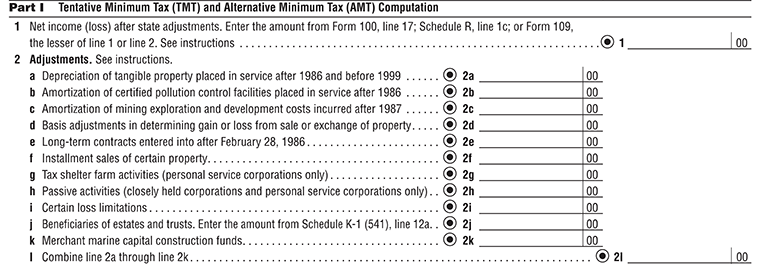
Line 1 – Net income (loss) after state adjustments
Enter the amount from Form 100, line 17. If filing Form 109 instead, enter the smaller of line 1 or line 2. If Schedule R was filed, use Schedule R, line 1c instead.
Line 2 – Adjustments
The adjustments are reported separately on lines 2a through 2k, and line 2l combines them.
Line 2a – Depreciation of Tangible Property
- Enter the difference between California depreciation and AMT-recomputed depreciation for qualifying tangible property placed in service after 1986 and before 1999.
- The adjustment is calculated on Form FTB 3885, and the resulting difference is entered.
- Do not include adjustments from tax shelter farm or passive activities here; those are reported on Line 2g or Line 2h.
Line 2b – Certified Pollution Control Facilities
- Applies to certified pollution control facilities placed in service after 1986.
- For facilities placed in service before 1999, recompute amortization using the alternative depreciation system (straight-line, no salvage value) instead of the regular five-year method.
- For facilities placed in service after 1998, use the straight-line method directly, no separate AMT recalculation is needed.
Line 2c – Amortization of Mining Exploration and Development Costs
- Enter the AMT adjustment for qualifying mining exploration and development costs incurred after 1987.
- Refigure the deduction using the required 10-year amortization period and report the difference from the regular-tax deduction.
- Skip this line if the corporation elected the optional 10-year write-off under IRC Section 59(e) for all assets in this category.
Line 2d – Basis Adjustments in Determining Gain or Loss From Sale or Exchange of Property
- If the corporation disposed of property, enter the difference between the regular-tax gain or loss and the AMT-recomputed gain or loss, after taking Lines 2a–2c into account.
- Enter the difference as a negative amount when the AMT-recomputed gain is lower or the AMT-recomputed loss is greater.
Line 2e – Long-Term Contracts
- Applies to contracts entered after February 28, 1986. Recompute income using the percentage-of-completion method under AMT rules.
- Enter the difference from the amount reported under regular tax; enter as negative if the AMT figure is lower.
- Use Form FTB 3834 to calculate interest under the look-back method for certain completed long-term contracts.
Line 2f – Installment Sales of Certain Property
- When a corporation uses the installment method for regular tax purposes but must recognize the full gain in the year of sale for AMT purposes, enter the current-year installment income reported for regular tax as a negative amount on Line 2f.
- Certain qualifying installment sales by farmers are not subject to this adjustment.
Line 2g – Tax Shelter Farm Activities (Personal Service Corporations Only)
- Complete Line 2g only when a personal service corporation has a gain or loss from a tax shelter farm activity that is not a passive activity.
- Refigure the activity using the applicable AMT adjustments and tax preference items, then enter the difference between the AMT result and the regular-tax result.
- If the tax shelter farm activity is a passive activity, report it with the other passive activities on Line 2h. Refigured losses are generally suspended and carried forward until the corporation has a gain from the same activity or disposes of it.
Line 2h – Passive Activities
Complete Line 2h for closely held corporations and personal service corporations with passive activities. Use a second Form FTB 3802 to refigure the activity for AMT by including applicable AMT adjustments, tax preference items, and prior-year AMT losses.
- Regular passive activities: Report the AMT adjustment after refiguring the passive activity gain or loss.
- Passive tax shelter farm activities: Refigure the gain or loss under AMT rules. An AMT gain may offset other passive AMT losses, while an AMT loss is generally suspended and carried forward until there is a gain from the same activity or the activity is disposed of.
- Insolvency: If the corporation is insolvent at year-end, the allowable passive activity loss may be increased by the amount that liabilities exceed the fair market value of assets, subject to the applicable limit.
Line 2i – Certain Loss Limitations
- Refigure allowable losses from at-risk activities and applicable partnership basis limitations using AMT adjustments and tax preference items.
- Enter the resulting difference on this line; when the AMT loss is greater, the adjustment is entered as a negative amount.
Line 2j – Beneficiaries of Estates and Trusts
Enter the amount from Schedule K-1 (541), line 12a that represents the applicable AMT adjustment received as a beneficiary of an estate or trust.
Line 2k – Merchant Marine Capital Construction Funds
Enter amounts that were deducted or excluded for regular tax purposes but are not deductible or excludable for AMT purposes. This includes qualifying deposits and earnings related to merchant marine capital construction funds.
Line 2l – Combine Lines 2a Through 2k
Add the amounts reported on Lines 2a through 2k and enter the total on Line 2l. This gives the total AMT adjustments carried into the next stage of the Schedule P (100) calculation.
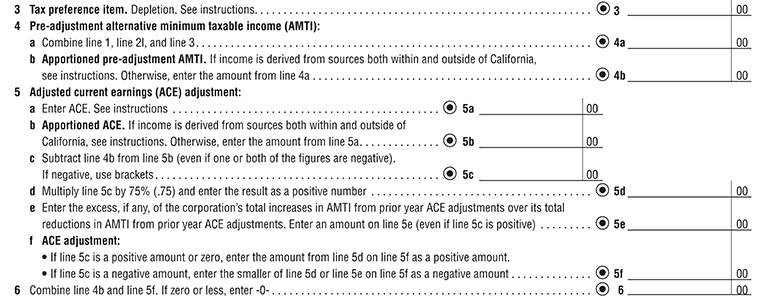
Line 3 – Depletion
- Report the adjustment for depletion when the depletion deduction under IRC Section 611 is greater than the property's adjusted basis at the end of the year.
- Calculate the excess separately for each mine, well, or other natural deposit and enter the total on Line 3.
Line 4 – Pre-Adjustment Alternative Minimum Taxable Income (AMTI)
Line 4a – Combine Lines 1, 2l, and 3
Add Line 1, Line 2l, and Line 3 to determine the corporation's pre-adjustment AMTI. Enter the total on Line 4a.
Line 4b – Apportioned Pre-Adjustment AMTI
- If the corporation has income from within and outside California, apportion the pre-adjustment AMTI to California using the applicable California apportionment rules.
- Refigure Schedule R using the AMT adjustments and enter the resulting amount from Schedule R, line 35 on Line 4b. Otherwise, enter the amount from Line 4a.
Line 5 – Adjusted Current Earnings (ACE) Adjustment
The ACE adjustment modifies AMTI based on adjusted current earnings (ACE). The calculation uses the ACE worksheet provided with the FTB instructions.
Line 5a – ACE (Adjusted Current Earnings)
Calculate California Adjusted Current Earnings (ACE) using the ACE worksheet included with the Schedule P (100) instructions. California generally follows the federal ACE rules under IRC Section 56(g), with California-specific modifications. Start with the pre-adjustment AMTI from Line 4a and make the required ACE adjustments.
- Taxes: Income-based taxes are generally not deductible from earnings and profits (E&P), including qualifying foreign income taxes even when no federal foreign tax credit is claimed.
- Depreciation and amortization: The ACE depreciation rules depend on when the property was placed in service. For property placed in service on or after January 1, 1998, ACE depreciation generally follows AMT depreciation, so no separate ACE depreciation adjustment is required.
- Dividends: Dividends deductible for regular California tax purposes are generally deductible from E&P, but certain federal dividend provisions do not apply for California ACE purposes.
- Interest income and expense: For entities not subject to the minimum franchise tax, interest income included in E&P cannot exceed the interest income reported for regular tax purposes. Interest expense deductions must also follow the applicable California limitations.
Line 5b – Apportioned ACE
- For an apportioning taxpayer or a corporation included in a combined report, determine the California portion of Adjusted Current Earnings (ACE) using the same apportionment method used for net income for regular tax and AMTI.
- The method described for Line 4b may also be used to calculate California ACE.
Line 5c – Difference Between Apportioned ACE and Pre-Adjustment AMTI
Subtract Line 4b from Line 5b. Complete the calculation even when either amount is negative. Use brackets when the result is negative.
Line 5d – 75% of the Line 5c Amount
Multiply Line 5c by 75% (0.75) and enter the result as a positive amount.
Line 5e – Prior-Year ACE Adjustments
For a combined report, each corporation must enter the excess of its accumulated positive California ACE adjustments from prior years over its accumulated negative California ACE adjustments.
Line 5f – ACE Adjustment
Use the amount from Line 5c to determine the ACE adjustment:
- When Line 5c is zero or greater, report the amount from Line 5d as a positive adjustment.
- When Line 5c is negative, compare Lines 5d and 5e and enter the smaller amount as a negative adjustment.
Line 6 – Combine Line 4b and Line 5f
Add Line 4b and Line 5f. If the result is zero or less, enter 0.
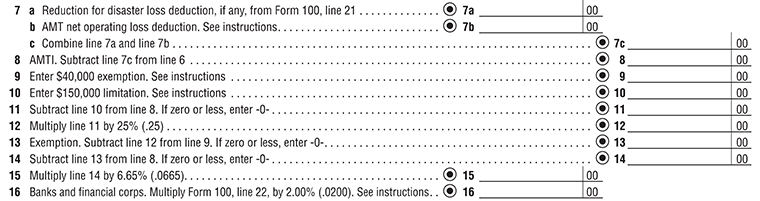
Line 7a – Reduction for Disaster Loss Deduction
- Enter the 2025 disaster loss deduction claimed by the corporation. This deduction is not subject to California's NOL suspension for taxable years beginning on or after January 1, 2024, and before January 1, 2027.
- Any remaining 2025 qualified disaster loss is carried forward under the applicable NOL rules.
Line 7b – AMT Net Operating Loss Deduction
Enter the corporation's allowable AMT net operating loss (NOL) deduction. The AMT NOL is generally based on the regular-tax NOL, with required AMT adjustments, tax preference items, and expired losses taken into account.
- The AMT NOL deduction cannot exceed 90% of the amount on Line 6.
- Enter the smaller of the allowable AMT NOL or 90% of Line 6.
- For taxable years beginning in 2024 through 2026, California's NOL suspension generally applies, subject to exceptions for corporations with taxable income under $1 million and corporations with disaster loss carryovers.
- Members of a unitary group filing a combined report must calculate and apply the NOL separately for each corporation.
- The AMT NOL carryover may differ from the regular-tax NOL carryover, so separate records should be maintained.
- Form FTB 3805Q provides the applicable NOL and disaster loss calculations.
Line 7c – Combine Lines 7a and 7b
Add Line 7a and Line 7b and enter the combined amount on Line 7c. This total is subtracted from Line 6 to determine AMTI on Line 8.
Line 8 – Alternative Minimum Taxable Income (AMTI)
Subtract Line 7c from Line 6 to calculate the corporation's Alternative Minimum Taxable Income (AMTI).
Line 9 – $40,000 Exemption
Enter the $40,000 AMT exemption shown on the schedule. For corporations included in a combined report, the exemption applies separately to each corporation that has a California filing requirement and AMTI.
Line 10 – $150,000 Limitation
Enter the $150,000 limitation used with the AMT exemption calculation. The $40,000 exemption and $150,000 limitation apply to each qualifying corporation in a combined report to the extent the corporation has AMTI.
Line 11 – AMTI Subject to Exemption Phaseout
Subtract Line 10 from Line 8. If the result is zero or less, enter 0.
Line 12 – 25% of Line 11
Multiply Line 11 by 25% (0.25) and enter the result. This amount is used to reduce the $40,000 exemption on Line 13.
Line 13 – Reduced AMT Exemption
Subtract Line 12 from Line 9. If the result is zero or less, enter 0. This gives the corporation's allowable AMT exemption.
Line 14 – AMT Taxable Amount
Subtract Line 13 from Line 8. If the result is zero or less, enter 0. This is the amount subject to the California AMT rate on Line 15.
Line 15 – Tentative Minimum Tax
Multiply Line 14 by 6.65% (0.0665) to calculate the corporation's California tentative minimum tax (TMT).
Line 16 – Banks and Financial Corporations
This line applies specifically to banks and financial corporations. Enter 2.00% of Form 100, line 22. If Form 100, line 22 is zero or negative, enter 0.

Line 17 – Tentative Minimum Tax (TMT)
Add Line 15 and Line 16 to calculate the corporation's Tentative Minimum Tax (TMT). Enter the total on Line 17.
Line 18 – Regular Tax Before Credits
Enter the regular California tax before credits from:
- Form 100, Line 23, or
- Form 109, Line 10.
For certain installment obligations, do not include tax increases attributable to interest on deferred tax liability subjected to IRC Section 453(l)(2)(B) and IRC Section 453A.
Line 19 – Alternative Minimum Tax (AMT)
- Subtract Line 18 from Line 17 to determine the corporation's California AMT. If the result is zero or less, enter 0.
- If Line 17 is greater than zero and the corporation has credits or credit carryovers, continue to Part II. Otherwise, report the Line 19 amount on Form 100, Line 29, or Form 109, Line 13.
Part II - Credits that Reduce Tax
Part II is completed only when the corporation has tax credits. It determines how much of those credits can be used against California tax, the amount of tax available to offset, and any credit that can be carried forward.

Line 1 – Regular Tax
Enter the regular California tax before credits from Form 100, line 23, or Form 109, line 10. This is the starting tax amount against which allowable credits are applied in Part II.
Line 2 – Tentative Minimum Tax (TMT)
Enter the TMT from Part I, line 17, but use at least the minimum franchise tax, when applicable. This amount establishes the minimum tax level that certain credits cannot reduce regular tax below.
Column Instructions
The columns in Sections A–C are used to determine the credit available, the amount that can be used in the current year, the remaining tax available for credits, and the credit carryover.
Column (a) – Credit Amount
Enter the amount of credit available to offset the tax for the current year.
Column (b) – Credit Used This Year
Enter the smaller of the credit in Column (a) or the tax remaining in Column (c) from the previous line.
- Total credits claimed in Column (b) generally cannot exceed $5 million.
- For a combined report, the $5 million limit applies at the group level.
- The limitation does not apply to the Low-Income Housing Credit or the prior-year AMT credit.
Column (c) – Tax Remaining
Subtract the credit used in Column (b) from the tax balance in Column (c) of the previous line. The result is the amount of tax that remains available to be offset by other credits.
Column (d) – Credit Carryover
- Subtract Column (b) from Column (a) to determine the credit that remains available for future years.
- Keep separate records of credit amounts that could not be used because of the $5 million credit limitation, as these amounts may be available in later years.
Section A – Credits that reduce excess regular tax
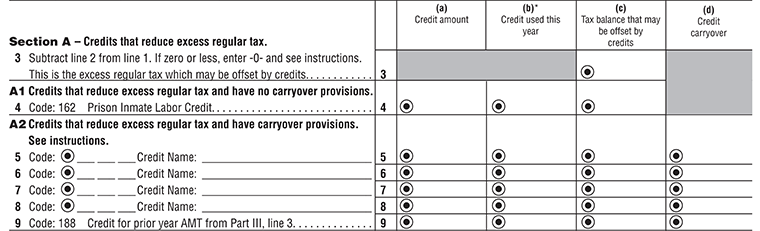
Line 3 – Excess Regular Tax
Subtract Part II, Line 2 from Part II, Line 1.
- If the result is greater than zero: Continue to the Section A1 instructions.
- If the result is zero or less: Follow Questions 1 and 2 to determine whether the credit should be claimed in Section B or Section C, carried forward to a future year, or not claimed.
Section A1 – Credits That Reduce Excess Regular Tax and Have No Carryover Provisions
Line 4 – Prison Inmate Labor Credit
Complete Line 4, Columns (a) through (c) if the corporation has the Prison Inmate Labor Credit listed in this section.
- For taxable years beginning on or after January 1, 2024, and before January 1, 2027, any portion of this credit disallowed because of the $5 million credit limitation may be carried forward.
- The carryover period is extended by the number of taxable years the credit was disallowed.
Section A2 – Credits That Reduce Excess Regular Tax and Have Carryover Provisions
- Section A2 covers credits with carryover provisions that may be used to reduce the corporation's excess regular tax. The FTB Credit Table should be used to identify which credits belong in Section A2 and their applicable credit codes.
Lines 5 – Line 8 – Credits With Carryover Provisions
- Use Lines 5 through 8 to report the credits listed in Section A2 that can reduce excess regular tax and have carryover provisions. For each applicable credit, enter the credit code, credit name, and available credit, then complete Columns (a) through (d) according to the Part II column instructions.
- Apply the credits in the order required by the FTB instructions, including using the prior-year AMT credit before other applicable credits. Unused amounts may generally be carried forward according to the specific credit rules.
Line 9 – Prior-Year AMT Credit
- Enter the credit for prior year AMT from Part III, Line 3. This credit is identified as Credit Code 188 on the 2025 Schedule P (100) and must be applied before other credits that can reduce regular tax below TMT.
- Credits with limited carryover periods are generally applied before credits with unlimited carryover periods. However, the corporation may use a different order when it is more beneficial.
Section B – Credits That May Reduce Regular Tax Below TMT
Section B covers tax credits that can reduce a corporation's regular California tax below its Tentative Minimum Tax (TMT). These credits may also be carried forward when allowed under the applicable credit rules.
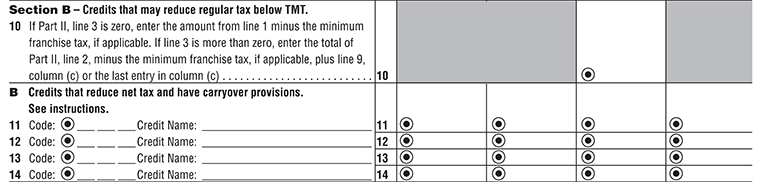
Line 10 – Tax Available for Section B Credits
Calculate the amount of regular tax available to be reduced by Section B credits:
- When Part II, Line 3 is zero, subtract the applicable minimum franchise tax from Part II, Line 1.
- When Line 3 is greater than zero, use the applicable amount of Part II, Line 2, adjusted for the minimum franchise tax, and add the amount from Line 9, Column (c) or the last applicable amount in Column (c).
Lines 11–14 – Credits That Reduce Net Tax and have carryover provisions
Use Lines 11 through 14 to report credits listed by the FTB as Section B credits with carryover provisions.
For each applicable credit:
- Enter the credit code and credit name.
- Complete Columns (a) through (d) using the Part II column instructions.
- Apply the credit against the tax amount determined through Line 10.
- Any unused amount may generally be carried forward, subject to the specific credit's rules.
Section C – Credits that may reduce AMT
Section C is used when a corporation has Alternative Minimum Tax (AMT) remaining after reducing regular tax to the applicable minimum franchise tax. Certain credit carryovers may then be used to reduce the AMT.
- Eligible credits include Solar Energy Credit, Commercial Solar Energy Credit, and Enterprise Zone Hiring & Sales or Use Tax Credit carryovers.
- Any eligible credit remaining after reducing AMT to zero may generally be carried forward to future taxable years.
- The Manufacturer's Investment Credit (MIC) can no longer be used to offset AMT because its carryover period has expired.

Line 15 – AMT
Enter the AMT from Part I, Line 19. This is the amount of California AMT that may be reduced by the eligible credits in Section C.
Lines 16a – Solar Energy Credit Carryovers
Enter Credit Code 180 – Solar Energy Credit carryover from Section B, Column (d).
Line 16b – Commercial Solar Energy Credit Carryovers
Enter Credit Code 181 – Commercial Solar Energy Credit carryover from Section B, Column (d). These carryovers may be used in Section C to reduce the AMT shown on Line 15.
Line 17 – Enterprise Zone Hiring & Sales or Use Tax Credit
Enter Credit Code 176 – Enterprise Zone Hiring & Sales or Use Tax Credit carryover from Section B, Column (d).
Line 18 – Adjusted AMT
Enter the remaining balance from Line 17, Column (c). This amount is the corporation's adjusted AMT after applying the allowable Section C credits.
Part III – Credit for Prior Year AMT

Line 1 – AMT From Prior Year
Enter the corporation's AMT from the 2024 Schedule P (100), Part I, line 19.
Line 2 – Prior-Year AMT Credit Carryover
Enter the unused prior-year AMT credit carryover from 2024 Schedule P (100), Part II, Line 9, Column (d). This is the portion of the prior-year AMT credit that remains available for use in 2025.
Line 3 – Total Available Prior-Year AMT Credit
Add Line 1 and Line 2. Enter the total on Part III, Line 3, and then carry the amount to Part II, Line 9, Column (a) as the corporation's available prior-year AMT credit.
Frequently Asked Questions
1. We are an exempt trust with unrelated business income. Should we file Schedule P (100) or Schedule P (541)?
An exempt trust with unrelated business income generally uses Schedule P (541), not Schedule P (100). The California FTB treats exempt organizations other than exempt trusts as corporations for Schedule P (100) purposes, while exempt trusts are covered under Schedule P (541).
For organizations filing Form 109, Schedule P (100) may apply when the organization meets the applicable AMT or credit requirements.
2. Our exempt organization is part of a combined report. Can we complete one Schedule P (100) for the whole group?
No. The FTB requires a separate Schedule P (100) for each corporation included in a combined report, with AMTI and ACE separately apportioned and allocated to each member. The $5 million credit limitation is applied at the combined-group level.
3. I’m filing Form 109 for an exempt organization. When would Schedule P (100) also be required?
An exempt organization filing Form 109 generally completes Schedule P (100) when its applicable AMT items and state net unrelated business taxable income exceed $40,000, or when it claims credits subject to TMT or AMT limitations. Exempt trusts generally use Schedule P (541) instead.