
Schedule D (541) Instructions (2025):
California Capital Gain or Loss
Understand what to report on each line of California Schedule D (541),
from capital gains and losses to carryovers and limitations.
Last updated:
-by Peter Samuel | TaxZerone
Schedule D (541) at a Glance
- What is Schedule D (541)? California Schedule D (541), Capital Gain or Loss, is used to report gains and losses from the sale or exchange of capital assets.
- Who is required to file? Estates, trusts, and tax-exempt organizations that have capital gains or losses that must be reported on Form 541 or Form 109.
- What does it report? It reports capital asset sales or exchanges, installment-sale gains, pass-through gains or losses, capital gain distributions, and capital loss carryovers.
- What is the 2025 capital loss limitation? If applicable, the allowable capital loss is generally limited to the smaller of the net loss or $3,000.
- What about capital loss carryover? The accompanying worksheet determines the amount of unused capital loss carried from 2025 to 2026.
Table of Contents
How to Complete Schedule D (541): Line-by-Line Instructions

Name as shown on the tax return
Enter the name of the organization, estate or trust as it appears on the associated CA Form 541 or CA Form 109.
FEIN
Enter the federal employer identification number (FEIN) associated with the entity and its related tax return.
Part I - Capital Gain and Loss
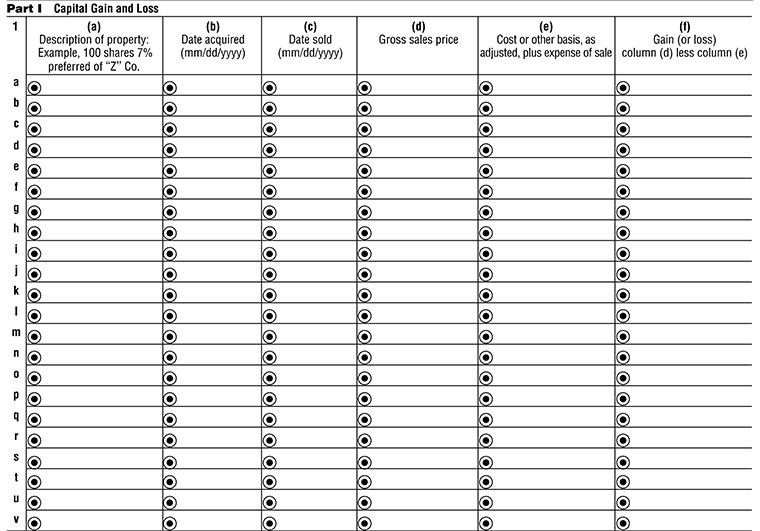
Line 1 – Sales or Exchanges of Capital Assets
- Report each sale or exchange of a capital asset during the 2025 taxable year in line 1.
- The 2025 Schedule D (541) provides six columns for each transaction: description of property, date acquired, date sold, gross sales price, cost or other basis plus expenses of sale, and gain or loss.
Column (a) – Description of Property
Enter a description of the capital asset that was sold or exchanged. The description should be specific enough to identify the property.
Column (b) – Date Acquired
Enter the date the capital asset was acquired using the format mm/dd/yyyy.
Column (c) – Date Sold
Enter the date the capital asset was sold or exchanged, using the mm/dd/yyyy format.
Column (d) – Gross Sales Price
Enter the gross sales price of the capital asset. This represents the gross amount associated with the sale before accounting for the applicable expense of sale reported in Column (e).
Column (e) – Cost or Other Basis, as Adjusted, Plus Expense of Sale
- Enter the property's cost or other basis, as adjusted, plus the expense of sale.
- This column therefore combines;
Adjusted cost or other basis + applicable expense of sale
Column (f) – Gain or Loss
Calculate the gain or loss by subtracting Column (e) from Column (d).
Formula:
Gain or Loss = Column (d) − Column (e)
For Example:
Here is an example as quick reference for filing Line 1 of Part I in Schedule D (541),
| (a) Description of property | (b) Date acquired | (c) Date sold | (d) Gross sales price | (e) Cost or other basis, as adjusted, plus expense of sale | (f) Gain (or loss) |
|---|---|---|---|---|---|
| 100 shares of ABC Corporation common stock | 03/15/2020 | 08/10/2025 | $20,000 | $14,500 (includes $14,000 basis + $500 selling expense) | $5,500 gain (($20,000 − $14,500)) |

Line 2 – Capital Gain From Installment Sales
- Enter the capital gain from installment sales reported on FTB 3805E.
- If an estate or trust sold property at a gain during the tax year and will receive a payment in a later tax year, the installment method generally applies.
- If the estate or trust elects out of the installment method, report the gain or loss on Line 1 instead.
Line 3 – Net Gain or Loss From Pass-Through Entities
Enter your share of net gain or loss from:
- S corporations
- Fiduciaries
- Partnerships
- Limited liability companies (LLCs)
Line 4 – Capital Gain Distributions
Enter the amount of capital gain distributions reported in federal Form 1099-DIV, refer to Box 2a.
Line 5 – Net Gain or Loss
Line 5 combines the gain or loss amounts from Line 1, Column (f), and Lines 2, 3, and 4.
Calculation:
Line 5 = Line 1, Column (f) + Line 2 + Line 3 + Line 4
For Example:
| Item | Amount |
|---|---|
| Line 1, Column (f) | $5,500 |
| Line 2 | $2,000 |
| Line 3 | $1,500 |
| Line 4 | $1,000 |
| Line 5 | $10,000 |
Line 6 – Gain From California Schedule D-1
Enter the applicable gain from California Schedule D-1, Sales of Business Property.
Line 7 – Capital Loss Carryover form Prior-Year
- Enter the amount of unused capital loss carryover from prior years. For the 2025 Schedule D (541), Line 7 specifically refers to the capital loss carryover from 2024.
- There is no capital loss carryover from a decedent to an estate.
Line 8 – Net Gain or Loss
Line 8 calculates the final net gain or loss for Part I by combining Line 5, Line 6, and Line 7.
For Example:
| Item | Amount |
|---|---|
| Line 5 | $10,000 |
| Line 6 | $3,000 |
| Line 7 | $(4,000) |
| Line 8 | $9,000 |
Part II – Summary of Part I

Line 9 – Allocation of Capital Gain or Loss
- Use Line 9 to summarize the net gain or loss calculated on Part I, Line 8, and allocate the amount between beneficiaries and the fiduciary. If Column (c) shows a net loss, complete Part III.
- Line 9 has three columns: (a) Beneficiaries, (b) Fiduciary, and (c) Total.
Column (a) – Beneficiaries
- Enter the amount of capital gain or loss allocable to the beneficiaries.
- Generally, do not allocate capital losses to beneficiaries unless the losses are required to offset capital gains.
- If this is the final year of the estate or trust, a capital loss carryover may be allowed to beneficiaries to the extent of their distributive shares.
Column (b) – Fiduciary
- Enter the amount of capital gain or loss allocable to the fiduciary.
- Also include in Column (b) any capital gain paid or permanently set aside for charitable purposes under IRC Section 642(c).
Column (c) – Total
- Enter the total of Columns (a) and (b).
- Where Column (c) = Column (a) + Column (b)
For Example:
| (a) Beneficiaries | (b) Fiduciary | (c) Total |
|---|---|---|
| $6,000 | $4,000 | $10,000 |
Part III – Computation of Capital Loss Limitation

Line 10 – Capital Loss Limitation
Complete Line 10 when Line 9, Column (c), shows a net loss. Enter the smaller of the net loss on Line 9, Column (c), or $3,000 as a loss on Line 10.
Frequently Asked Questions
1. My estate sold property in 2025 but will receive some of the payment in 2026. Which line should I use?
If the estate uses the installment method, report the applicable capital gain on Line 2 using the amount calculated on FTB 3805E. If the estate elects out of the installment method, report the gain or loss on Line 1 instead.
2. My Schedule D (541) shows a $5,000 net capital loss. Can I claim the entire $5,000?
No. If Line 9, Column (c) shows a net loss, Line 10 is limited to the smaller of the net loss or $3,000. The amount not allowed on Line 10 may be included in the calculation of the capital loss carryover to the following year.
3. My trust has a capital loss from a previous year. How do I use it on the 2025 Schedule D (541)?
Enter the applicable unused capital loss carryover from prior years on Line 7. For the 2025 form, Line 7 specifically identifies the carryover from 2024. A capital loss cannot be carried over from a decedent to an estate.