
Form 7205 Instructions
Learn how to complete Form 7205, determine eligibility, and calculate the Section 179D
energy-efficient commercial buildings deduction.
Form 7205 at a Glance
- Understand the purpose of IRS Form 7205 and how it is used to calculate and claim the Section 179D Energy Efficient Commercial Buildings Deduction for qualifying energy-efficient property.
- Learn who can claim the Section 179D deduction and how the rules apply to building owners and eligible designers of qualifying property installed in certain tax-exempt buildings.
- Explore how to complete Form 7205 line by line, including building information, energy savings or EUI reduction, deduction limits, qualifying property costs, certifications, and designer allocation details.
- Understand which property may qualify for the deduction, including Energy Efficient Commercial Building Property (EECBP) and Energy Efficient Building Retrofit Property (EEBRP), and the applicable energy-efficiency requirements.
Form 7205, Energy Efficient Commercial Buildings Deduction, is an IRS form used to calculate and claim theSection 179D deduction for qualifying energy-efficient property installed in commercial buildings. Building owners and eligible designers must attach Form 7205 to their federal income tax return to reportenergy-efficient commercial building property (EECBP) or energy-efficient building retrofit property (EEBRP), document required certifications, and determine the allowable deduction based on energy savings, building square footage, and applicable deduction limits.
Table of Contents
What is IRS Form 7205?
IRS Form 7205, Energy Efficient Commercial Buildings Deduction is used to calculate and claim the tax deduction under Section 179D for qualifying energy-efficient commercial building property. The form is generally used by building owners and, in certain cases, designers of energy-efficient property installed in buildings owned by specified tax-exempt entities. It covers qualifying improvements to interior lighting, heating, cooling, ventilation, hot water systems, and the building envelope.
What's New in Form 7205
- Section 179D termination date:Under P.L. 119-21, commonly known as the One Big Beautiful Bill Act, the Section 179D energy efficient commercial buildings deduction is terminated for qualifying propertythe construction of which begins after June 30, 2026.
- Therefore, the deduction remains available for qualifying property whose construction begins on or before June 30, 2026, subject to the applicable Section 179D requirements.
What is the Purpose of Form 7205
The primary purpose of Form 7205 is to calculate and claim the Energy Efficient Commercial Buildings Deduction under Section 179D.
The IRS requires this form to:
Calculate the Deduction
Taxpayers use the form to determine the amount of deduction available based on:
- Building square footage
- Energy savings achieved
- Cost of qualifying property
- Applicable deduction limitations
- Prior deductions claimed for the building
Report Energy-Efficient Property
The form identifies the specific building where the property was installed and confirms that the property meets Section 179D requirements.
Verify Eligibility
Form 7205 helps establish that the taxpayer is eligible to claim the deduction, either as:
- The building owner, or
- An eligible designer who received an allocation from a qualifying tax-exempt building owner
Document Required Certifications
The IRS requires certification from qualified professionals to support the deduction. Form 7205 records information about these certifications.
Claim the Final Deduction
After all calculations are completed, Form 7205 determines the allowable Section 179D deduction that can be reported on the taxpayer's federal income tax return.
Who must file form 7205?
Individuals and business entities claiming a Section 179D deduction for qualifying energy-efficient property (EEP) placed in service during the tax year must file Form 7205.
Eligible filers include:
- Commercial building owners claiming the deduction for qualifying property installed in their buildings.
- Designers of energy-efficient property installed in buildings owned by eligible tax-exempt entities when the deduction has been properly allocated to them.
- Partnerships, corporations, S corporations, trusts, estates, and individuals claiming the deduction.
What Tax return is Form 7205 Attached To?
Depending on the type of taxpayer, Form 7205 may be attached to one of the following returns
| Tax Type | Federal tax Return |
|---|---|
| Individual | From 1040 |
| Partnership | Form 1065 |
| S corporation | From 1120-S |
| C Corporation | From 1120 |
| Trust or Estate | Form 1041 |
Who Qualifies for the Section 179D Deduction?
The following taxpayers may qualify for the deduction:
- Owners of commercial buildings located in the United States.
- Designers of qualifying energy-efficient property installed in buildings owned by:
- Tax-exempt organisations
- Government entities
- Indian tribal governments
- Alaska Native corporations
Projects meeting prevailing wage and apprenticeship requirements may qualify for increased deduction amounts.
What Type of Property Qualifies for the Deduction?
Qualifying Energy Efficient Property (EEP) includes:
Energy Efficient Commercial Building Property (EECBP)
- Property that is depreciable.
- Property that is installed in a U.S. commercial building.
- Property that is part of:
- Interior lighting systems
- Heating systems
- Cooling systems
- entilation systems
- Hot water systems
- Building envelope
- Reduces annual energy and power costs by at least 25% compared to a reference building meeting ASHRAE Standard 90.1 requirements.
Energy Efficient Building Retrofit Property (EEBRP)
Property that:
- Is depreciable.
- Is installed pursuant to a qualified retrofit plan.
- Is installed in a qualified building.
- Is certified by a qualified professional.
Line-by-Line Instructions for Form 7205
Basic Information
Before completing Form 7205, enter the taxpayer information exactly as it appears on the federal income tax return and identify who is claiming the Section 179D deduction.

Name(s) Shown on Return
Enter the taxpayer's name exactly as it appears on the federal income tax return to which Form 7205 is attached.
Identifying Number
Enter the taxpayer's identifying number, such as anSSN, EIN, or TIN, as shown on the tax return.
Claiming Deduction As (Check One)
Building Owner:Check this box if you own the building where the qualifying energy-efficient property was installed and are claiming theSection 179Ddeduction.
Designer of Energy Efficient property:Check this box if you are claiming a deduction allocated to you by a qualifying tax-exempt building owner.
Part I: Building and Energy Efficient Property (EEP) Information
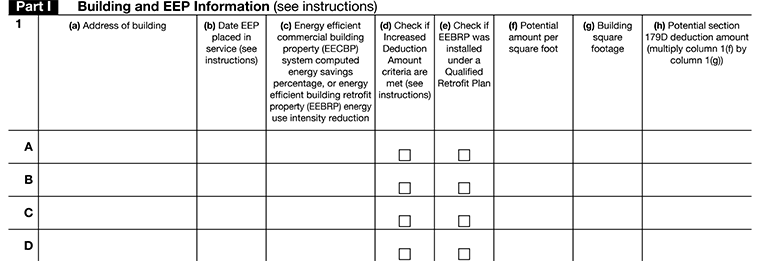
Line 1, Column (a): Building Information
Enter the building's name and complete address, including the street address, city, state, and ZIP code where the energy-efficient property was installed. If reporting multiple buildings, enter each building on a separate line.
Line 1, Column (b): Date Placed in Service
Enter the date the energy-efficient property was placed in service and became available for use.
Line 1, Column (c): Energy Savings Percentage or EUI Reduction
Enter the applicable energy savings percentage calculated using the Performance Rating Method for EECBP, or the applicable Energy Use Intensity (EUI) reduction for EEBRP. Round the percentage to two decimal places.
Line 1, Column (d): Increased Deduction Eligibility
Check this box if the project qualifies for the increased Section 179D deduction amount, such as meeting prevailing wage and apprenticeship requirements or if installation began before January 29, 2023.
Line 1, Column (e): Energy Efficient Building Retrofit Property (EEBRP)
Check this box if the property was installed under a qualified energy-efficient building retrofit plan. If the same building includes both EECBP and EEBRP property, report each on a separate line.
Line 1, Column (f): Potential Deduction Amount Per Square Foot
Calculate and enter the potential deduction amount per square foot using the Form 7205 worksheet. The allowable amount may be limited based on deductions previously claimed for the building.
Line 1, Column (g): Building Square Footage
Enter the total square footage of the building used to calculate the deduction.
Part II: Computation of Energy Efficient Commercial Buildings Deduction Amount

Line 2, Column (a): Prior Year Deduction Amount
- Enter the totalper-square-foot amount of Section 179D deductionsclaimed for the building during the prior 3 tax years.
- Use a 4-tax-year period if the deduction is allowable to the designer. Include amounts claimed by you or other parties, including previous building owners.
Line 2, Column (b): Remaining Deduction Limit
Enter the resulting difference in Column (b). Subtract the amount shown in Line 2, Column (a) from the maximum allowable deduction for the tax year (as specified in the chart below).
The maximum allowable amount for each tax year is provided in the chart below.
| Tax year | Maximum full amount allowed | Maximum partial amount allowed |
|---|---|---|
| All years beginning before January 1, 2021 | $1.80 | $0.60 |
| For tax years beginning on or after January 1, 2021 | $1.82 | $0.61 |
| For tax years beginning on or after January 1, 2022 | $1.88 | $0.63 |
| For tax years beginning on or after January 1, 2023 | $5.36 | $1.07 |
| For tax years beginning on or after January 1, 2024 | $5.65 | $1.13 |
| For tax years beginning on or after January 1, 2025 | $5.81 | $1.16 |
| For tax years beginning on or after January 1, 2026 | $5.94 | $1.19 |
Line 2, Column (c): Deduction Limit Test
Check this box if the amount in column (b) is greater than or equal to the potential deduction amount reported in column 1(f).
Line 2, Column (d): Deduction Amount from Column 1(h)
- If you checked the box in line 2, column (c), enter the amount from line 1, column (h) into line 2, column (d). Leave columns (e) and (f) blank, then continue with column (g).
- If the box in column (c) is not checked, enter 0 in line 2, column (d), and proceed to column (e).
Line 2, Column (e): Deduction Comparison Test
Check this box if the amount in column (b) is less than the amount in column 1(f).
Line 2, Column (f): Calculated Deduction Amount
If column (e) is checked, multiply the amount in column (b) by the building square footage reported in column 1(g).
Line 2, Column (g): Cost of Energy Efficient Property (EEP)
Enter the cost of qualifying energy-efficient property placed in service during the tax year. Do not include total building costs, general renovations, elevators, escalators, exterior lighting, or manufacturing equipment. If ownership is shared, enter only your allocated share.
Line 2, Column (h): Applicable Deduction Amount
Enter the greater of the amounts calculated in column (d) or column (f). If ownership is less than 100%, enter only your allocated portion.
Line 2, Column (i): Allowable Deduction Amount
Enter the lesser of the qualifying property cost in column (g) or the deduction amount calculated in column (h).
Line 2, Column (j): Designer Allocation Amount
If claiming the deduction as a designer, enter the Section 179D deduction amount allocated to you by the tax-exempt building owner.
Line 2, Column (k): Final Section 179D Deduction
Building owners should enter the amount from column (i). Designers should enter the lesser of column (i) or the allocated amount in column (j).
Line 3: Total Section 179D Deduction
Add all amounts from line 2, column (k), and enter the total deduction on line 3. Report this amount on the applicable line of your federal income tax return and attach Form 7205. If reporting more than four properties, file an additional Form 7205 and include the combined deduction total on line 3.
Part III: Certification Information for Each Property Listed in Part I
- Enter the information for the qualified individual who completed the certification for each property listed in Part I.
- If Box 1(e) in Part I is checked, enter the information for the qualified professional who completed the final qualifying certification.
- Separately stated income and deduction items
- Refer to the definitions of "Qualified Individual" and "Qualified Professional" in the earlier instructions of the form.

Line 4(a): Name of Qualified Individual Completing Certification
Enter the full name of the person who completed the certification for the property.
Line 4(b): Date of certification
Enter the date on which the certification was completed.
Line 4(c): Employer of Qualified Individual
Enter the name of the employer (company or organization) of the qualified individual.
Line 4(d): Address of Qualified Individual
Enter the complete mailing or business address of the qualified individual.
Part IV: Designer Allocation Information for Each Property Listed in Part I (to be completed by Designer only)

Complete this section only if you are the designer responsible for allocation for the property listed in Part I.
Line 5(a): Identified Owner of Building
Enter the full name of the building owner for the property being reported.
Line 5(b): Date of Allocation
Enter the date when the allocation was completed by the designer.
Line 5(c): Building Owner’s Authorized Representative (Name)
Enter the full name of the authorized representative of the building owner who completed the allocation process.
Line 5(d): Building Owner’s Authorized Representative (Address)
Enter the complete address of the building owner’s authorized representative.
For Rows A, B, C, and D
Repeat the above details separately for each property listed in Part I, ensuring each entry corresponds correctly to the respective property.
What Are the Common Filing Mistakes to Avoid on Form 7205?
- Claiming property that does not meet Section 179D requirements.
- Missing required certifications.
- Using incorrect building square footage.
- Failing to maintain prevailing wage and apprenticeship records.
- Incorrectly calculating prior deduction limitations.
- Forgetting to attach Form 7205 to the tax return.
- Claiming designer deductions without a valid allocation statement.
What Should You Know Before Filing Form 7205?
- Verify that the property meets all Section 179D eligibility requirements.
- Retain all certifications and supporting documentation.
- Keep records supporting prevailing wage and apprenticeship compliance.
- Review prior-year Section 179D deductions before calculating the current deduction.
- Use additional Forms 7205 if reporting more than four properties.
- Ensure all certifications are completed by qualified professionals .
Frequently Asked Questions
1. What is the purpose of Form 7205?
Form 7205 is used to calculate and claim theSection 179D Energy Efficient Commercial Buildings Deductionfor qualifying energy-efficient commercial building property. It helps taxpayers report eligible property details and determine the allowable deduction amount.
2. Can designers claim the deduction?
Yes.Eligible designers can claim the Section 179D deduction when the deduction is allocated to them by a qualifying tax-exempt building owner for designing energy-efficient building property.
3. What types of property qualify for the Section 179D deduction?
- The Section 179D deduction may apply toenergy-efficient commercial building property (EECBP)andenergy-efficient building retrofit property (EEBRP) that meet the applicable IRS requirements.
- EECBP generally includes qualifying improvements to a building’sinterior lighting, heating, cooling, ventilation, hot water, and building envelope systems.
- EEBRP generally refers to qualifying energy-efficient property installed as part of aqualified retrofit planfor an existing building. The property must satisfy the applicable energy-efficiency, certification, and other Section 179D requirements.
4. Is Form 7205 required every year?
Form 7205 is required only for tax years when a taxpayer claims theSection 179D Energy Efficient Commercial Buildings Deduction.If no deduction is claimed, Form 7205 is generally not required.
5. What happens if I do not attach Form 7205?
If Form 7205 is required but not attached to the tax return, the taxpayer maynot be able to properly claim the Section 179D deduction.The IRS may require additional information or deny the deduction until the required form is provided.