
Schedule B-2 (Form 1065): Election Out of the
Audit Regime
Learn how eligible partnerships can elect out of the centralized partnership audit regime and
how to complete Schedule B-2.
Last updated:
-by Nikhil Chowdary | TaxZerone
Schedule B-2 (Form 1065) at a Glance
- Understand the purpose of Schedule B-2 (Form 1065) and how eligible partnerships use it to elect out of the Centralized Partnership Audit Regime (CPAR) under Section 6221(b).
- Learn how to complete Schedule B-2 line by line, including reporting eligible partners and their TINs, listing S corporation shareholders, calculating the total number of Schedules K-1, and using the continuation sections in Parts IV and V when needed.
- Understand the eligibility and filing requirements for Schedule B-2, including the 100-partner limit, eligible and ineligible partner types, the K-1 counting rules, and how to attach the schedule to Form 1065 for each year the election is made.
Schedule B-2 (Form 1065) is used by eligible partnerships with 100 or fewer partners to elect out of the Centralized Partnership Audit Regime (CPAR) under Section 6221(b). If the partnership answers “Yes,” it must complete and attach Schedule B-2 to Form 1065 and enter the total from Part III, line 3. The schedule reports eligible partner information and TINs to verify qualification for the election. If the partnership answers “No,” it must complete the Designation of Partnership Representative section instead.
Table of Contents
What is Schedule B-2?
Schedule B-2 (Form 1065) is an IRS attachment used by eligible partnerships to elect out of the Centralized Partnership Audit Regime (CPAR) under Section 6221(b). The schedule is filed along with Form 1065 to report partner information, verify eligibility requirements, and confirm that the partnership qualifies for exclusion from the centralized IRS partnership audit system. It is generally used by partnerships with 100 or fewer eligible partners, including individuals, corporations, S corporations, certain foreign entities, and estates of deceased partners.
What’s New in Schedule B-2 (Form 1065)
- The Bipartisan Budget Act of 2015 (BBA) introduced a new centralized partnership audit regime applicable to partnership tax years beginning after 2017.
- Under Section 6221(b), as amended by the BBA, partnerships with100 or fewer partnersmay elect out of the centralized partnership audit regime if they meet eligibility requirements.
- This provision allows qualifying partnerships to avoid entity-level audit treatment and instead be handled under partner-level audit rules
- Schedule B-2 was developed to facilitate this election and must be used to formally notify the IRS when a partnership chooses to opt out of the centralized audit system.
Purpose of Schedule B-2 (Form 1065)
- Schedule B-2 is used by eligible partnerships to elect out of the IRS centralized partnership audit regime for a tax year.
- A partnership can make this election only if it has 100 or fewer eligible partners and all partners meet the IRS eligibility requirements.
- Eligible partners include individuals, C corporations, S corporations, certain foreign entities treated as corporations, and estates of deceased partners.
- When calculating the total number of partners, the partnership must also include shareholders of any S corporation partner.
- Partnerships making this election must complete and attach Schedule B-2 to Form 1065 for the applicable tax year.
- The form helps the IRS verify the partnership’s eligibility to opt out of the centralized partnership audit system.
Eligible Partnership
- A partnership is considered an eligible partnership if it has 100 or fewer eligible partners for the tax year.
- The total number of partners is determined by counting all Schedules K-1 issued by the partnership for the tax year.
- In addition, the partnership must also include the number of Schedules K-1 issued by any S corporation partner to its shareholders for the S corporation tax year that ends with or within the partnership tax year.
- This combined K-1 count is used to determine whether the partnership meets the 100-partner eligibility limit for electing out of the centralized partnership audit regime.
Ineligible Partner Types
A partnership is not eligible to elect out of the centralized partnership audit regime if it is required to issue a Schedule K-1 to any of the following partner types: .
- Another partnership (as partners)
- A trust
- A foreign entity that would not be treated as a C corporation if it were a domestic entity
- A disregarded entity (as described in Regulations section 301.7701-2(c)(2)(i))
- An estate of an individual other than a deceased partner
- Any person holding an interest in the partnership on behalf of another person If any of the above partner types are present, the partnership does not qualify for the Schedule B-2 election.
Who Must File Schedule B-2
- Partnerships, including Real Estate Mortgage Investment Conduits (REMICs), must complete Schedule B-2 if they choose to elect out of the centralized partnership audit regime.
- The form must be filed for every tax year in which the election is intended to be effective.
- Each annual filing is required to ensure the election remains valid for that specific tax year.
- The Schedule B-2 must be accurately completed and attached to the partnership’s tax return.
- If the form is not completed correctly, the IRS may determine that the election is invalid, and the partnership may remain subject to the centralized partnership audit regime.
How to File Schedule B-2
- Schedule B-2 must be attached to Form 1065 when filing the partnership return.
- In the case of a Real Estate Mortgage Investment Conduit (REMIC), the form must be attached to Form 1066.
- The return must be timely filed, including any approved extensions.
- Schedule B-2 must be submitted for every tax year in which the partnership elects out of the centralized partnership audit regime.
- Failure to attach the form properly or file on time may result in the election being treated as invalid by the IRS.
Line-by-Line Instruction for Schedule B-2 (Form 1065)
Basic Information
Before completing Schedule B-2, provide the partnership's identifying information at the top of the form.

Name of Partnership – Enter the partnership's legal name exactly as it appears on Form 1065 and IRS records.
Employer Identification Number (EIN) – Enter the partnership's IRS-issued nine-digit EIN exactly as reported on Form 1065.
Part I – List of Eligible Partners
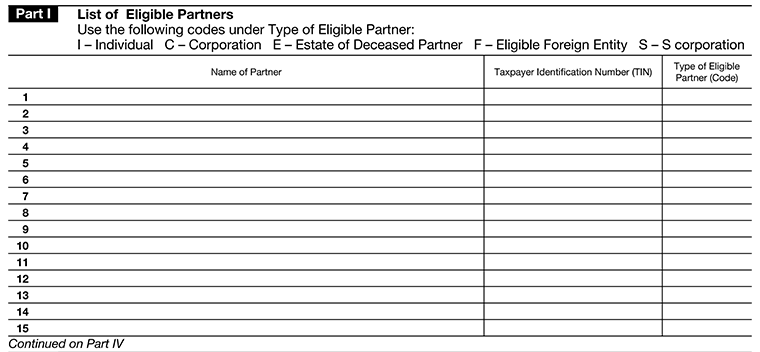
Coumn1 – Name of Entity Owner
Enter the full legal name of each partner who must receive a Schedule K-1 from the partnership for the tax year.
Column 2 – Taxpayer Identification Number (TIN)
Enter the correct U.S. TIN for each partner. The TIN must be accurate; incorrect or missing TINs may result in validation errors and may cause the IRS to treat the election as invalid.
Column 3 – Type of Eligible Partner (Code)
Enter the appropriate code for each partner using only the following values:
- I – Individual
- C – Corporation
- S – S corporation
- E – Estate of deceased partner
- F – Eligible foreign entity treated as a C corporation if domestic
If the partnership has more than 15 partners, continue listing additional partners in Part IV (Continuation List of Eligible Partners).
By completing Part I, the partnership certifies that all listed partners meet the eligibility requirements under Section 6221(b)(1)(C) and that all required information has been accurately provided.
Part II – List of S Corporation Shareholders
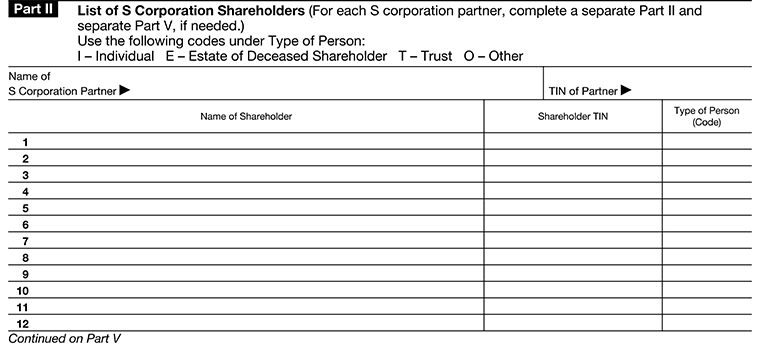
Column 1 – Name of S Corporation Partner
Enter the full legal name of the S corporation that is a partner in the partnership. A separate Part II must be completed for each S corporation partner.
Column 2 – TIN of Partner
Enter the correct U.S. Taxpayer Identification Number (TIN) of the S corporation partner. The TIN must be accurate; incorrect or missing TINs may result in validation errors and may cause the IRS to treat the election as invalid.
Column 3 – Name of Shareholder
Enter the full legal name of each shareholder of the S corporation for the tax year ending with or within the partnership tax year.
Column 4 – Shareholder TIN
Enter the correct U.S. TIN for each shareholder. The TIN must be accurate; incorrect or missing information may affect the validity of the election.
Column 5 – Type of Person (Code)
Enter the appropriate code for each shareholder using only the following values:
- I – Individual
- T – Trust
- E – Estate of deceased shareholder
- O – Other
“Other” includes pension plans under section 401(a), including ESOPs, section 501(c)(3) charitable organizations, and eligible disregarded entities.
If there are more than 12 shareholders for an S corporation partner, continue listing the shareholders in Part V (Continuation Sheet) for the same S corporation.
By completing Part II, the partnership certifies that all S corporation shareholder information is complete, accurate, and properly reported as required under the Schedule B-2 filing rules.
Part III – Total Number of Schedules K-1 Required to Be Issued

Line 1 – Total Partners (Part I + Part IV)
Enter the total number of Schedules K-1 required to be issued by the partnership. This includes all partners listed in Part I and any additional partners listed in Part IV (Continuation List).
Line 2 – Total S Corporation Shareholders (Part II + Part V)
Enter the total number of Schedules K-1 required to be issued by all S corporation partners to their shareholders. This includes all shareholders reported in Part II and any additional shareholders listed in Part V. Do not include the S corporation partner itself in this count, as it is already included in Line 1.
Line 3 – Total Count
Add Line 1 and Line 2 and enter the total number of Schedules K-1 required to be issued for the tax year.
Reporting Requirement
The total from Line 3 must also be carried to Form 1065, Schedule B, Question 25.
Part IV – Continuation List of Eligible Partners
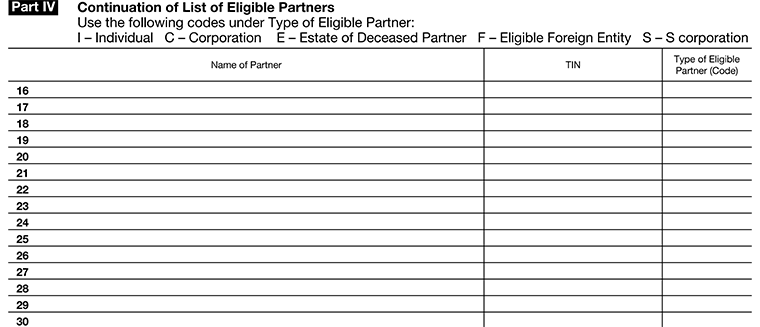
- Complete Part IV only if the partnership is required to issue Schedules K-1 to more than 15 partners.
- This section is a continuation of Part I – List of Eligible Partners.
- Enter all additional eligible partners using the same details required in Part I:
- Partner name
- Taxpayer Identification Number (TIN)
- Type of eligible partner code
- Ensure all information entered in this section is complete and accurate and follows the same eligibility rules as Part I.
- Part IV is used only to extend the list of eligible partners and does not change the partnership’s eligibility to make the election under Section 6221(b).
Part V – Continuation of S Corporation Shareholders
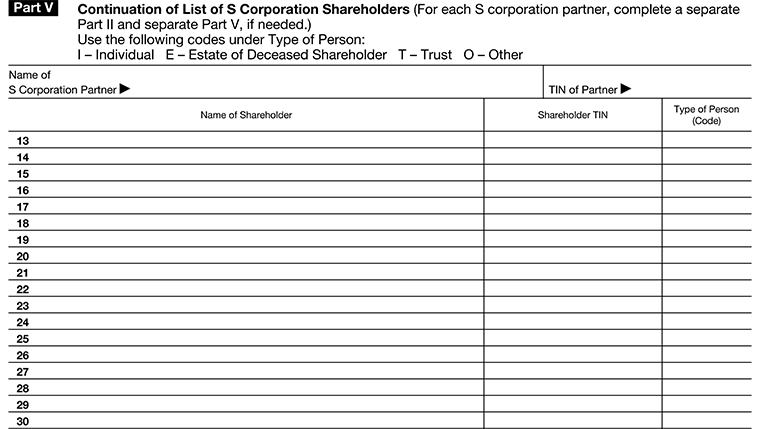
- Complete Part V only if the S corporation partner is required to issue Schedules K-1 to more than 12 shareholders.
- This section is a continuation of Part II – List of S Corporation Shareholders.
- Always include the name of the S corporation partner and its U.S. Taxpayer Identification Number (TIN)at the top of the page for proper identification of the shareholder group.
- Enter all additional shareholders using the same details required in Part II:
- Shareholder name
- Shareholder Taxpayer Identification Number (TIN)
- Type of person code
- Use the same classification codes as Part II:
- I – Individual
- T – Trust
- E – Estate of deceased shareholder
- O – Other
- Ensure all information entered in this section is complete, accurate, and consistent with Part II reporting requirements.
- Part V is used only to extend the shareholder listing and does not change the partnership’s eligibility under Section 6221(b).
Important Filing Tips – Schedule B-2 (Form 1065)
- Confirm the partnership is eligible (100 or fewer partners, and all must be eligible partner types).
- Correctly apply the K-1 counting rule, including S corporation shareholders.
- Use only valid partner codes (individual, corporation,S-corporation, estate, Eligible foreign entity).
- Enter accurate and complete TINs for all partners and shareholders.
- Include all required details for S corporation shareholders, using Part V if needed.
- Use Part IV and Part V when partner or shareholder limits exceed the form space.
- Attach Schedule B-2 to a timely filed Form 1065 (or Form 1066 for REMICs).
- Complete the formevery yearthe election is made.
- Double-check all entries to avoid errors that may invalidate the election.
Common Mistakes to Avoid – Schedule B-2 (Form 1065)
- Not including S corporation shareholders in the total partner count
- Listing ineligible partners (trusts, partnerships, disregarded entities, etc.)
- Entering incorrect or missing TINs
- Using wrong partner or shareholder codes
- Not using Part IV or Part V when required
- Failing to attach the form to a timely filed return
- Not meeting the 100-partner eligibility rule
- Providing incomplete or inconsistent information
Frequently Asked Questions (FAQs)
1. What is the purpose of Schedule B-2 (Form 1065)?
Schedule B-2 (Form 1065) is used by eligible partnerships to elect out of the centralized partnership audit regime (CPAR) under Section 6221(b). It helps the IRS verify that the partnership meets the eligibility requirements, including partner type and total partner count, before allowing the election.
2. Who must file Schedule B-2 (Form 1065)?
Partnerships (including REMICs) must file Schedule B-2 if they choose to elect out of CPAR for a tax year and meet the eligibility rules. The form must be attached to Form 1065 for every year the election is made.
3. Is Schedule B-2 filed separately from Form 1065?
No. Schedule B-2 must be attached to Form 1065 (or Form 1066 for REMICs). It cannot be filed as a separate standalone form.
4. Where can I find Schedule B-2 (Form 1065) instructions?
You can find Schedule B-2 (Form 1065) instructions on the official IRS website or through authorized tax filing platforms that support Form 1065 e-filing, such as TaxZerone. These resources provide detailed guidance on eligibility rules, partner and shareholder reporting requirements, K-1 counting rules, and step-by-step instructions for completing Parts I through V of Schedule B-2 when electing out of the centralized partnership audit regime.