
Schedule B-1 (Form 1065): Partners Owning 50% or More
Learn who must be reported on Schedule B-1 and how to provide information
about partners who own 50% or more of the partnership.
Last updated:
-by Nikhil Chowdary | TaxZerone
Schedule B-1 (Form 1065) at a Glance
- Understand the purpose of Schedule B-1 (Form 1065) and how partnerships use it to report individuals, estates, and entities that directly or indirectly own 50% or more of the partnership’s profit, loss, or capital.
- Explore how to complete Schedule B-1 step by step, including Part I for entities and Part II for individuals or estates, along with ownership percentages and required identification information.
- Understand how Schedule B-1 identifies direct and indirect ownership interests and how the reported information helps ensure accurate ownership reporting and compliance with Form 1065 filing requirements.
Table of Contents
What is IRS Schedule B-1 (Form 1065)?
Schedule B-1 (Form 1065) is an IRS attachment used to report individuals, entities, or estates that directly or indirectly own 50% or more of a partnership’s profit, loss, or capital. Partnerships must attach this schedule to Form 1065 when they answer “Yes” to specific ownership questions in Schedule B.
The form helps the IRS identify major owners and track ownership structures involving corporations, partnerships, trusts, tax-exempt organizations, foreign governments, individuals, and estates.
What Information is Reported on Schedule B-1?
The schedule requires partnerships to disclose:
- Name of each 50% or greater owner
- Identifying number (SSN or EIN)
- Type of owner (individual, corporation, partnership, trust, estate, etc.)
- Country of citizenship or organization
- Percentage of ownership in profits, losses, or capital
- Direct and indirect ownership relationships
The IRS uses Schedule B-1 to track ownership concentration and verify related-party reporting obligations.
The schedule is divided into two parts:
- Part I – Reports entities such as corporations, partnerships, trusts, tax-exempt organizations, and foreign governments.
- Part II – Reports individuals and estates.
- A partnership must complete this form if any owner holds 50% or more of the partnership’s profit, loss, or capital at the end of the tax year.
How Schedule B-1 Differs from Other Form 1065 Schedules?
| Schedule | What It Reports |
|---|---|
| Schedule B-1 | Information about partners owning 50% or more of the partnership |
| Schedule B | Other Information about the partnership, accounting methods, and tax questions |
| Schedule B-2 | Election Out of the Centralized Partnership Audit Regime |
| Schedule K | Total partnership income, deductions, credits, and other items |
| Schedule K-1 | Each partner’s distributive share of partnership items |
| Schedule L | Partnership balance sheet per books |
| Schedule M-1 | Reconciliation of book income with taxable income |
| Schedule M-2 | Analysis of partners’ capital accounts |
Who Must File Schedule B-1?
A partnership filing Form 1065 must complete Schedule B-1 if:
Any partner owned directly or indirectly 50% or more of:
- The partnership’s profit interest,
- Loss interest, or
- Capital interest at any time during the tax year.
This requirement applies to:
- Individuals
- Corporations
- Partnerships
- LLCs
- Trusts
- Estates
- Nominees or disregarded entities
Indirect ownership rules apply, meaning ownership through another entity may still require disclosure.
Filing Deadlines
Schedule B-1 must be attached to Form 1065 and filed by the partnership’s tax return due date.
| Entity Type | Main Return | Filing Deadline (Tax Year 2025) | Extension Form |
|---|---|---|---|
| Partnerships | Form 1065 | March 16, 2026 | Form 7004 |
Step-by-Step Instruction for Schedule B-1 (Form 1065)
Basic Information
Before completing Schedule B-1, provide the partnership's identifying information at the top of the form.

Name of Partnership – Enter the partnership's legal name exactly as it appears on Form 1065 and IRS records.
Employer Identification Number (EIN) – Enter the partnership's IRS-issued nine-digit EIN exactly as reported on Form 1065.
Part I – Entities Owning 50% or More
Complete Part I if an entity directly or indirectly owns at least 50% of the partnership.
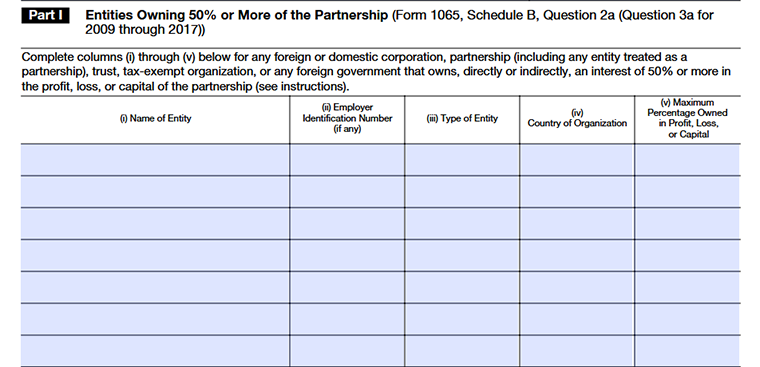
Coumn1 – Name of Entity Owner
Enter the full legal name of the corporation, partnership, trust, tax-exempt organization, or foreign government that owns 50% or more of the partnership.
Example
ABC Holdings Inc.
Column 2 – Employer Identification Number (EIN)
Enter the entity’s EIN exactly as assigned by the IRS.
Example
12-3456789
Column 3 – Type of Entity
Specify the type of owner entity.
Common entity types include:
- Corporation
- Partnership
- Trust
- Tax-Exempt Organization
- Foreign Government
Example
If the owner is tax-exempt, enter Tax-Exempt Organization
Column 4 – Country of Organization
Enter the country where the entity was legally organized or formed.
Example
If the entity was formed in the United States, enter United States
Column 5 – Maximum Percentage Owned
Enter the highest percentage of profit, loss, or capital owned directly or indirectly during the tax year.
Example
If a corporation owns:
- 40% directly, and
- 20% indirectly through another partnership,
the total ownership is 60%, enter 60%
Part II – Individuals or Estates Owning 50% or More
Complete Part II if an individual or estate directly or indirectly owns at least 50% of the partnership.
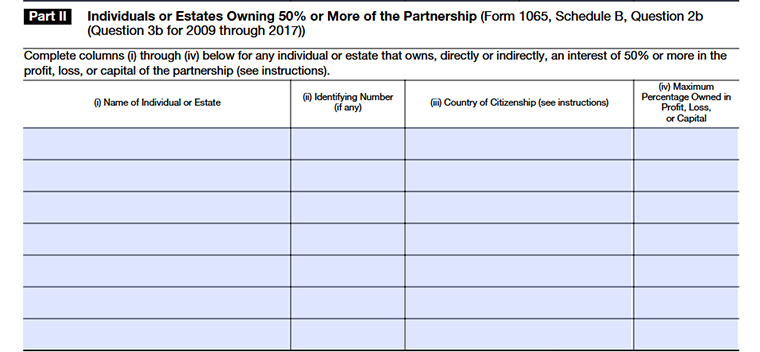
Column 1 – Name of Individual or Estate
Enter the full name of the individual or estate owner.
Example
John Smith or Estate of Robert Miller
Column 2 – SSN or EIN
Enter the Social Security Number (SSN) for individuals or Employer Identification Number (EIN) for estates.
Example
123-45-6789
Column 3 – Country of Citizenship
Enter the country of citizenship for the individual. For estates, enter the citizenship of the decedent.
Example
United States
Column 4 – Maximum Percentage Owned
Enter the highest percentage of profit, loss, or capital owned directly or indirectly during the year.
Example
If an individual owns 50% of the partnership, enter 50%
Family Attribution Rules
Family ownership is not automatically attributed unless the family member directly owns an interest or indirectly owns an interest through another entity.
Example
A owns 50% of Partnership X.
B, A’s daughter, owns no direct or indirect interest.
Partnership X reports A on Schedule B-1 but does not report B because family attribution rules do not apply in this situation.
Important Filing Tips
- Report both direct and indirect ownership interests.
- Use the parent corporation for consolidated groups instead of subsidiaries.
- Report the owner of a disregarded entity rather than the disregarded entity itself.
- Attach Schedule B-1 to Form 1065 when required.
- Ensure ownership percentages are calculated correctly before filing.
Common Mistakes to Avoid
| Mistake | Impact |
|---|---|
| Failing to report indirect ownership | IRS penalties or audit risk |
| Omitting a 50% owner | Incomplete return filing |
| Incorrect ownership percentages | IRS notices and amended filings |
| Missing EIN or SSN information | Processing delays |
| Not attaching Schedule B-1 when required | Return rejection or compliance issues |
Best Practices for Schedule B-1
- Maintain updated ownership records throughout the year.
- Track changes in profit, loss, and capital ownership percentages.
- Review partnership agreements for ownership allocations.
- Verify indirect ownership structures carefully.
- Ensure Schedule B-1 information matches Schedule K-1 and other partnership filings.
- Use automated tax filing software like TaxZerone to simplify Form 1065 filing and attachment preparation.
Frequently Asked Questions (FAQs)
1. What is the purpose of Schedule B-1 (Form 1065)?
Schedule B-1 (Form 1065) is used to report individuals, estates, and entities that directly or indirectly own 50% or more of a partnership’s profit, loss, or capital. The IRS uses this information to identify significant ownership interests in partnerships and related entities.
2. Who must file Schedule B-1 (Form 1065)?
A partnership must file Schedule B-1 if it answers “Yes” to Question 2a or 2b of Schedule B (Form 1065). The schedule is required when an entity, individual, or estate owns, directly or indirectly, 50% or more of the partnership's profit, loss, or capital at the end of the tax year. Schedule B-1 must be attached to Form 1065.
3. Where can I find Schedule B-1 (Form 1065) instructions?
You can find Schedule B-1 (Form 1065) instructions on the official IRS website or through tax filing platforms such as TaxZerone, which provide e-filing support and access to partnership tax forms, including Form 1065 and Schedule B-1. The instructions cover filing requirements, ownership reporting rules, direct and indirect ownership calculations, and guidance for completing Parts I and II of the schedule.
4. What happens if Schedule B-1 (Form 1065) is not filed?
If a partnership is required to file Schedule B-1 but fails to do so, the IRS may consider the partnership return incomplete. This can lead to IRS notices, requests for additional information, delays in processing the return, and potential penalties if the omission affects the partnership's filing compliance.
5. Is Schedule B-1 (Form 1065) filed separately?
No. Schedule B-1 is not filed separately. It must be completed and attached to Form 1065, U.S. Return of Partnership Income,when the partnership answers "Yes" to the applicable ownership questions on Schedule B.
6. Who should be reported on Schedule B-1?
Report any entity, individual, or estate that directly or indirectly owns 50% or more of the partnership's profit, loss, or capital at the end of the tax year.